
Welcome to The Vault Militaria
Welcome to
The Vault Militaria
Authentic pieces. Timeless stories. Exceptional service.
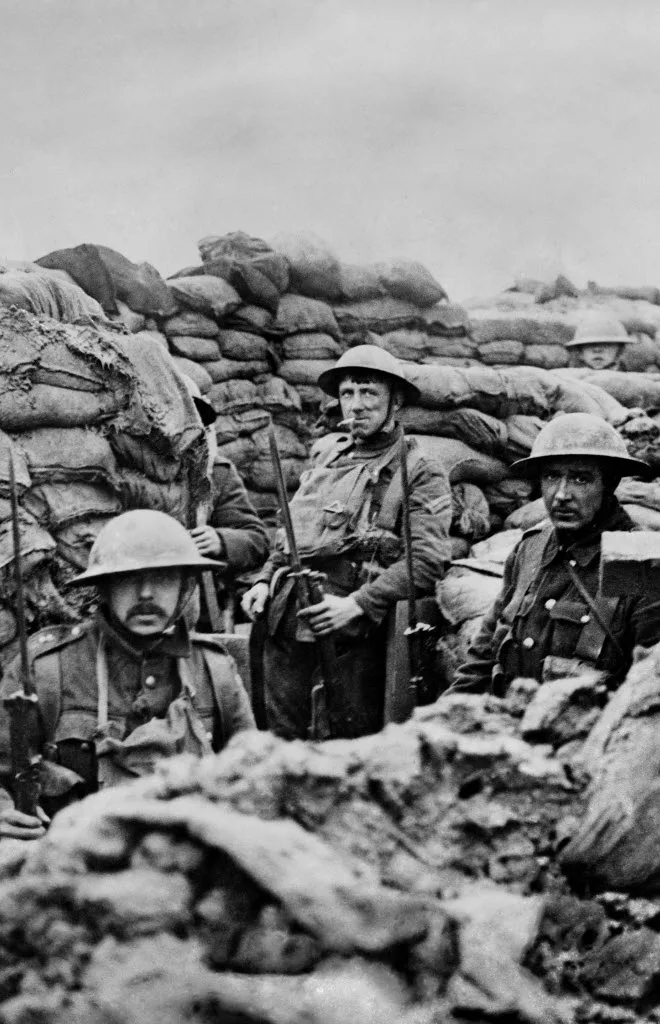
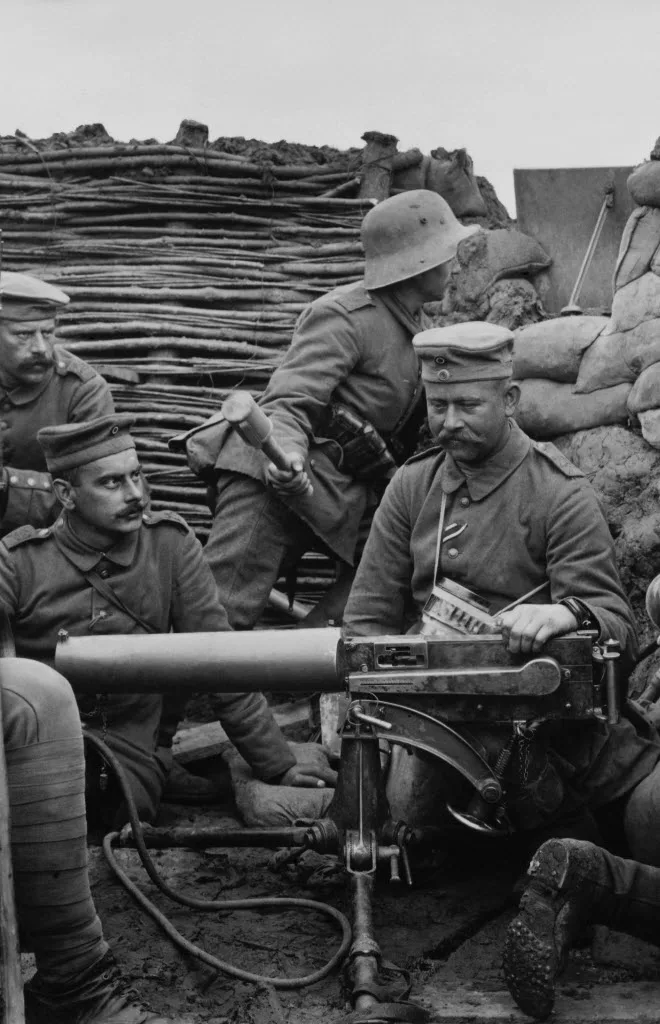
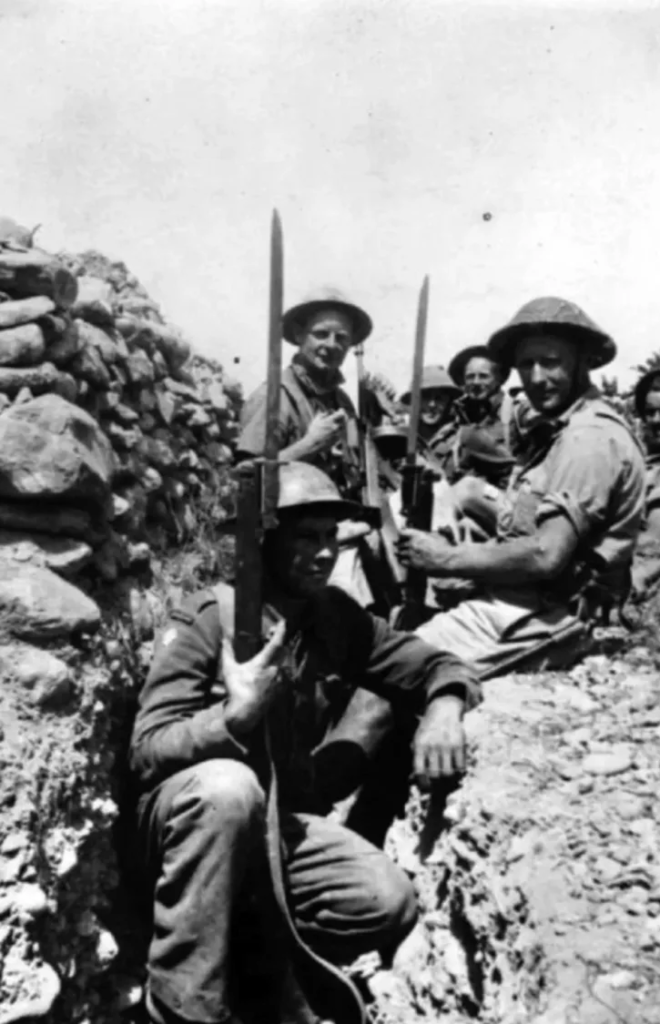
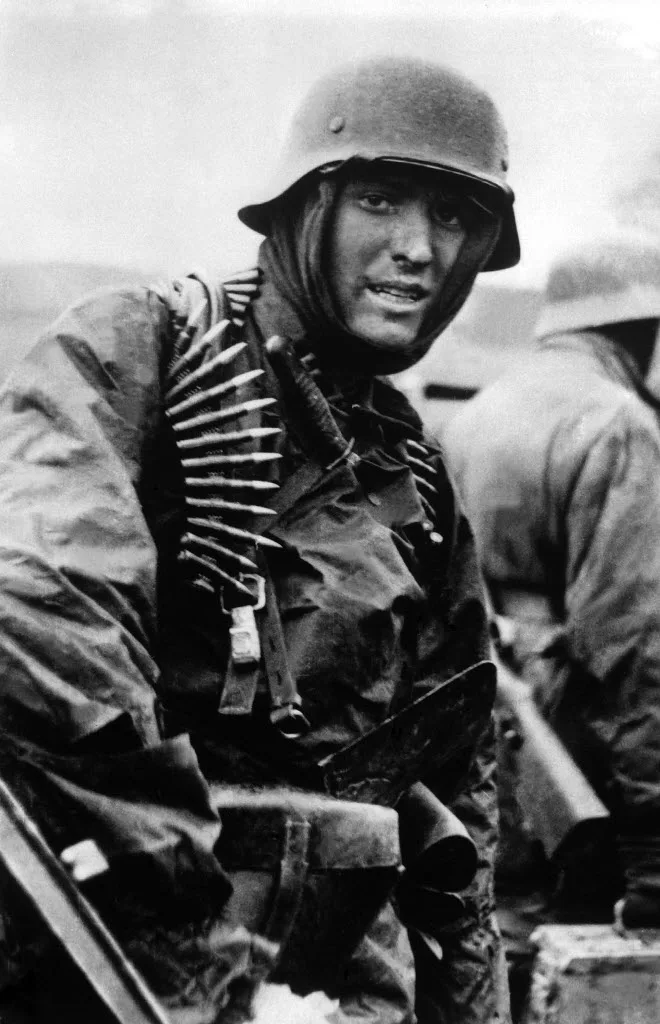
The Vault Militaria is the UK’s newest destination for authentic wartime memorabilia and collectables. Specialising in rare and hard-to-find items from World War I and World War II, we offer history enthusiasts and collectors a carefully curated selection of genuine artefacts.

new items every week
Rare finds
Our team of experts meticulously sources, authenticates, and catalogues each piece, ensuring that you receive only the finest quality items with verified provenance. And we’re adding more and more items on a regular basis.
From battle-worn uniforms and medals to vintage weapons, field equipment, and personal effects, The Vault Militaria brings you closer to the tangible remnants of wartime history.
knowledge & experience
We buy & sell
The founders of The Vault Militaria bring over 50 years of combined collecting experience to the table. They have a pair of keen eyes for the unusual together with an extensive knowledge of wartime collectables to ensure that every item offered is both authentic and exceptional.
With decades spent honing their expertise, they’ve developed an unparalleled ability to source and validate rare military artifacts, making The Vault Militaria a trusted name in the field.
Contact Mark on 07471 058445 or Andrew on 07944 609319
Contact Mark on 07471 058445
or Andrew on 07944 609319
Browse our latest items
-
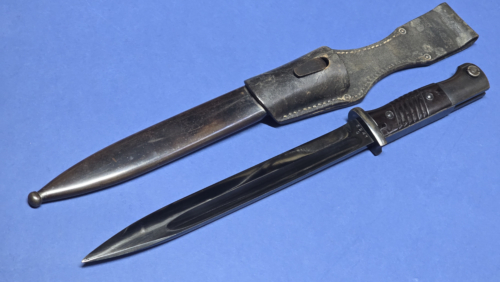
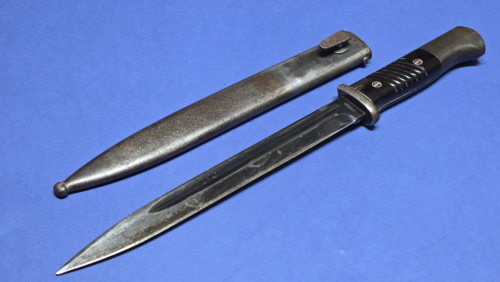
A superb World War 2 German K98 bayonet produced by Coppel G.m.b.H. and dated 1940, complete with its original matching scabbard and a 1940-dated frog bearing faint LBA markings. This is a particularly attractive example with an excellent blade and strong wartime bluing throughout.
Blade
The blade is outstanding and very close to mint condition. The blade remains unsharpened, with approximately 98% of the original bluing remaining. The front of the blade carries the serial number 5241, while the spine is clearly dated 40, confirming 1940 production. The point remains strong, though not quite as needle sharp as some examples encountered. Overall, this is a magnificent blade that would be difficult to upgrade.Hilt & Grips
The hilt retains an excellent amount of original bluing. The dark bakelite grips are in superb condition and remain secured by their original screw bolts. The flash guard shows no indentations and retains strong bluing. The rifle retaining button functions correctly. The hilt displays the usual two Waffenamt inspection stamps, including one on the retaining button itself. These stamps are particularly clear and easy to read, which is not always the case on K98 bayonets.Scabbard
The scabbard retains a good amount of original bluing and remains matching to the blade with the serial number 5241 stamped on the throat. On the reverse of the scabbard the maker Coppel G.m.b.H. and the date 1940 are present. There is a dent to one side of the scabbard which is largely covered by the frog when fitted. Toward the lower section near the scabbard ball there is another dent along with some surface scratches above it. These are clearly shown in the photographs. The scabbard ball itself bears a clear Waffenamt inspection stamp. The blade fits the scabbard perfectly with a snug, correct fit.Frog
An excellent original 1940-dated leather frog accompanies the bayonet. The leather remains strong with good shape and structure, and the four original rivets are present. The stitching remains intact and tight throughout. There is a split above the area where the scabbard lug fits, though it has not gone all the way through. For this reason it would be advisable to leave the frog on the scabbard to prevent further stress. The rear of the frog shows a partially worn maker’s stamp along with the date 1940 and the marking LBA, indicating issue through Luftwaffe supply channels (Luftwaffe Bekleidungsamt), although these markings are very faint and hard to read. A stamped number 4 is also present near the lower rear.Overall
A very impressive and highly collectible matching numbers 1940 Coppel K98 bayonet with strong original finish, clear inspection marks, and an original 1940 dated frog. The blade condition in particular is exceptional.Historical Note
The S84/98 III pattern bayonet was the standard bayonet issued to the German Wehrmacht for use with the Karabiner 98k rifle during World War 2. Manufactured in Solingen by Coppel G.m.b.H., these bayonets were produced in large numbers but truly high-condition examples with matching components and period frogs have become increasingly difficult to find today.
We ship to the USA, Europe, and most worldwide destinations.
All items are carefully packed for safe transit. -
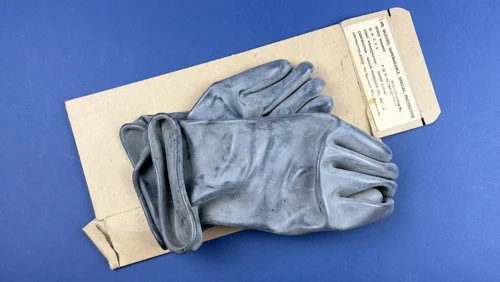
This is an original and complete pair of WW2 US Army impermeable protective gloves, clearly dated 13 April 1943 and retaining their original issue box. These gloves were produced as specialist protective equipment for use in chemical warfare and decontamination roles. Issued through the Quartermaster Corps and associated with Medical Corps use, they were designed to provide a barrier against hazardous substances, including chemical agents and contaminated materials. Items of this type formed part of the wider US Army approach to chemical defence during the war, particularly in training, preparedness, and specialist operational roles. The original carton is clearly printed “Gloves, Impermeable, Special, Protective” and carries the full contract details, including the maker Miller Products Co., Inc., along with the precise wartime date of April 1943. This level of clear marking and dating adds strong authenticity and display appeal, particularly for collectors focused on US chemical warfare or medical equipment. Both gloves are present as a matched pair and are marked size 11. Examples of these gloves are far less commonly encountered than more typical WW2 glove types, and they are often missing entirely from surviving chemical or decontamination sets. As such, a complete and clearly identified pair such as this represents a scarce and interesting component of US wartime protective equipment. The rubber is notably thicker than might be expected and remains in very good overall condition. It is still supple, shows no cracking when flexed, and is free from any stickiness or tackiness, with no rips or tears present. When handled, the gloves retain a natural firmness and will return to their resting shape as shown in the photographs. The original box is present and retains its clear dated label, although it has seen wear. The closing flaps (“ears”) are largely missing, with only one remaining and that showing a significant tear. As such, the box is best suited for display in a flattened form, with the gloves presented alongside. A solid and increasingly collectible piece of WW2 US Army chemical defence equipment, ideal for display, research, or inclusion within a broader chemical warfare or Medical Corps collection.
-
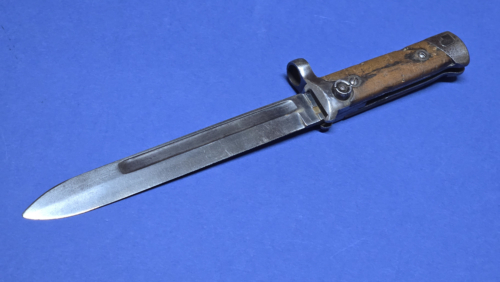
Italian Mannlicher–Carcano Model 1891/38 Folding Bayonet – Serial No 23889
£230.00 SKU: 0400MA scarce and interesting Italian folding bayonet designed for the Mannlicher–Carcano Model 1891/38 rifle. This pattern was engineered to remain attached to the rifle and fold neatly alongside the fore-end when not in use. Because of this design, many examples encountered today are found without their original scabbards, as the bayonet typically remained fixed to the weapon and the separate scabbards were often lost or discarded over time.
This is a compact and clever little design typical of late Carcano development. Compact and well engineered, these folding bayonets represent an interesting variation within the Carcano bayonet family and are always sought after by collectors of Second World War Italian militaria.
Blade
The bayonet carries its original narrow knife blade with a fuller running along each side. The blade remains clean and bright overall. It appears to have seen period sharpening, though it does not show the heavy signs of crude post-war sharpening sometimes encountered. The blade is best described as an honest service example, structurally sound and still presenting well.
Hilt & Grips
The wooden grips show normal service wear with a few small chips visible but remain solid overall. The grips retain their original four screws and washers. On the spine of the hilt the serial number 23889 is clearly stamped.
The rifle retaining button is strong and functioning correctly. The blade folds and locks as it should. When opened into the fixed position there is a small amount of movement in the blade, which is commonly encountered on these folding examples, though the spring mechanism remains strong and fully operational.
Scabbard
No scabbard is present. These bayonets were designed to remain attached to the rifle and fold into position when not in use, and as a result many examples found today are encountered without their original scabbards as they were often separated or lost over time.
Overall
A good, honest example of the Italian Mannlicher–Carcano Model 91/38 folding bayonet. Showing typical service wear but remaining mechanically sound, with the folding mechanism working as it should. A neat and collectible WWII piece that displays well.
Historical Note
The folding bayonet was introduced with the Mannlicher–Carcano Model 1891/38 rifle, a simplified development of the earlier Carcano rifle system. Italy adopted this design in the late 1930s in an effort to streamline production and improve battlefield practicality.
The folding bayonet allowed the soldier to keep the blade permanently attached to the rifle, eliminating the risk of losing a detachable bayonet and speeding deployment in combat. When not required, the blade simply folded back alongside the rifle’s fore-end. These rifles and their folding bayonets saw service with Italian forces during the Second World War across multiple theatres.
We ship to the USA, Europe, and most worldwide destinations.
All items are carefully packed for safe transit. -
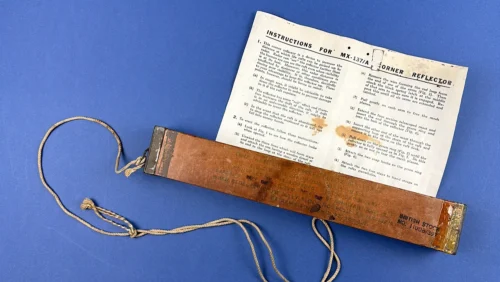
This is an original WW2 British MX-137/A corner reflector, complete with its original transit case and instruction sheet. Corner reflectors of this type were issued as part of air-sea rescue equipment, designed to increase the visibility of life rafts on radar. By reflecting radar signals, they significantly improved the chances of detection during search and rescue operations, particularly in poor visibility or open sea conditions. As such, they were an important piece of survival equipment used by RAF and naval personnel during the war. The reflector remains housed within its original cardboard transit case, which is clearly marked with British Stock details and period inspection stamps. The original instruction sheet is also present, illustrating how the reflector would be assembled and deployed when required. These paper instructions are often missing, so their inclusion here is a strong point. The contents remain inside the case and have not been removed, which is quite common with examples of this type. Given the age and construction, it has been left undisturbed to preserve its integrity. An attempt was made to carefully remove the contents for photography, however they appear firmly in place, and no force has been applied to avoid causing damage. As such, the item is presented and sold as seen. Condition is consistent with age and storage. The outer case shows wear, fading, staining, and some reinforcement with old tape, all of which is visible in the photos. The internal components appear intact from what can be seen, and the instruction sheet shows signs of use and age but remains readable. A scarce and interesting piece of WW2 survival equipment, appealing to collectors of RAF, naval, and air-sea rescue related items.
-
WW2 German K98 Bayonet – Matching Numbers – 1941 ASW (E&F Hörster, Solingen)
£195.00 SKU: 0399MAn original World War II German S84/98 III K98 bayonet dated 1941 and manufactured by ASW (E. & F. Hörster, Solingen). This is a matching numbers example.
Condition is clearly service-worn and this is not a piece for the collectors chasing mint condition, but it remains an honest wartime bayonet with matching numbers. The sharpening of the blade has been reflected in the price.
Blade
The blade retains a reasonable amount of its original bluing, though it has unfortunately been sharpened in a heavy-handed manner. This sharpening has left visible scratches running along the blade. The ricasso is stamped with the number 7684. The reverse carries the date 1941 together with the maker mark ASW, the wartime code used by E. & F. Hörster, Solingen.
Hilt & Grips
The hilt is fitted with dark bakelite grip plates which remain in good condition, and are secured with their original screw bolts. The rifle retaining button is functioning correctly, and the pommel carries the usual Waffenamt inspection stamps. The flash guard remains undamaged.
Scabbard
The steel scabbard is structurally sound and retains its original throat screw. The front of the scabbard carries the matching serial number 7684, with 1941 and ASW stamped to the reverse.
There is one noticeable indentation to the rear lower section of the scabbard. Most of the original bluing has been lost and the scabbard now shows surface rust and age-related wear.
Wear marks indicate the scabbard has previously been carried in a frog. The bayonet fits the scabbard correctly and securely as expected from a matching set.
Overall
This is not a mint example and the blade has been poorly sharpened, however, it remains a genuine wartime K98 bayonet with matching numbers, which is always desirable.
The condition has been fully reflected in the price, making it an affordable example for collectors who prefer honest, been-there-and -done-it pieces.
Historical Note
The S84/98 bayonet was the standard bayonet issued with the Karabiner 98k rifle during the Second World War. Produced by a number of manufacturers, these bayonets were carried by German forces throughout the war.
The maker code ASW was used by E. & F. Hörster, Solingen, one of the major producers of German edged weapons during the period.
We ship to the USA, Europe, and most worldwide destinations.
All items are carefully packed for safe transit. -
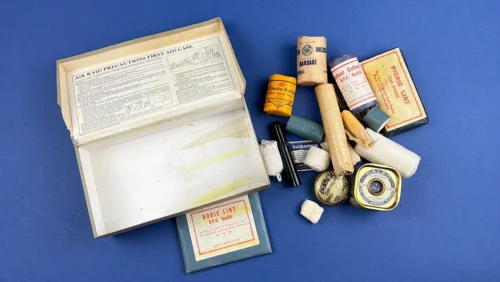
This is an original WW2 British ARP “Householders’ First Aid Case”, a civilian-issued emergency medical kit sold through Boots and intended for use on the Home Front during air raids. Designed to provide immediate treatment in the aftermath of bombing raids, kits such as this were kept in homes, workplaces, and shelters across Britain. They were intended for use before professional medical assistance could be reached, and the contents reflect the types of injuries expected during air raid conditions, including burns, wounds, and shock. The original paper label to the lid is clearly printed and remains well preserved, detailing the contents and bearing the Boots Chemists name. Inside the lid is the printed “Air Raid Precautions First Aid Case” instruction sheet, reprinted from the official Home Office booklet. This is a particularly desirable feature, as these sheets are often missing and provide a direct link to official wartime guidance issued to civilians. The kit retains a good selection of its original contents, including boric lint, picric lint for burns, bandages, adhesive plaster tins, scissors, and small medical items such as tablets and dressings. These components are typical of ARP household kits and help to give the set strong display and historical value. Condition is honest and in keeping with age. The cardboard box shows wear, including edge damage, creasing, and a tear to one corner, but remains structurally sound and displays well. The label is still clear and legible, and the contents appear largely unused, though naturally showing signs of age. A very good and increasingly sought-after example of a WW2 Home Front medical item, combining strong visual appeal with clear historical context. Ideal for collectors of ARP, Civil Defence, or general Home Front material.
-
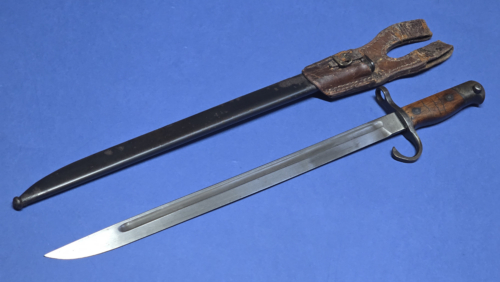
A very presentable early Japanese Arisaka Type 30 bayonet complete with its leather frog. These bayonets were produced from 1897 through to the end of the second world war and were issued with several Arisaka rifle types including the Type 30, Type 38 and Type 99. This example is the earlier style featuring the strongly curved hooked quillon and comes complete with its correct leather frog. The bayonet displays very well throughout and remains a very attractive and collectible example, particularly as it retains its frog and an excellent unsharpened blade.
Blade
The blade is in excellent condition, remaining bright with a clean finish. Importantly, the blade appears to be unsharpened, which is a bonus to find on these bayonets. The blade retains a fine, well-defined tip and shows only minor signs of age and use. The blade is fullered on both sides as expected for this model. On the ricasso is the Kokura Arsenal “stacked cannonball” mark, with a small inspection stamp positioned beneath.Hilt & Grips
The hilt retains a fine set of wooden grips which remain solid and well fitted to both the crossguard and pommel. The grips are secured with the correct two screw bolts with oval washers. There appears to be a set of lines carved into the rear grip, likely a period personalisation or soldier mark, visible in the photographs. The crossguard features the muzzle ring and strongly curved hooked quillon, confirming this as an earlier production example. Both the crossguard and pommel retain the majority of their original blued finish. The rifle retaining button remains fully functional. On the top of the pommel is the serial number 17891555, with two small inspection stamps located beneath.Scabbard
The steel scabbard retains the majority of its original bluing and remains in good overall condition. There are areas of pitted rust present, with the most noticeable section located beneath the frog on the front of the scabbard and another area to the centre of the rear. Despite this, the scabbard still displays well and pairs nicely with the bayonet.Frog
The bayonet is accompanied an original Japanese leather frog, pre 1938 made, identifiable by the buckle arrangement. The leather shows expected age and wear, and the securing tab that passes through the scabbard and fastens to the buckle has split, a common occurrence on these frogs. Importantly, the frog remains structurally sound with all stitching still present and tight. The rear of the frog displays several Japanese markings including the Kokura arsenal mark, which is a nice pairing with the bayonet maker. The fit between frog and scabbard is excellent.Overall
A very attractive early Type 30 Arisaka bayonet featuring the desirable hooked quillon and complete with an original leather frog. The bayonet displays honest service wear with an excellent bright blade that remains unsharpened, strong original bluing to the hilt, and a well-fitting frog with Japanese markings. A very presentable and collectible example.Historical Note
The Type 30 bayonet was introduced in 1897 and remained the primary Japanese bayonet design through both the early twentieth century and the Second World War. It was issued with several Arisaka rifle types and saw service across numerous conflicts including the Russo-Japanese War, the First World War, and the Pacific campaigns of the Second World War. Earlier examples such as this, with their strongly curved hooked quillon and higher quality finish, are particularly sought after by collectors today.
We ship to the USA, Europe, and most worldwide destinations.
All items are carefully packed for safe transit. -
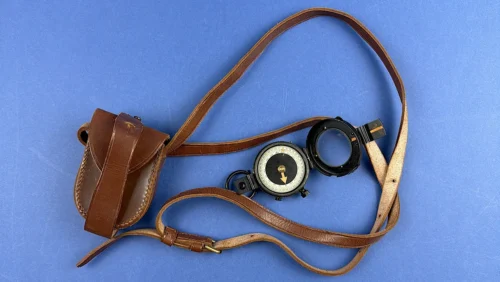
This is an original WW2 British prismatic marching compass, complete with its leather case and full-length carrying strap, and named to an individual owner, A.H. Goodban of Headington, Oxford. Compasses of this type were standard issue for British Army officers and specialist troops, used for navigation in the field. The design features a blackened brass body with a rotating 360-degree dial, folding prism sight, and internal wire sight line, allowing accurate bearings to be taken while simultaneously viewing the dial. The thumb ring and robust construction made these compasses well suited to active service conditions. The compass itself is a typical wartime British example, consistent in form and construction with those produced during the early to mid-war period. While the maker is not clearly defined here, the overall build quality and materials are entirely correct for the era. Of particular note is the scratched ownership inscription reading “A H Goodban, 12 York Rd, Headington,” which is consistent with wartime practice. It was common for officers and other personnel to mark their equipment with their name and home address, both for identification and to aid in the return of lost kit. This transforms the piece from a standard example into a named, personal item with clear potential for further research. The compass is housed in its original brown leather case, which remains in very good condition with strong stitching and a rich, even finish. The accompanying leather strap is also present and remains supple, allowing the compass to be worn around the neck or shoulder as intended. The overall condition is very good. The dial is clean and clearly legible, the prism is intact, and the sighting wire remains in place. The case shows only light, honest wear from use, and the strap is complete and usable. As with all original compasses of this type, functionality has not been formally tested for accuracy, but the needle appears free-moving. A solid and complete example of a WW2 British military compass, made more desirable by its named owner and complete field setup, this is a strong addition to any collection of British Army equipment or personal wartime items.