
Welcome to The Vault Militaria
Welcome to
The Vault Militaria
Authentic pieces. Timeless stories. Exceptional service.
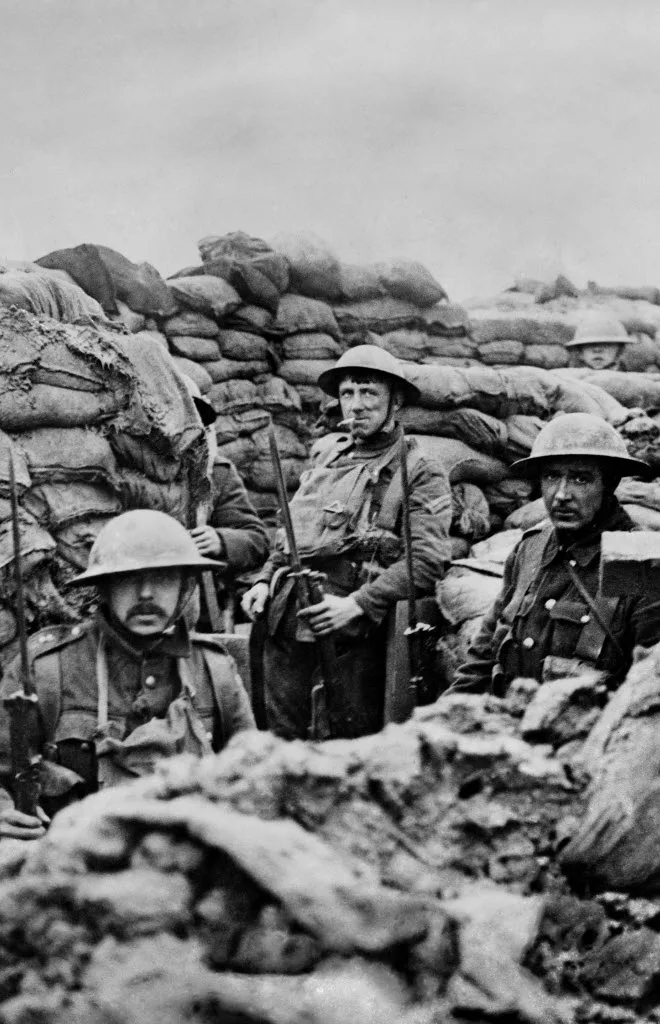
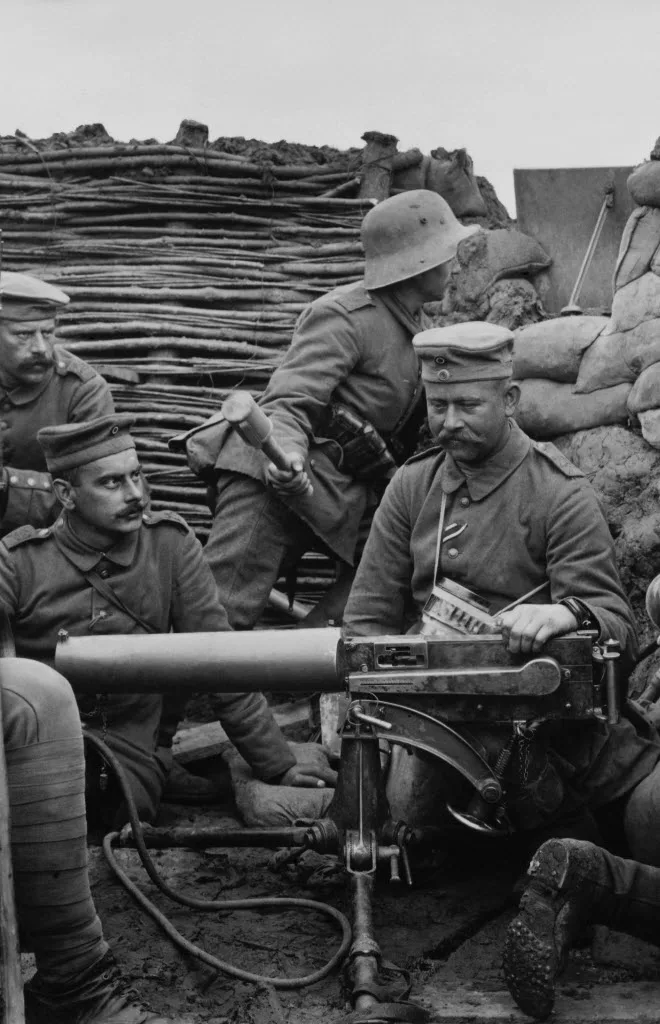
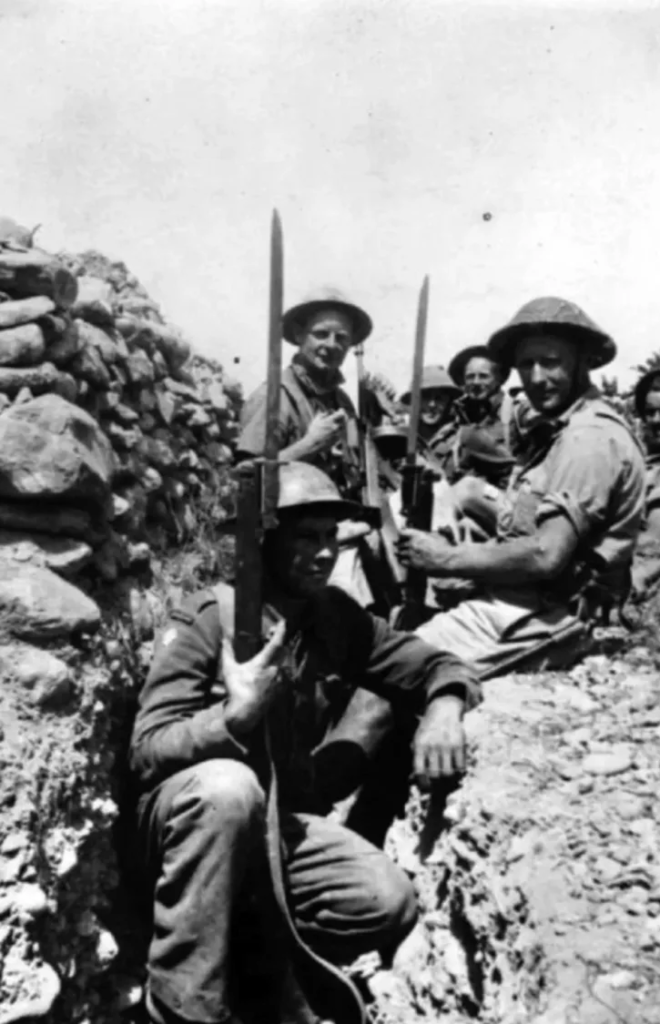
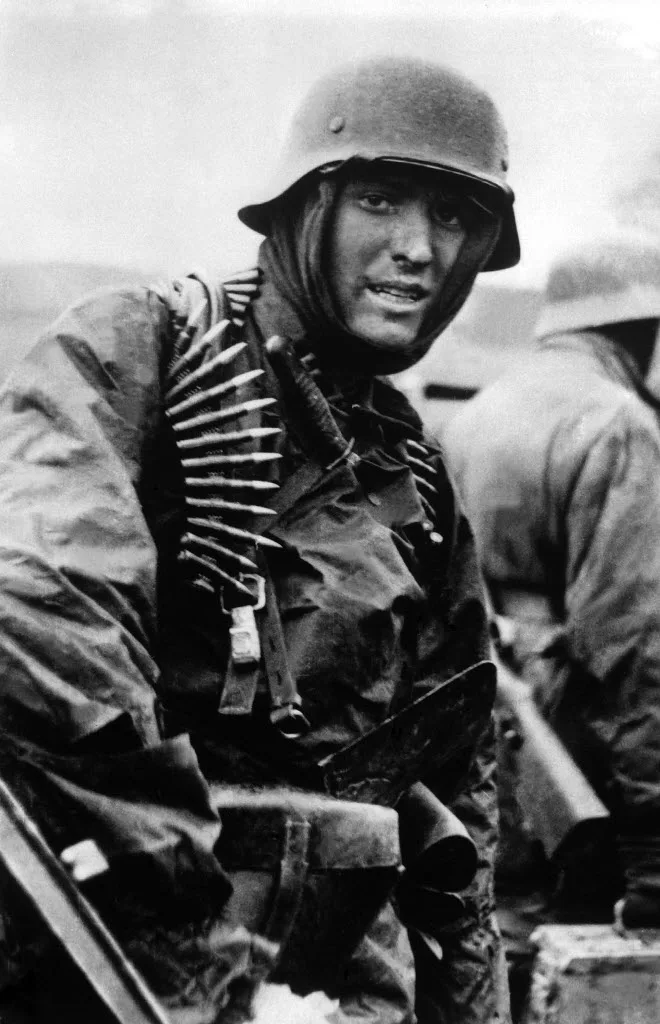
The Vault Militaria is the UK’s newest destination for authentic wartime memorabilia and collectables. Specialising in rare and hard-to-find items from World War I and World War II, we offer history enthusiasts and collectors a carefully curated selection of genuine artefacts.

new items every week
Rare finds
Our team of experts meticulously sources, authenticates, and catalogues each piece, ensuring that you receive only the finest quality items with verified provenance. And we’re adding more and more items on a regular basis.
From battle-worn uniforms and medals to vintage weapons, field equipment, and personal effects, The Vault Militaria brings you closer to the tangible remnants of wartime history.
knowledge & experience
We buy & sell
The founders of The Vault Militaria bring over 50 years of combined collecting experience to the table. They have a pair of keen eyes for the unusual together with an extensive knowledge of wartime collectables to ensure that every item offered is both authentic and exceptional.
With decades spent honing their expertise, they’ve developed an unparalleled ability to source and validate rare military artifacts, making The Vault Militaria a trusted name in the field.
Contact Mark on 07471 058445 or Andrew on 07944 609319
Contact Mark on 07471 058445
or Andrew on 07944 609319
Browse our latest items
-
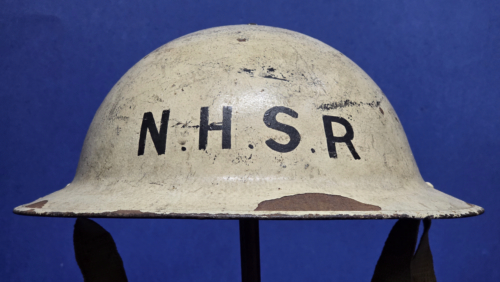
Here we have an original British MKII helmet, produced during the second World War and later reissued in the 1950s for Cold War civil defence use. The front and back is boldly marked N.H.S.R., which stands for the National Hospital Service Reserve. The helmet retains the majority of its wartime white paint finish, showing honest service wear and patina throughout. The stencilled N.H.S.R. letters remain clear on both sides. inside, the liner is manufacturer marked "FFL II", identifying it as a product of Fisher-Foile Ltd, a recognised wartime maker. It is dated 1941 and marked as a size 7 1/4. The liner shows typical ageing and some cracking to the rubber components but remains complete, along with its khaki web chin strap. Faintly inscribed inside the rim is the name "Greta Garbo II", almost certainly added by its original owner as a touch of humour - a light hearted nod to the famous Hollywood actress of the 1920s/1930s. This sort of personalisation was quite common during wartime, as servicemen and civilians alike often added small jokes, names, or nicknames to their equipment as a way of bringing a bit of personality into difficult times. Historical Background: While the helmet itself was manufactured wartime, the N.H.S.R. (National Hospital Service Reserve) markings date from the 1950s, when Britain reorganised its civil defence system in response to Cold War tensions.
We sell to the USA, Europe, and most worldwide destinations.
All items are securely packed for safe transit.
-
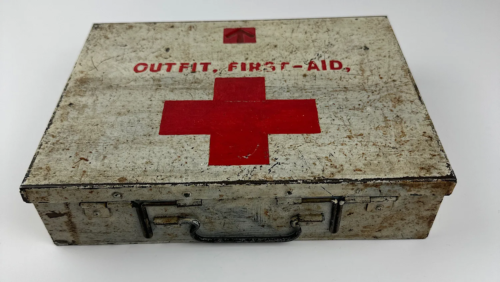
Red Cross Outfit First Aid Tin
£60.00 SKU: 0107APlease see the bottom text for contents. This Red Cross First Aid Tin has a LOT of items inside, and it also has the wartime mark. You see a lot of these tins classed as wartime, yet their contents are dated post war. This is because, during the “mend and make do” era after the war, these tins were repurposed. So, you could say it’s a wartime tin, with post war contents. Being made of metal, this tin helps to keep the contents inside safe for when they’re really needed. The size of it also places it as likely being used on a jeep, or other military vehicle of similar size. Most of the contents are unopened, and even have original seals too. The tin itself has certainly been well loved, but the red cross, and red lettering including wartime marking is still clearly visible. The hinges work as they should, and the closing mechanism is nice and stiff still. The lid closes and opens without problems too. Functionally, it’s in excellent condition. Not only is this piece an important part of British wartime history, it’s also a piece that can be opened, and looked through. The contents can be removed, looked at and researched, or left inside and be part of a home-front display or collection. This tin contains: Triangular bandage pack, umbilical cord dressing pack, 2x Melolin non-adherent absorbent dressings, compressed absorbent gauze, elastic adhesive plater, tube of Savlon antiseptic cream, Dibromopropamidine cream, sterile lint dressing, sterilised absorbent gauze, sterilised medium wound dressing, khaki compressed bandage, standard no.12 large burn dressing, sterilised absorbent cotton wool, standard no.12 euflavine (large) dressing, standard medicated lint dressing, white open wove bandages, waterproof plasters, standard dressing no.11, sterilised hand or foot dressing no.3, compressed triangular bandages, medium sterilised lint dressing, 9x Asprin tablets on tube, standard envelope for hands, pair of scissors, 12 safety pins, eye bath and a notice sheet entitled “advice on first aid”. -
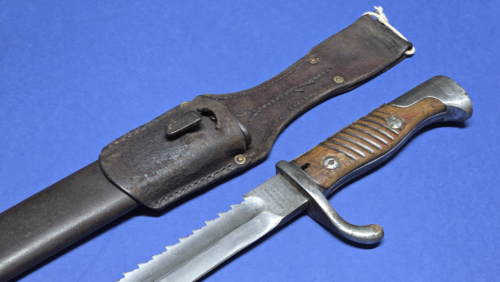
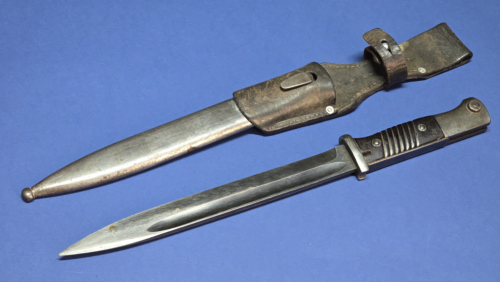
WW1 German 98/05 “Butcher” Bayonet – Sawback – Mauser A.G. Oberndorf
£425.00 SKU: 0297MHere we have a German WW1 98/05 bayonet, commonly referred to by collectors as the "Butcher bayonet" due to its distinctive wide blade profile. This example has a nice clean blade. It has been sharpened but remains bright and straight, with very sharp and intact saw-back teeth. The ricasso is stamped "Waffenfabrik Mauser A.G. Oberndorf a.N", one of the well known makers of the period. The spine does show markings, although, very faint. (see photos). The hilt features wooden grips with one side noticeable darker than the other, possibly due to how it has been stored over the years. Both grips show service wear and age, with some small dents and handling marks. The flash guard also shows some light dings. The rifle retaining button is fully functional, and both original grip screws are intact. A Waffenamt inspection stamp can be seen at the top of the pommel. The scabbard is nice and straight, with only miner indentations and wear consistent with service wear. It retains the throat screw and bears Waffenamt stamps on both the throat and lower ball. Accompanying this is the correct WW1 leather frog, showing expected wear and age but still retaining its original stitching and all four rivets.Historical Note:
The 98/05 bayonet was first introduced in 1905 for use with the Gewehr 98 rifle and quickly became the standard German bayonet of WW1. Its heavy, cleaver-like blade earned it the nickname "Butcher Bayonet" among allied troops. In 1917 Germany officially ordered the removal of the saw-back feature from new production, making surviving examples like this particularly sought after by collectors.
We sell to the USA, Europe, and most worldwide destinations.
All items are securely packed for safe transit.
-
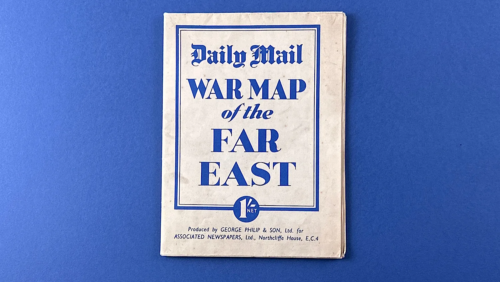
WW2 Daily Mail War Map of the Far East
£45.00 SKU: 0106AIssued by the Daily Mail during WW2, this War Map of the Far East was one of a series of maps designed to help readers track the progress of the conflict. Select editions included flags or stickers that could be placed on the map to mark battles and troop movements. The Daily Mail are maps are slightly more scarce when compared to the Daily Express versions. They’re also formatted differently, at least this one is. Measuring 30 inches wide or around 76cm and 40 inches tall or just over a meter. The colours are stunning, with the yellow and blue really popping. Usually, if these maps have been pinned to a wall, the colours fade over the years but this is a clean indication that it’s been left, folded. Given the condition of the cover, vs the rest (see photos) you can see this is the case. The corners are in amazingly condition, and the only damage at all on the entire piece is a couple of very tiny holes where it’s been folded. Pretty much unavoidable given it’s age and material. Being of the Far East, this map would be of particular interest for relatives of those who were prisoners of war and who worked on the Burma Railway or “Death Railway”. The bottom left is marked: “Copyright 1944, George Philip & Son Ltd” and on the bottom right; “The London Geographical Institute”. -
WW2 German K98 Bayonet – Matching Numbers (Alexander Coppel, 1942)
£325.00 SKU: 0296MHere we have a nice example of the famous K98 German WWII bayonet, complete with frog and matching numbers. Blade: Unsharpened blade is in excellent condition, retaining the majority of its wartime bluing. Serial number on the ricasso is stamped 3399, whilst the reverse is stamped 42FNJ, identifying it as made by Alexander Coppel in 1942. Hilt & Grips: Undamaged dark brown colour bakelite grips, secured by two screw bolts. Flash guard is in good condition, with a fully functioning rifle retaining button. The hilt is stamped with the usual two Waffenamt inspection stamps. Scabbard: Undented and in great condition, although missing the majority of its original bluing. It shows a Waffenamt stamp to the lower ball, and the scabbard throat screw remains present. On the front of the scabbard we see the matching numbers 3399, and on the reverse the marking 42FNJ, which also corresponds to the blade. Frog: Comes complete with the correct leather frog. The leather is very strong, with all stitching intact, including the four rivets. A fine example.
We sell to the USA, Europe, and most worldwide destinations.
All items are securely packed for safe transit.
-
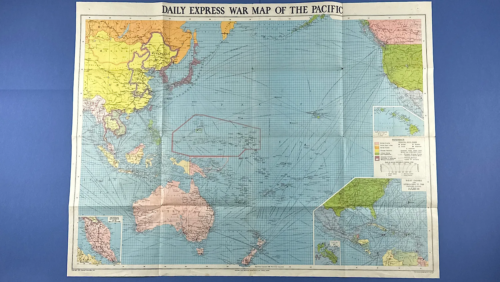
WW2 Daily Express War Map of The Pacific
£40.00 SKU: 0105AThis War Map of the Pacific, published by the Daily Express during WW2, was one of several maps issued by the newspaper to help readers follow the conflict from home. Some editions even included flags or stickers so that families could mark the shifting fronts themselves. In the bottom left hand corner, “Copyright, 1941, George Philip & Son Ltd.” is printed, and in the bottom right; “The London Geographical Institute” has also been printed. This particular map has some hand written notes too (see photos). All the colours are vibrant, bright and beautiful, with the blue of the sea being really very striking. This tells us, it’s been folded up for much of it’s life and not pinned to a wall. Also, the fact no holes are in the corners support this. Like other maps similar to this one, it would make a perfect backdrop to any collection, offering colour but also a genuine map, published in 1941 of The Pacific. ALL corners are in excellent condition, none have been dog-eared and there are NO rips, tears or cuts whatsoever on any part of this map, giving it rarity in terms of condition alone. The only damage to this map comes in the form of a couple of holes from where it’s folded – an extremely common element and pretty much impossible to avoid, given it’s age and material. It measures, 29.5 inches or 75cm tall, and 39 inches or 1 meter wide. -
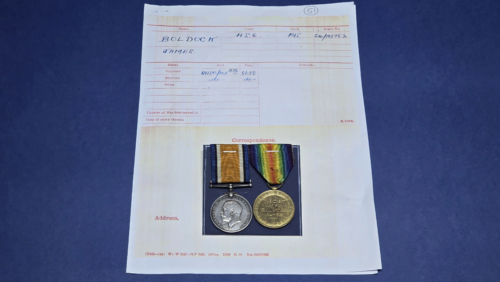
WW1 British Medal Pair to Private James Boldock – Army Service Corps
£48.00 SKU: 0295MA genuine First World War medal pair awarded to Private James Boldock, Army Service Corps (service No. S4/125352) British War Medal 1914-1920 Obverse showing King George V, reverse with St. George on horseback. Victory Medal 1914-1919 With the classical winged Victory design. Both medals are correctly impressed on the rim to: S4-125352 PTE. J. BOLDOCK. A.S.C. The medals come with paperwork confirming entitlement. The Army Service Corps: (Later the Royal Army Service Corps) was the vital logistical backbone of the British Army, responsible for transport, supply, and maintaining the flow of essential goods to the front line. Men of the A.S.C. often served in demanding conditions close behind the fighting units, ensuring food, ammunition, and equipment reached the troops. -
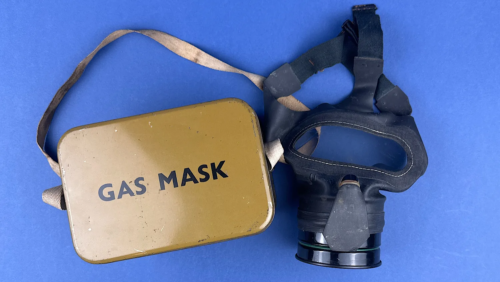
WW2 Avon Gas Mask (rare)
£130.00 SKU: 0101AThis British, WW2 Avon Gas Mask is a very rare version, noted by the additional piece above the filter. This piece, called an “exhalation valve cover” is usually missing from most gas masks of the era. The Avon Rubber Company, founded in 1885 in Wiltshire, England, specialised in rubber products ranging from tyres and industrial goods to protective equipment. During WW2, Avon became a major supplier of gas masks for both civilians and the military, producing millions of respirators that were vital to Britain’s civil defence. Today, under the name Avon Protection, the company continues to manufacture advanced respiratory and ballistic protection for armed forces and emergency services worldwide. It has a variety of markings on it, but they date this piece as November 1940, being made by Avon Rubber Company. The “7” denotes a pattern number or part reference. The “B.R. 8 11 40” marking on the back side of the nose piece relates to British Respirator/ Board Reference which ties is to WW2. It’s in incredible condition, with all the rubber being pliable, supple and in great smooth condition. The filter has NO dents at all to it which is amazing in itself. Usually these parts have at least one or two dents, or some paint missing but here, no. The herringbone webbing straps are in great condition too – and someone has added a pair of safety pins. Just to keep the excess webbing from flapping about too much. The webbing attaches to the body of the mask by being moulded directly into the rubber. This is a major stress point for these type of masks but here, there is ZERO wear. Overall this mask is almost new looking with its excellent condition. Also as stated before, the exhalation valve cover above the filter is usually missing on other designs – making this one very rare indeed. The viewing window has very minor wear marks to it too. The tin is comes in, has the original cardboard packaging. This is just used to keep the mask stable in transport, and on the inside of the tin, the familiar filter circle can be seen where the filter has rubbed against the inside of the tin. On top of the tin, “Gas Mask” is clearly marked in black paint, and also on the back side of the lid, also in black paint; “container manufactured by Barringer, Wallis & Manners Ltd, Mansfield.”. It’s of a simple, usual design. Being made out of metal, painted brown colour and clearly marked as a gas mask container. It’s also got an integrated strap (which is also herringbone – matching the design of the webbing on the mask – a nice touch) so it can be carried on a shoulder. The tin has got a few chips on the paint, but 99% of it remains. There is also a small dent on the back, and a TINY dent on the front. So small, they were a challenge to properly photograph. Most interestingly, there’s a name written on the strap. We think the name is “Cobenhall”. This is a really nice piece, in amazing condition but not only that, very rare with the exhalation valve cover not only present but still intact and in good condition.