
Welcome to The Vault Militaria
Welcome to
The Vault Militaria
Authentic pieces. Timeless stories. Exceptional service.
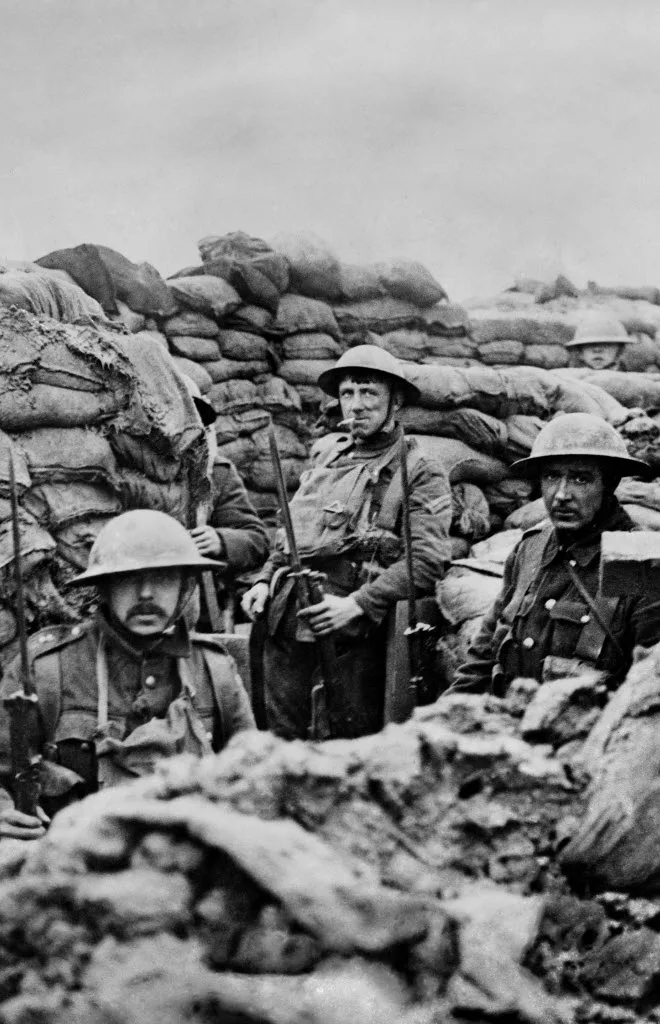
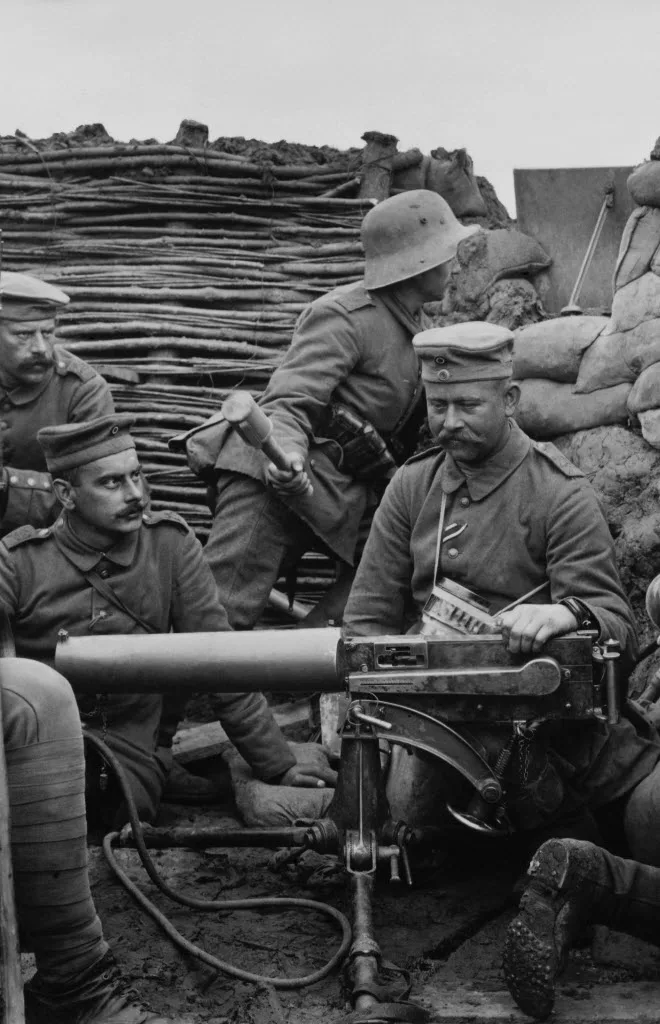
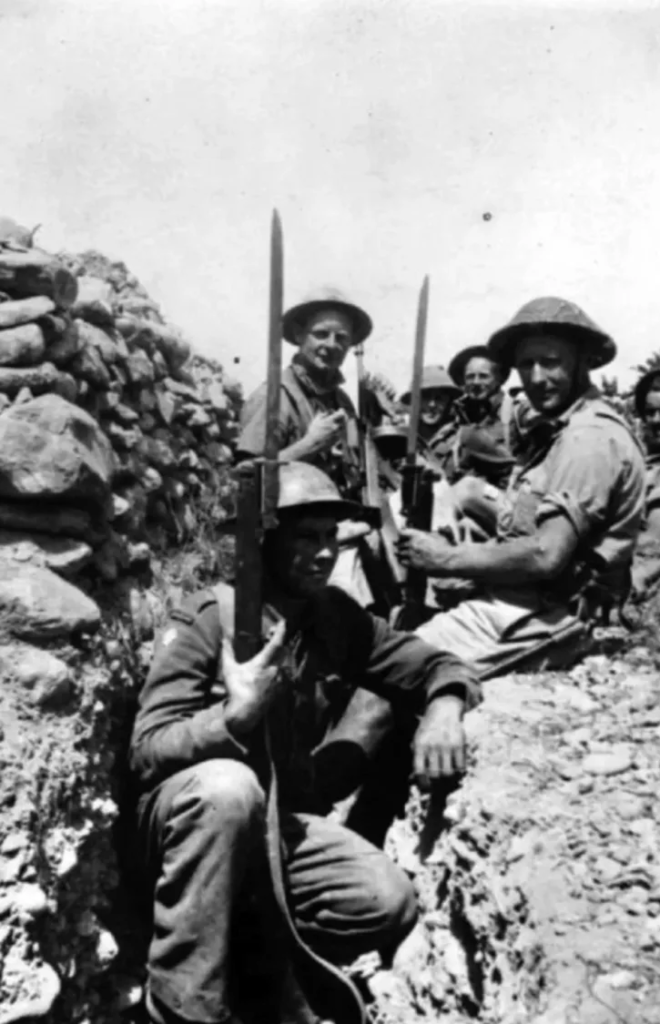
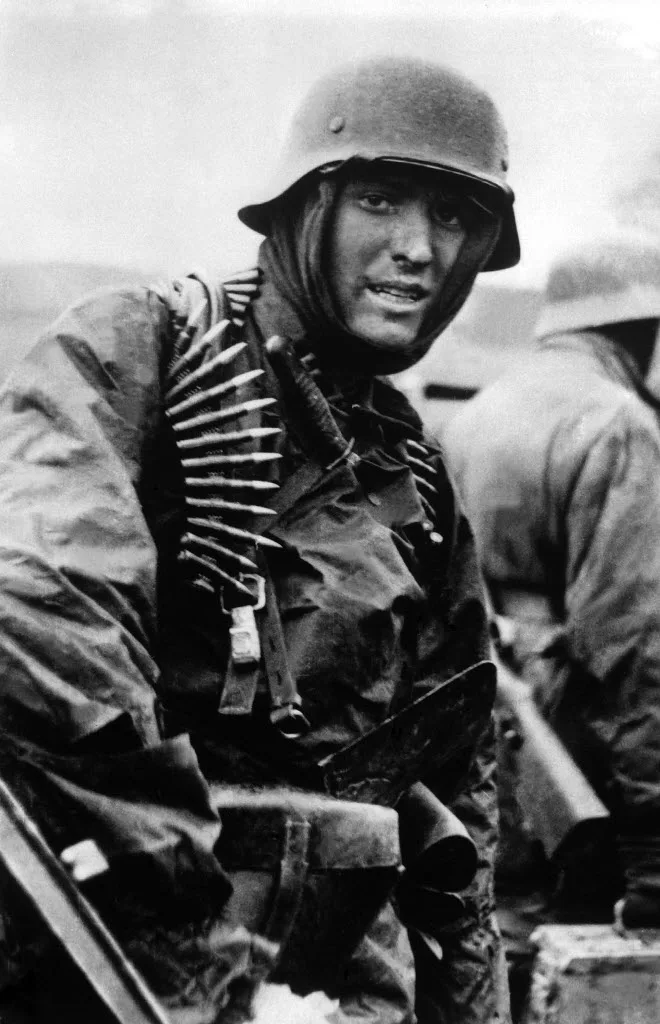
The Vault Militaria is the UK’s newest destination for authentic wartime memorabilia and collectables. Specialising in rare and hard-to-find items from World War I and World War II, we offer history enthusiasts and collectors a carefully curated selection of genuine artefacts.

new items every week
Rare finds
Our team of experts meticulously sources, authenticates, and catalogues each piece, ensuring that you receive only the finest quality items with verified provenance. And we’re adding more and more items on a regular basis.
From battle-worn uniforms and medals to vintage weapons, field equipment, and personal effects, The Vault Militaria brings you closer to the tangible remnants of wartime history.
knowledge & experience
We buy & sell
The founders of The Vault Militaria bring over 50 years of combined collecting experience to the table. They have a pair of keen eyes for the unusual together with an extensive knowledge of wartime collectables to ensure that every item offered is both authentic and exceptional.
With decades spent honing their expertise, they’ve developed an unparalleled ability to source and validate rare military artifacts, making The Vault Militaria a trusted name in the field.
Contact Mark on 07471 058445 or Andrew on 07944 609319
Contact Mark on 07471 058445
or Andrew on 07944 609319
Browse our latest items
-
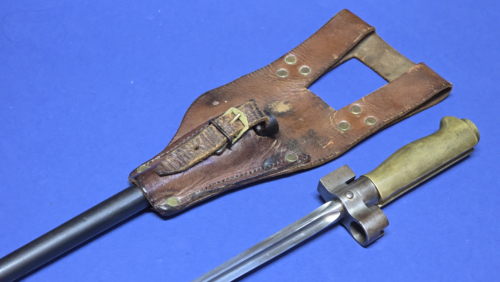
WWI French M1886/15 Lebel Bayonet with Matching Numbers & Frog
£195.00 SKU: 0405MA very strong and honest example of the iconic French M1886/15 Lebel bayonet, complete with its matching numbered scabbard and original leather frog. This is a 1915 configuration with brass grips and straight quillon. An excellent example.
Blade
The distinctive cruciform (épee-style) blade remains in excellent condition, retaining a bright, clean finish throughout. The blade presents very well, showing hardly any signs of wear. This bayonet has clearly been well looked after and stored well.Hilt & Grips
The original grips were made with nickel-silver alloy, but after 1914 brass grips were introduced as certain metals became scarce. The cross-guard muzzle ring and block are in excellent condition with the spring loaded button working in perfect order. Manufactured without the hooked quillon, reflecting the simplified wartime production changes. Serial number A60175 is clearly stamped on the block and matches the scabbard.Scabbard
The steel scabbard is undented, and retains 95% of its original colour finish. Matching serial number present A60175, confirming the two pieces have always lived together. The bayonet draws from the scabbard smoothly with a snug, correct fit.Frog
Complete with its original French leather frog in excellent condition. The leather remains supple, with all stitching intact and tight. This is the reinforced variation, identifiable by the additional brass rivets — a later improvement introduced after earlier frogs were found to fail in wet conditions.Overall
A complete and highly collectible example of the M1886/15 Lebel bayonet. Matching numbers, strong bluing, excellent blade, and leather frog make this a desirable piece.Historical Note
The M1886 Lebel bayonet, often referred to as the “Rosalie,” was the standard bayonet of the French Army throughout the First World War. The 1915 modifications simplified production, introducing brass grips and removing the hooked quillon. Its long, needle-like blade was designed for thrusting and became one of the most recognisable bayonets of the war.
We ship to the USA, Europe, and most worldwide destinations.
All items are carefully packed for safe transit.
-
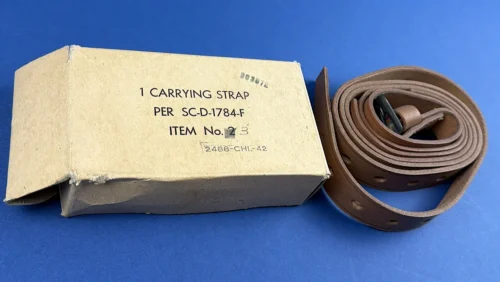
This is an original WW2 U.S. Signal Corps carrying strap, dated 1942 and complete with its original issue box. Manufactured under contract in Chicago and marked to specification SC-D-1784-F, this strap was produced for use with Signal Corps equipment such as field telephones, radios, and associated cases. The box is clearly printed “1 Carrying Strap” and bears the maker’s details for the International Telephone & Radio Mfg. Corp., a known wartime supplier of communications equipment to the U.S. Army. The additional contract marking “2488-CHI-42” confirms Chicago procurement and 1942 production. The strap itself is constructed from brown leather and fitted with an adjustable series of punched holes, along with a metal hook and loop arrangement designed to attach securely to equipment fittings. This type of strap would have allowed Signal Corps personnel to carry or sling their equipment more easily in the field, making it a practical and necessary accessory rather than a decorative item. Condition is very good overall. The leather remains supple with no cracking or stiffness, and the stitching is intact. The metal fittings show light age-related patina but remain solid and functional. There are two adjustment holes that haven't been completely punched, suggesting the strap was never fitted or used, and has survived in near-issued condition. The original box is present and complete, though it does show expected wartime wear including edge rubbing, minor crushing, and some light marking, all consistent with age and storage. A nice, honest and complete Signal Corps accessory, ideal for collectors of U.S. communications equipment or as a companion piece to a field telephone or radio set.
-
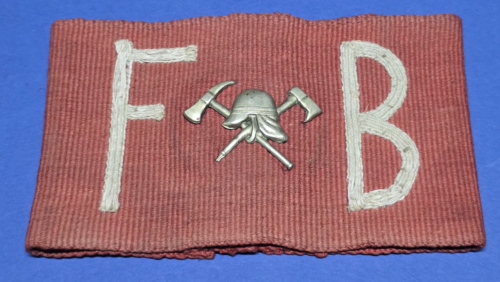
Original German Feuerwehr (Fire Brigade) armband with applied “F B” lettering and central helmet with crossed axes device. A very good example.
Construction
Ribbed red cloth body with white “F B” lettering stitched directly to the surface. The central device is fixed through the band with its original prongs and backing plate. The cloth remains in excellent condition, showing minimal wear, with the metal badge having a nice patina.Overall
A clean, genuine example that displays well.Historical Note
The German Feuerwehr (Fire Brigade) was responsible for firefighting and emergency response, forming part of the wider civil defence structure. During the 1920s and 1930s, these units became more organised and visible, often taking part in public events and parades. Armbands such as this were worn to identify personnel during duties and organised activities.
We ship to the USA, Europe, and most worldwide destinations.
All items are carefully packed for safe transit. -
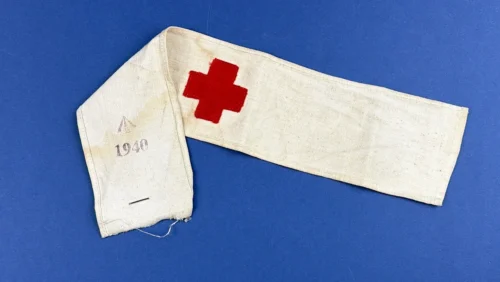
This is an original WW2 British Red Cross armband, clearly dated 1940 and bearing a Broad Arrow marking, confirming official government issue during the early war period. Constructed from plain white cotton, the armband features a stitched red cross to the centre, in keeping with recognised Red Cross identification used by medical personnel and first aid workers throughout the war. The simple, functional design reflects its intended use in practical and often demanding conditions. Armbands of this type were worn by Red Cross volunteers, first aid parties, and other medical personnel operating on the British Home Front. They provided immediate visual identification during air raids and emergency situations, allowing wearers to be recognised as authorised to administer aid in often chaotic and low-visibility conditions. The presence of the Broad Arrow marking is particularly significant, indicating that this example was issued as official government property rather than being a privately produced or later civilian example. Combined with the clear 1940 date, this places the armband firmly in the early war period, a time of intense Home Front activity during the Blitz. The armband fastens with a safety pin, allowing it to be easily worn over civilian clothing, uniforms, or heavier outer garments as required. The armband remains in original, used condition, showing visible age-related staining and wear to the fabric, along with some fraying to the edges. The red cross remains securely attached, and the markings are still legible. The safety pin is present and functional, though likely a period replacement. Overall, it presents as an honest and well-used example of wartime Home Front medical equipment.
-
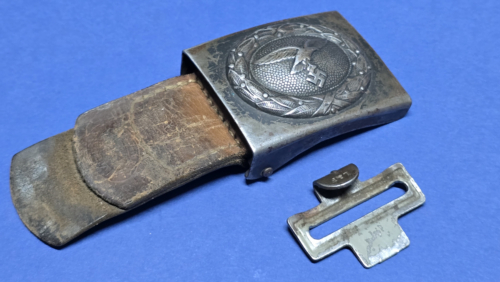
A WW2 German Luftwaffe enlisted man’s steel belt buckle, complete with its original leather tab and separate belt hook. This is the combat-type buckle, produced in stamped steel with a subdued blue/black finish, as seen on these examples.
The buckle is untouched and never been cleaned. It features the Luftwaffe eagle clutching a swastika within a wreath, set against a pebbled backing.
Buckle
The buckle is of stamped steel construction, retaining some of the original blue/black finish correct for this buckle. The pebbled field remains clear, and the eagle and wreath detail are well defined.
There is honest wear throughout, with areas of finish loss and a natural, untouched patina.
Fittings
The reverse shows correct period construction, including the integral catch and prong bar. The separate belt hook (Gegenstück) is present and is stamped “L&F” (Linden & Funke), a known wartime manufacturer.
Leather Tab
The original brown leather tab is present and faintly dated 1941, with a partially legible maker’s stamp reading "Dransfeld & Co". The leather shows expected age and wear but remains intact.
Overall
A complete Luftwaffe steel buckle set, with correct wartime construction and components. Showing honest wear, but remaining a solid and untouched example.
Historical Note
During WW2, Luftwaffe enlisted buckles transitioned from aluminium to steel due to material shortages. These steel examples, often finished in blue/grey, became standard issue for combat troops including ground personnel, flak units, and paratroopers.
We ship to the USA, Europe, and most worldwide destinations.
All items are carefully packed for safe transit. -
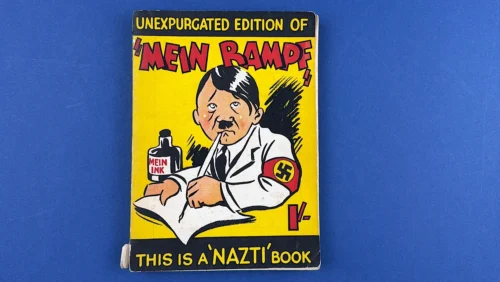
This is an original WW2 British anti-Nazi satirical booklet titled “Mein Rampf”, a striking and characterful example of Home Front humour used to ridicule and undermine the enemy through wit, cartooning, and morale-boosting propaganda. Produced in Great Britain by Wells Gardner, Darton & Co. Ltd., this 128-page booklet is packed with sharp, often absurd cartoons and parody text aimed squarely at the Nazi regime and its leadership. The crude caricatures and playful language — such as “Smile-Itler” — reflect the uniquely British ability to meet fear and uncertainty with humour, turning one of the darkest periods in history into something that could be laughed at, even if only briefly. Items like this were part of the wider psychological effort on the Home Front. They weren’t just made to entertain — they served a purpose. In homes, shelters, and barracks, pieces like this helped people cope, offering a moment of relief, a smirk, or even a proper laugh in the middle of air raids, rationing, and constant anxiety. It’s easy to forget now just how important that was. There’s something particularly human about this booklet. It isn’t grand or official. It doesn’t carry authority or command attention in the way military items do. Instead, it sits quietly in the background of the war — a reminder that ordinary people carried on, found humour where they could, and refused to let the weight of the conflict take everything from them. From a collecting standpoint, this is a scarce and highly displayable piece of WW2 Home Front ephemera. The bold, colourful cover artwork makes an immediate impact, while the interior offers genuine depth and interest beyond simple display value. It fits perfectly within any Home Front, propaganda, or wartime paper collection, and stands out as something a little different — more personal, more relatable, and arguably more telling of the civilian experience. Although no explicit publication date is printed, the booklet was produced in Great Britain by Wells Gardner, Darton & Co. Ltd., and is clearly of WW2 period, both in content and style. Condition is consistent with age and use. The covers show visible wear, including edge rubbing and areas of loss, particularly to the rear. The spine and binding remain intact but show signs of handling and age. Internally, the pages are complete and generally clean, with some light age toning and staining visible in places. There is a small handwritten note to the rear. Someone has sadly written a small marker in Biro (see photos). Overall, it presents well and retains strong visual appeal, especially the front cover artwork which remains vibrant and striking.
-
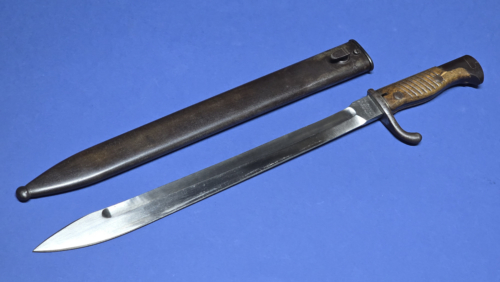
A solid and honest example of a World War I German S98/05 “butcher” bayonet, dated 1916, showing the removal of the sawback. This is a good, collector-grade piece with clear markings and a consistent overall appearance, reflecting both its wartime use and modification. Sawback blades became controversial during the First World War due to their perceived brutality, and were often ground down during wartime service.
Blade
The blade is super clean and bright, and free from any damage or rust. The blade has been sharpened, but very neatly done, and displays a well defined tip. The rear ricasso is marked Waffenfabrik Mauser A.G. Oberndorf a/N, which is nicely stamped and easily readable. On the spine of the blade we have the usual marking's, a crown with a "W" underneath, the number "16" referring to the date "1916", and an inspection stamp.Hilt & Grips
The bayonet is fitted with its original wooden grips, with an attractive light tone in colour, and overall in good condition. There is some minor chipping to one side, but nothing excessive.
The grips are secured with their original two screw bolts, with the rifle retaining button functioning as it should, and an inspection stamp visible above. This model as a flash guard fitted, showing some very minor small indentations.Scabbard
The scabbard is in excellent condition, that remains straight and structurally sound. There is the smallest faint indentation to the rear — subtle enough to be difficult to see, but just about detectable by hand. The original scabbard throat screw is present, with the rear of the scabbard being maker marked Waffenfabrik Mauser A.G. Oberndorf, giving a matching maker to the blade.Overall
A very nice example of the S98/05 butcher bayonet. It displays well, with clear maker markings, and a matching scabbard. A great example that would sit well in a World War I edged weapons collection.Historical Note
The German S98/05 “butcher” bayonet was widely issued during World War I. Early production examples featured a sawback spine intended for utility use.During the war, many of these sawbacks were removed, largely due to the controversy surrounding their use in combat and the reaction they provoked among opposing forces. As a result, surviving examples often show this modification.
Only a small proportion of these bayonets were originally produced with sawbacks, making any example — even one that has been altered — an important part of the wider story of German edged weapons in the First World War.
-
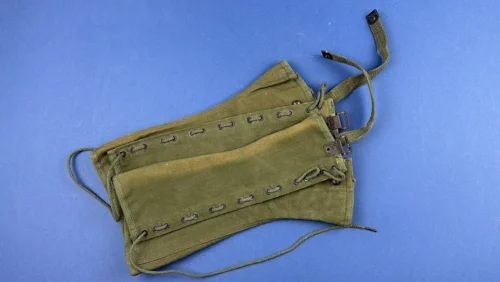
This is an original pair of WW2 British Army canvas gaiters, manufactured by BAGCRAFT Ltd and clearly dated 1945. Constructed from heavy-duty khaki canvas, these gaiters represent a more substantial and less commonly encountered form of lower leg equipment when compared to the standard short anklets associated with British infantry webbing. The design features multiple rows of press stud fastenings, reinforced panel construction, and an integrated lacing system, all intended to provide a secure and supportive fit around the lower leg. Adjustable straps with metal buckles are also present, allowing the gaiters to be firmly secured in use. Examples of this pattern are typically associated with specialist roles where additional protection or support was required, such as dispatch riders, motorcycle troops, or personnel operating machinery and equipment. Their heavier construction and extended coverage set them apart from standard issue anklets, making them an interesting and more unusual variation within British WW2 field equipment. Both gaiters are stamped BAGCRAFT Ltd 1945, confirming late-war production, and also display the British broad arrow marking, denoting official government issue. The presence of a clear maker, date, and issue mark adds to their desirability, particularly for collectors seeking well-marked and identifiable wartime equipment. Condition wise, these are in good condition. The stamp is slightly faint but remains readable, although difficult to photograph clearly. Each gaiter retains its original lacing, and all components are present as they should be. There is some light bleaching to the canvas, which suggests they may have been displayed previously, likely as part of a collection. The colour may appear to vary slightly between photographs due to lighting conditions, but both gaiters are a consistent olive drab / ranger green colour in hand and are a matching pair. A solid and increasingly hard-to-find pair of late-war British Army gaiters, offering a slightly different and more distinctive addition to any WW2 collection.