Welcome to The Vault Militaria
Welcome to
The Vault Militaria
Authentic pieces. Timeless stories. Exceptional service.
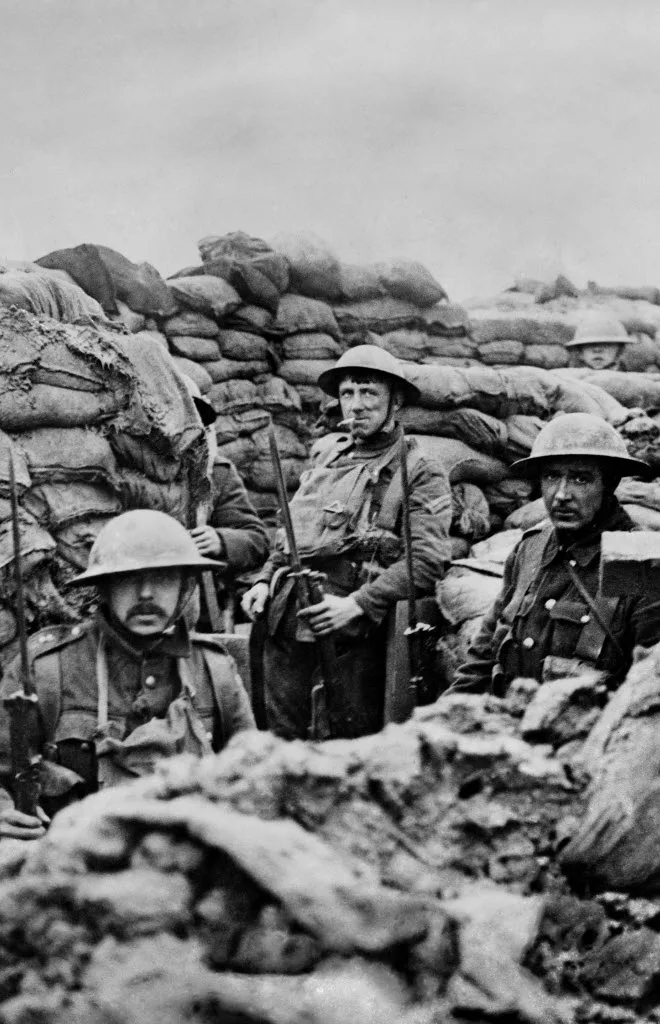
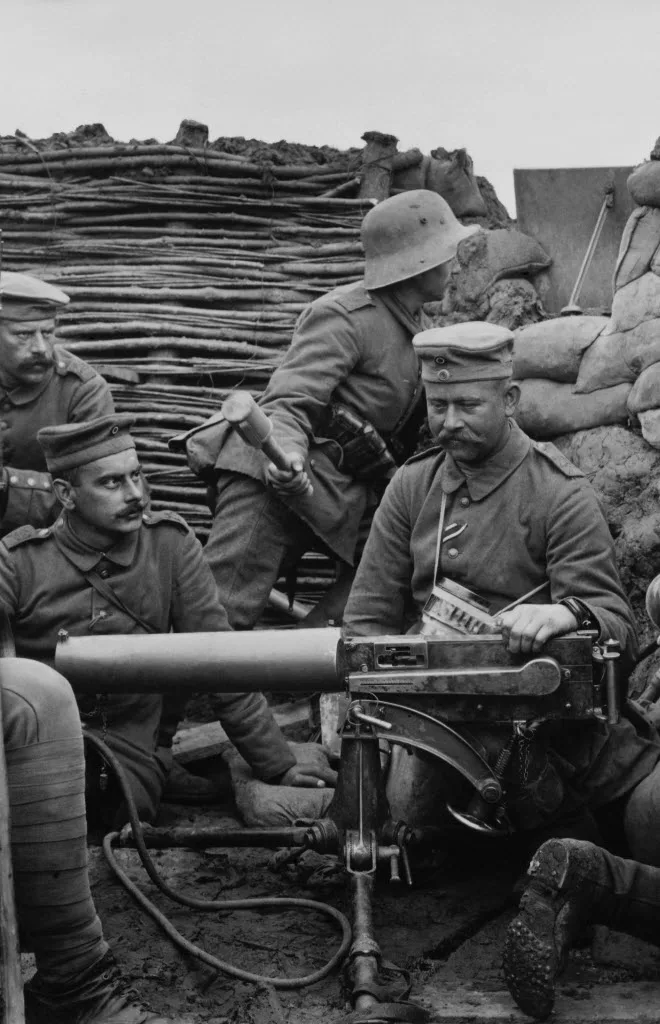
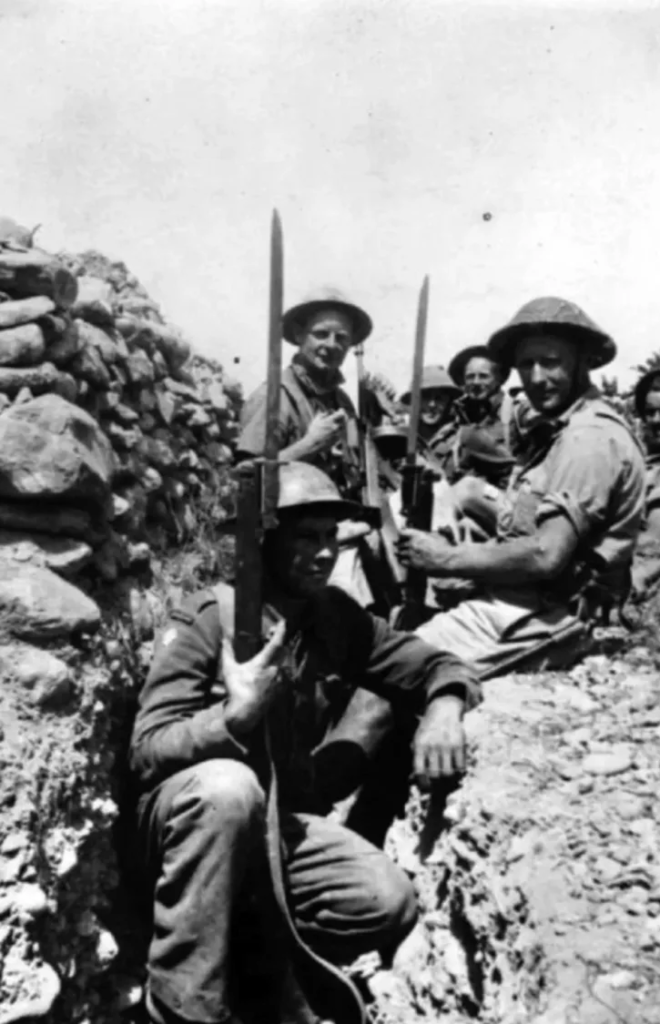
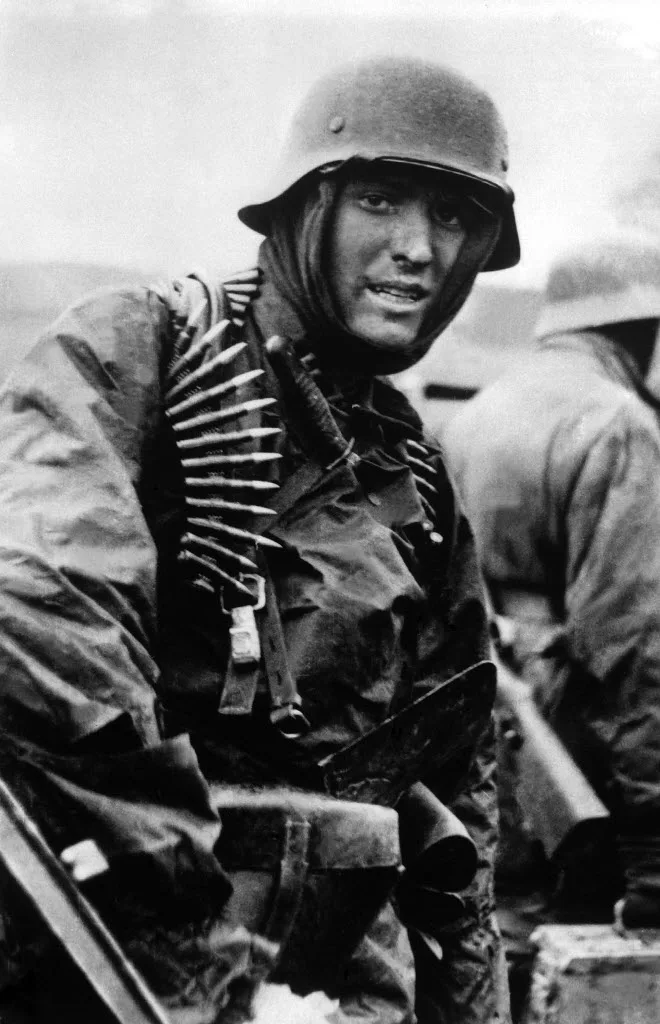
The Vault Militaria is the UK’s newest destination for authentic wartime memorabilia and collectables. Specialising in rare and hard-to-find items from World War I and World War II, we offer history enthusiasts and collectors a carefully curated selection of genuine artefacts.

new items every week
Rare finds
Our team of experts meticulously sources, authenticates, and catalogues each piece, ensuring that you receive only the finest quality items with verified provenance. And we’re adding more and more items on a regular basis.
From battle-worn uniforms and medals to vintage weapons, field equipment, and personal effects, The Vault Militaria brings you closer to the tangible remnants of wartime history.
knowledge & experience
We buy & sell
The founders of The Vault Militaria bring over 50 years of combined collecting experience to the table. They have a pair of keen eyes for the unusual together with an extensive knowledge of wartime collectables to ensure that every item offered is both authentic and exceptional.
With decades spent honing their expertise, they’ve developed an unparalleled ability to source and validate rare military artifacts, making The Vault Militaria a trusted name in the field.
Contact Mark on 07471 058445 or Andrew on 07944 609319
Contact Mark on 07471 058445
or Andrew on 07944 609319
Browse our latest items
-
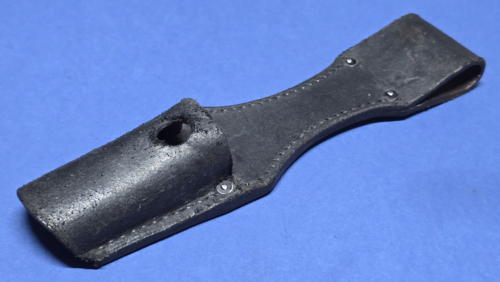
WW2 German K98 Leather Frog – Heinrich Sohn KG, Neu-Ulm. 1941
£85.00 SKU: 0314MHere we have an excellent original WW2 German K98 frog, maker-marked Heinrich Sohn KG, followed by Neu-Ulm, and dated 1941. This is a very clean wartime example that has not seen much use.Condition:
The leather is in excellent condition with no rips, tears, or any signs of damage. The frog shows minimal wear, with all stitching being firmly in place, with no repairs. It's a tidy example that has survived better than most frogs from this period. The original four rivets are all present, and the makers name and date are stamped on the reverse. (see photos) A great example to pair with any decent K98 bayonet.Historical Note:
By 1941, German manufacturers were producing large quantities of frogs for the K98 bayonet, with firms such as Heinrich Sohn KG supplying leather accoutrements to the Wehrmacht and police units. Maker-marked pieces are always desirable as they allow collectors to trace exactly when and where the item was produced.Reference Note:
For collectors who like to research their pieces, I strongly recommend Roy Williams "A Collector's Guide to German Bayonet Belt Frogs 1825-1945." It's a superb reference book, packed with clear photos, wartime maker marks, and detailed construction variations. Frogs from Heinrich Sohn KG appear in the book.
We sell to the USA, Europe, and most worldwide destinations.
All items are securely packed for safe transit.
-
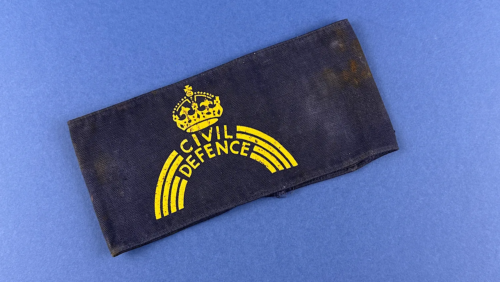
This is a British Civil Defence Corps Armband, post war, with a FOUR-ARC emblem. These four arcs are significant for dating this piece – don’t get caught out. This piece has some interesting history behind it. Before WW2, the British government realised that future wars would target cities and civilians from the air. So in 1935, it created the Air Raid Precautions (ARP) organisation - later renamed the Civil Defence Service in 1941. By 1944, over 1.9 million men and women served as full-time or volunteer Civil Defence personnel. After WW2 ended, the Civil Defence Service was stood down in 1945. With the rise of the Soviet nuclear threat, the British government re-established civilian protection under the Civil Defence Corps in 1949. With the new nuclear threat, the government wanted a modernised, unified image for the revived service. So the Home Office commissioned a completely new emblem; a distinctive yellow four-arched “Civil Defence” badge under the St. Edward’s Crown, which is exactly what we see here. Made from a CLASSIC dark blue/ navy serge (which also helps us to date this piece), it’s in good condition, with some marks here and there (see photos). But the stitching is in an excellent condition, and the yellow printed design is also in a very good condition still. Printed designs like this one tend to crack or fade over the years but this one still has plenty of life left in it. The St. Edward’s Crown is a notable feature here, again helping us to date this piece and overall, the yellow printing is nice and bright too. It’s an interesting piece, and although not directly from WW2, the organisation it represents precedes that era - giving it historical value, depth of interest, and a tangible link to Britain’s Home Front legacy that goes beyond its years.
-
This original WW2 British “Westwood” blackout torch is an early-war example with a painted metal body and toggle switch. Designed for civilian and ARP use during the blackout, its shrouded lens directed light safely downward to avoid detection from enemy aircraft. Westwood manufactured these sturdy torches in Birmingham around 1939–41, before switching to Bakelite bodies later in the war. This example remains in fine overall condition, retaining much of its original black finish and a clear Westwood maker’s mark to the base. It shows only light surface wear and a couple of small dents from service use. The lens is intact, both end caps unscrew freely, and the internal battery springs and switch mechanism are still present and functional. The original battery type is now obsolete, but compatible modern adapters are available, allowing it to be displayed or used safely today. A genuine and well-preserved piece of Home Front lighting equipment from Britain’s wartime years.
-
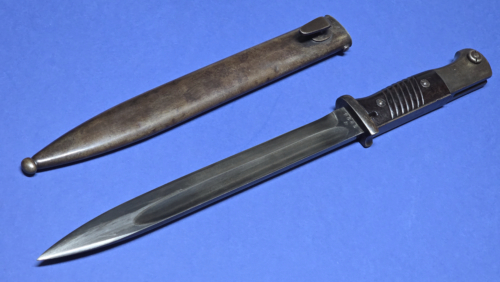
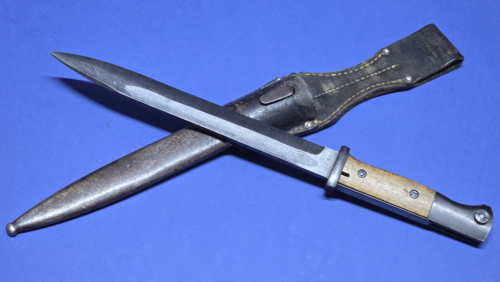
WW2 German K98 Bayonet by WKC – 1939 Dated – Matching Numbers
£260.00 SKU: 0309MA nice WW2 German K98 bayonet by the renowned Solingen maker WKC (Weyersberg Kirshchbaum & Co). This example is matching - numbered, with both blade and scabbard marked 1845, confirming they've lived together since issue.Blade:
The blade is in fine condition with a good sharp tip and a smooth finish. Some original bluing remains, slightly faded but still visible. The blade shows signs of a very light sharpen - barely visible unless closely inspected. On one side of the ricasso is the maker mark "WKC", and on the other side we have the serial number "1845". We also have the number "39" on the spine of the blade, confirming production in 1939.Hilt & Grips:
Fitted with dark bakelite grips, undamaged and secured firmly by two screw bolts. The rifle retaining button functions as it should. Several Waffenamt stamps can be found - two above the press stud, another on the button itself, and a further example just above the flash guard (see photos).Scabbard:
The scabbard remains straight and solid, showing a few very small indentations but nothing detracting. It carries matching serial number "1845" and is stamped "WKC 1939" on the reverse side. A further Waffenamt stamp is present on the lower ball. The throat screw remains in place, and the blade fits the scabbard smoothly.Overall:
A very attractive matching-number WW2 K98 bayonet by a highly respected maker of the period. Good condition, matching number K98 bayonets are becoming harder to find today.Historical Note:
Issued for the German Karabiner 98K rifle, the K98 bayonet saw service on every front of WW2. Maker's codes, dates, and Waffenamt stamps help identify production periods, from the finely finished early-war types. Although widely produced, well-marked and matching-number examples in original condition remain the most sought after by collectors.
We sell to the USA, Europe, and most worldwide destinations.
All items are securely packed for safe transit.
-
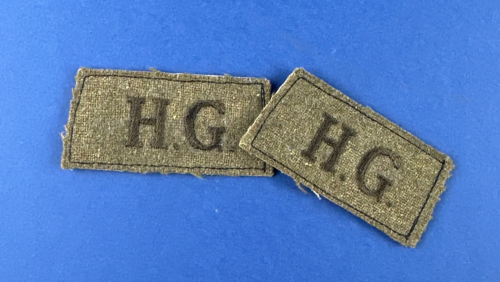
Pair of WW2 Home Guard Patches (Home Front)
£42.00 SKU: 0115AThis is a pair of Home Guard patches, complete with fabric loop for sliding onto shoulder epaulettes or shoulder straps, rather than sewing directly on. When the Home Guard (originally the Local Defence Volunteers, or LDV) was formed in 1940, its members were issued whatever uniforms and insignia could be produced quickly. By mid-1940, the War Office authorized these cloth shoulder titles marked “H.G.” to identify Home Guard personnel before full battledress insignia became standardized. Made out of khaki serge or wool, the fabric loop on the back was so they didn’t need to be directly sewn on but also, so they could be removed easily, if for example, a unit transitions to a new rank or position. Being embroidered rather that printed makes these late war pieces. 1941 – 1944. The earliest Home Guard insignia (summer 1940) were cheaply printed on khaki cotton — made quickly when the force was first raised as the Local Defence Volunteers (LDV). Both patches are in excellent condition, the wool is still fluffy, and thankfully there are no pulls or areas of damage. The embroidery is in perfect condition as well, with no pulls or damage either. Lovely little additions to any Home Front collection. -
WW2 German K98 Bayonet – Dated 1944 – Carl Eickhorn – Mint Blade – Frog
£240.00 SKU: 0308MHere we have an excellent example of a late-war German WW2 K98 bayonet, produced by Carl Eickhorn, Solingen - one of the main German edged weapon manufacturers of the period, renowned for their high-quality bayonets and dress daggers. This example is dated 1944 and remains in excellent condition throughout.Blade:
The blade is mint, and quite literally looks as it would have the day it left the Eickhorn factory. It retains its original machining marks and the characteristic course late-war finish typical of 1944 production, when speed and efficiency replaced the finer polished bluing of earlier years. The surface displays that unissued look, with no signs of sharpening or post-war cleaning, and forming into a sharp factory tip. The ricasso is clearly maker-marked "cof 44" for Carl Eickhorn, and serial-numbered 0526 on the reverse.Hilt & Grips:
The wooden grips are superb, showing no splits or damage and firmly held by two screw bolts. The pommel retains a fully functioning rifle catch with two Waffenamt stamps above. The crossguard, flashguard, and hilt show the original factory finish, with no signs of wear.Scabbard:
The scabbard remains straight but does have several faint indentations, which are very minor and only noticeable upon close inspection. It has lost its original bluing, yet still presents very well. The original throat screw is present, and the scabbard is stamped on the reverse "cof 42" (Carl Eickhorn) with a low number 33 on the front. Although the numbers do not match the blade, it's a bonus that both are from the same maker.Frog:
Accompanied by an original wartime K98 leather frog, all stitching is tight and intact with four rivets present. The leather remains strong and in very good condition.Overall:
An excellent condition late-war 1944 K98 bayonet by Carl Eickhorn (cof), complete with its original frog and a mint, unsharpened blade that still appears factory-fresh.Historical Note:
By 1944, German bayonet production had shifted toward practicality as materials and time grow scarce. The refined polish and blued finishes of early-war production were replaced by coarser machining and simplified methods. Carl Eickhorn remained one of the most prolific Solingen manufacturers, and maintained higher quality than most even as the wartime constraints increased.
We sell to the USA, Europe, and most worldwide destinations.
All items are securely packed for safe transit.
-
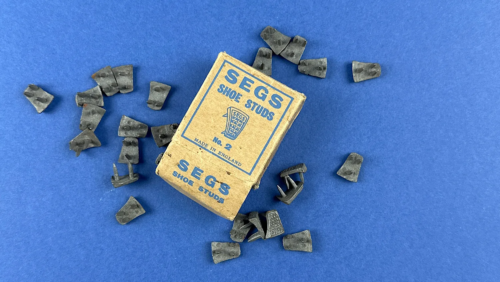
WW2 War Time Pack of Segs Shoe Studs (Home Front)
£18.00 SKU: 0113AThis is a genuine war time pack of segs shoe studs, complete with original box and 26 studs, made by Blakey’s. Shoe protectors known as ‘segs’ are still in use today, but during WW2 they were strongly encouraged, as leather was rationed from 1941 onwards. Fitting these small metal plates to the soles helped extend the life of shoes. They were hammered into place on the toe, heel, or heel corners, and were usually made from cast iron or steel. Each one in this box, has three spikes and a small design on the face of the stud (see pictures). The box itself does indeed have a dent and someone has, for some reason, decided to write “war time pack” next to the printed text. However, the other side is in excellent condition indeed, with no wear or marks. It also has a little picture of one of the segs, “Made in England” and a size reference; No. 2. A really interesting feature about this specific item is that the manufacturer (Blakey’s) chose to imprint “segs” as the main focus on the packaging, and not their own name. Why? Because throughout WW2 the term “segs” had entered everyday British vocabulary. Much like “Hoover” for vacuum cleaners. Blakey’s leaned into that recognition, using “Segs” as the headline and “Made by Blakey’s” as more of a mark of authenticity. Also, during WW2, companies were ordered to simplify packaging, forcing them to make things clearer instead of letting them focus on branding. This, dates this particular box to somewhere around 1942- mid 1944. The lid closes and opens just fine, though one of the ears has a rip, all the text on the outside of the box is perfect, sharp and bright as well. It’s a great little trinket, great for Home Front collectors and an interesting piece as it’s made by Blakey’s. -
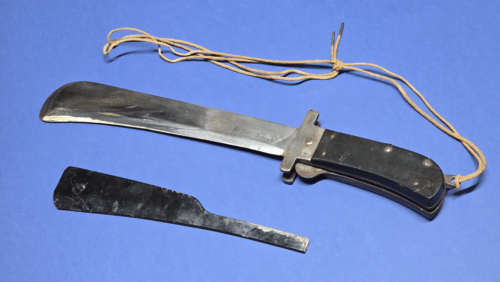
An original WW2 RAF Folding Survival Machete, manufactured by G. Butler & Co of Sheffield, England, and clearly dated 1945 beneath the Broad Arrow acceptance mark. These compact folding machetes were issued to Royal Air Force aircrews as part of their emergency survival kits during the latter stages of the Second World War. This one includes the scarce removable metal blade guard (often lost on surviving examples).
Blade:
The blade is very clean and bright, and features the distinctive forward curved single edge profile, designed for efficient cutting through dense vegetation or for general survival use. It is maker-marked G. Butler & Co, Sheffield on one side and Broad Arrow over 1945 on the reverse, confirming British military issue. The blade retains its correct wartime shape and shows light service wear, including sharpening and scratches, although, a lot better condition than we normally find these blades in. It folds correctly into the handle, with the locking catch mechanism working as it should.Grip & Fittings:
The grips are the correct black composite plates, secured by three rivets per side and showing only minor age wear. A Key identifying feature of the RAF variant is the lanyard loop fitted to the base, which remains present on this example, along with its cord strap. This loop was unique to the British design and allowed aircrew to secure the machete to their flight gear or survival pack.Summary:
Overall, this machete remains in very good used condition, showing light service use, but no real damage or repairs. An honest good example with all the correct wartime features present.Historical Note:
The U.S. AAF introduced a folding survival machete in 1942 for B-2/B-4 bailout kits, replacing the bulkier Collins Model 18. The RAF adopted the concept and contracted G. Butler & Co to produce a near-copy for British aircrew. Two practical British tweaks distinguish it from the American pattern. 1. Lanyard loop at the butt for securing to flight gear. 2. Issue with a separate metal blade guard.
We sell to the USA, Europe, and most worldwide destinations.
All items are securely packed for safe transit.