
Welcome to The Vault Militaria
Welcome to
The Vault Militaria
Authentic pieces. Timeless stories. Exceptional service.
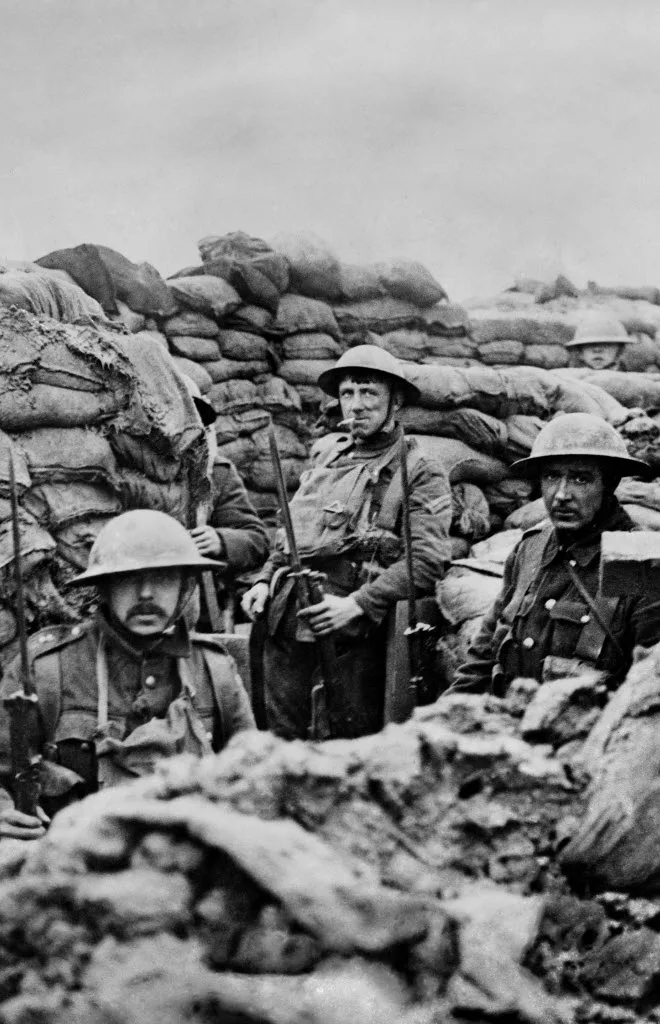
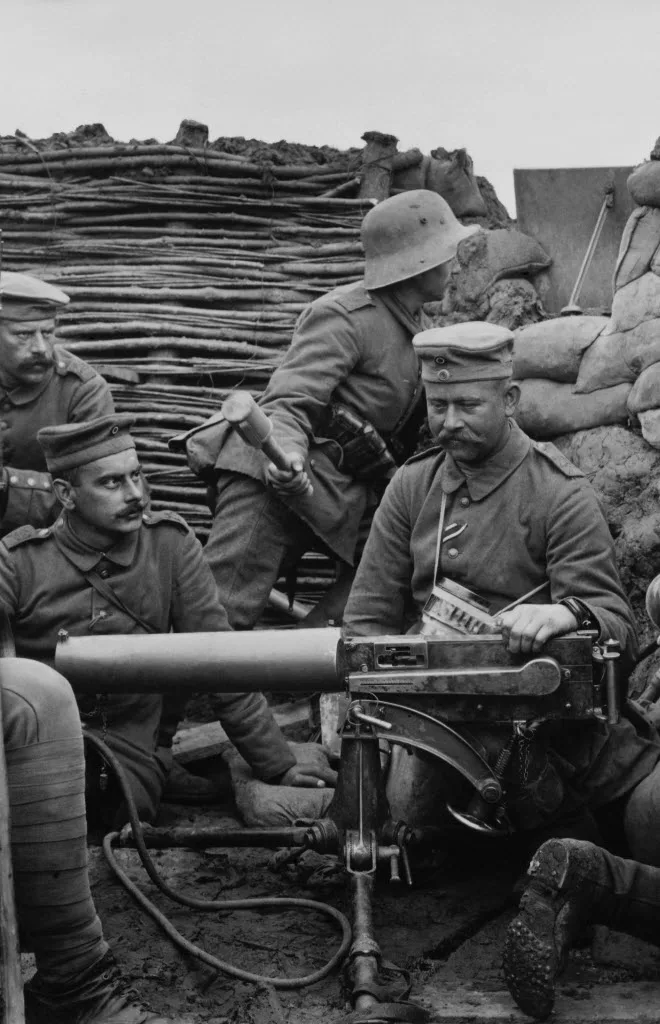
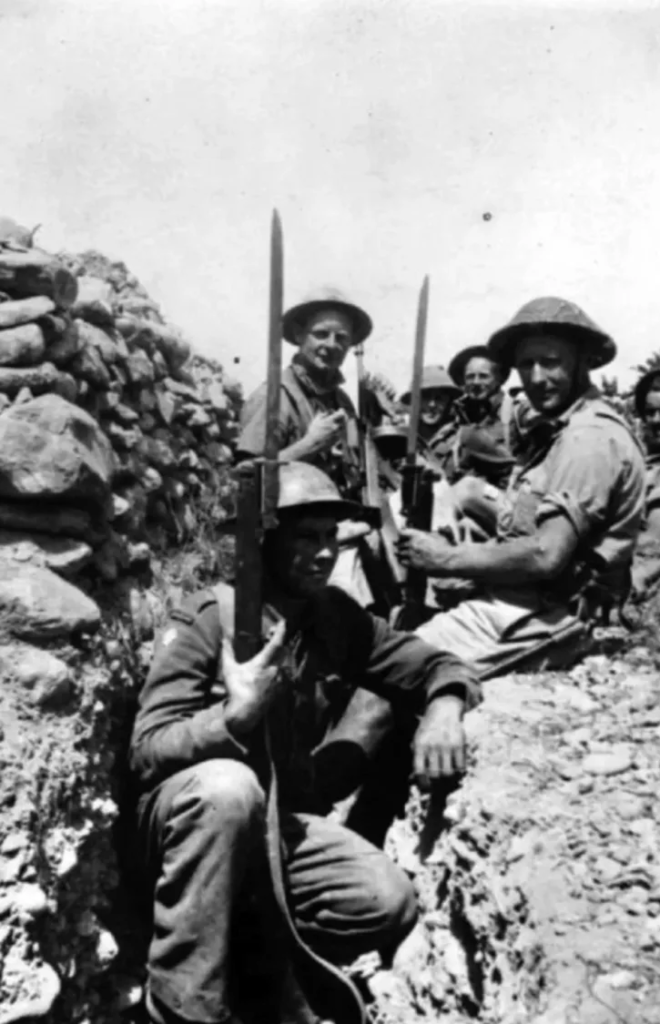
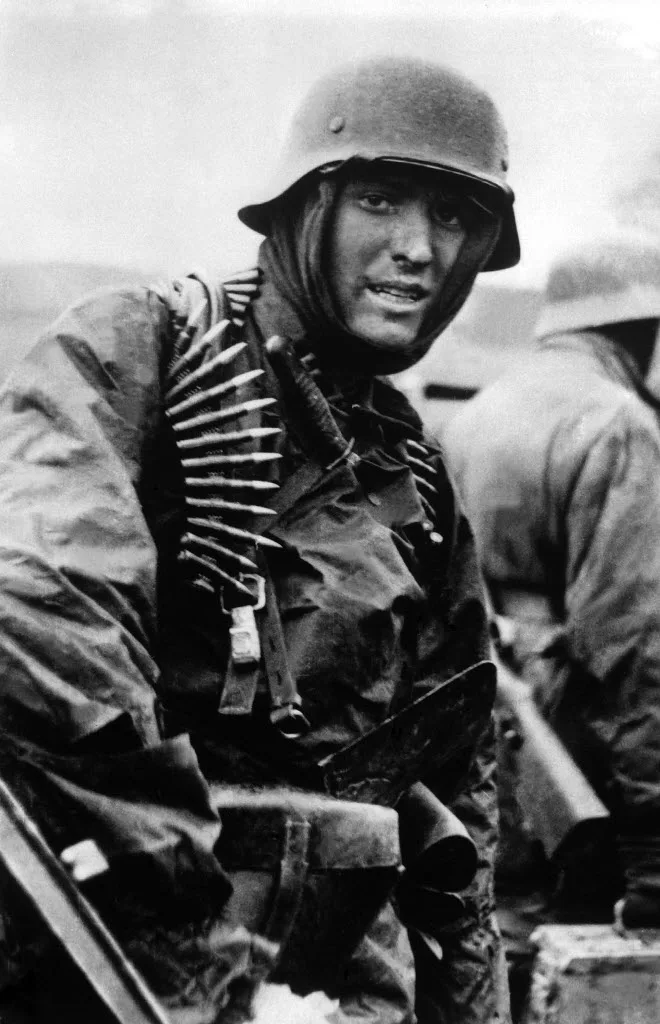
The Vault Militaria is the UK’s newest destination for authentic wartime memorabilia and collectables. Specialising in rare and hard-to-find items from World War I and World War II, we offer history enthusiasts and collectors a carefully curated selection of genuine artefacts.

new items every week
Rare finds
Our team of experts meticulously sources, authenticates, and catalogues each piece, ensuring that you receive only the finest quality items with verified provenance. And we’re adding more and more items on a regular basis.
From battle-worn uniforms and medals to vintage weapons, field equipment, and personal effects, The Vault Militaria brings you closer to the tangible remnants of wartime history.
knowledge & experience
We buy & sell
The founders of The Vault Militaria bring over 50 years of combined collecting experience to the table. They have a pair of keen eyes for the unusual together with an extensive knowledge of wartime collectables to ensure that every item offered is both authentic and exceptional.
With decades spent honing their expertise, they’ve developed an unparalleled ability to source and validate rare military artifacts, making The Vault Militaria a trusted name in the field.
Contact Mark on 07471 058445 or Andrew on 07944 609319
Contact Mark on 07471 058445
or Andrew on 07944 609319
Browse our latest items
-
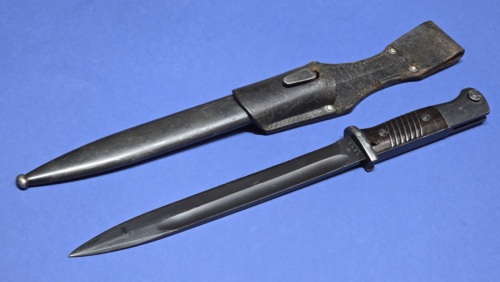
WW2 German K98 Bayonet – 1942 – E.& F. Horster – Matching Numbers – Frog
£295.00 SKU: 0320MHere we have a nice WW2 German K98 bayonet, matching numbers, dated 1942 and made by E. & F. Horster (ASW), complete with its frog. A good honest example throughout.Blade:
The unsharpened blade is in excellent overall condition, still holding around 95% of its original bluing. One side is marked 42 ASW (1942 - E. & F. Horster), and the other side carries the serial number 5844. The only small point worth mentioning is that the tip isn't quite as fine as we usually see on some examples.Hilt & Grips:
The bakelite grips are the darker type and remain in excellent condition, with no cracks or damage, and only the lightest signs of wear. Both screw bolts are present, and the flashguard is free from any indentations. The rifle-retaining button works exactly how it should, and the top of the hilt shows the usual two Waffenamt stamps.Scabbard:
The scabbard is nice and straight, showing no dents or damage. It shows areas of original bluing remaining, mixed with mostly light surface rust. The lower ball carries a further Waffenamt stamp, and the throat screw is present. The front is stamped with the matching serial number 5844, and the reverse shows 42 ASW. The blade fits the scabbard perfectly, as it should from a matching pair.Frog:
It comes with a late-war, crude K98 frog, completely original to the period. A very similar example is shown on page 234 of Roy William's book "A Collector's Guide to German Bayonet Belt Frogs, 1825-1945." These late-war frogs were put together quickly using previously-used leather parts, often showing wide, uneven stitching-and this one fits that description well. The small perforated holes around the front also match the reused-leather construction noted in the book. Despite the crude finish, the frog is structurally sound, with all four rivets in place.Overall:
A good honest 42 ASW matching-number K98 bayonet, that would display very well.Recommended Reference:
For collectors interested in German bayonet frogs and their construction, I highly recommend Roy William's "A Collector's Guide to German Bayonet Belt Frogs 1825-1945". It's one of the most detailed works on the subject. An excellent reference for identifying frog types, materials, stitching patterns, and makers.
We sell to the USA, Europe, and most worldwide destinations.
All items are securely packed for safe transit.
-
This charming original 1939 edition of the Brighter Blackout Book is a wonderfully characterful piece of early-war British Home Front history. Published at the very beginning of the conflict, when blackout regulations were first introduced and spirits were still adjusting to wartime life, it was created to bring humour, comfort, and light-hearted relief to households across the country. Packed with witty anecdotes, charming illustrations, puzzles, and gentle satire on everyday blackout challenges, it perfectly captures the mood of a nation learning to cope with nightly darkness, interrupted routines, and the uncertainty of the months ahead. Books like this were immensely popular during the early war years and today stand as a vivid reminder of the resourcefulness and resilience of the civilian population. This example retains its original boards and is complete throughout, offering an authentic feel in hand that modern reprints simply cannot replicate. For collectors of Home Front material, wartime printed items, or those building a display around ARP, blackout regulations, or wartime morale, this is a particularly evocative and desirable addition — a genuine slice of 1939 Britain preserved on the page. The spine is actually quite interesting. It is an original cloth strip spine. This type of simple cloth strip spine was typical of early-war ‘economy’ bindings, introduced by publishers in 1939–40 as paper, board, and binding materials were already being conserved for the war effort. Unfortunately but, understandably this does mean the spine doesn’t have the same rigidity as a more modern spine. However, it’s perfectly serviceable and none of the pages here in this book are at risk of falling out. The back cover, is looser than the front (see photos) however. The back of the cover is completely plain. Four pages in, there’s a date marking and some information. “First published in 1939” Though this doesn’t specifically date this book as 1939, there’s a clue in the back of the book which does. There’s a ‘donation form’ page in the back for the Daily Sketch War Relief Fund. After 1940, publishers stopped using this exact donation form and instead replaced by the Spitfire Fund (1940-41), Warship Week (1941 and Comforts for Troops Fund (1942 onwards). There’s also the Lady Kemsley reference. She chaired the fund in 1939 and early 1940 which strongly indicates it to be a late 1939 publication, or early 1940. Overall, this is a wonderfully evocative and early example of wartime morale literature, offering both historical interest and genuine charm. Its early 1939–40 features, complete condition and original economy binding make it an appealing addition to any Home Front or WW2 printed-material collection. A superb piece of period character with real display value.
-
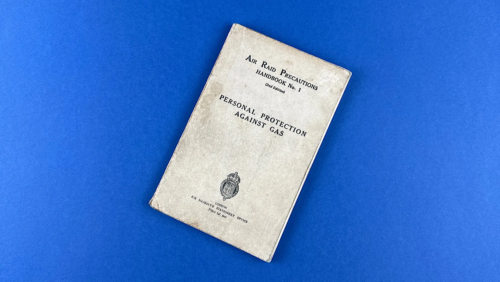
An authentic, 1938 dated, Pre-WW2 ARP Handbook No. 1 – Personal Protection Against Gas (2nd Edition, HMSO), issued during Britain’s growing fear of air raids and gas warfare, offering a detailed look at early civil defence planning. Printed before the outbreak of WW2, it sets out the government’s first formal instructions on recognising different gases, using civilian respirators, basic first aid, and decontamination procedures. A classic piece of British Home Front history, it reflects the widespread fear of chemical warfare that shaped civil defence policy throughout the late 1930s. These early editions are increasingly sought after by collectors, as they capture the development of ARP strategy before the mass-issue wartime versions were standardised in 1939. An ideal addition for collectors of ARP, civil defence, wartime ephemera, or pre-war British history, and a tangible reminder of the preparations made on the eve of conflict. Condition wise, it’s good. Not a single page has been dog-eared, the cover is not only intact but has no significant damage. There’s no staining and all pages are present. The only wear on it at all is on the inside of the spine. The glue holding the spine of the cover in place has failed (see photos). While no militaria collectible is in perfect condition, this one is in better condition than others we have seen.
-
WW1 German 98/05 Sawback Bayonet – Untouched Attic Find – Durkopp werke AG
£360.00 SKU: 0317MA Completely untouched attic find WW1 German 98/05 "Butcher" sawback bayonet. This is a bit of a time-capsule piece that has never been cleaned, polished, or interfered with. Every metal surface shows an even coating of surface rust from long-term storage in damp conditions, but beneath that you can actually see it has had very little use. This one is for collectors that are not chasing condition, and enjoy untouched as-found pieces.Blade:
The blade is the stand out feature here. Despite the exterior corrosion on the metal fittings and scabbard, the blade is surprisingly clean, showing that it has spent decades undisturbed inside the scabbard. The saw teeth remain sharp, and the blade forms a perfect sharp tip. There are also clear signs that someone has oiled the blade at some stage - the remnants of that oil have dried onto the surface. This would clean of easily if the next owner chooses to, but we never touch or clean any of our items. On the spine we have an inspection stamp but no date and no later acceptance stamp, indicating this one was never issued for active military service. The maker mark is the desirable Durkoppwerke AG (triangle logo) - far less common than big Solingen firms. The reverse ricasso shows a second maker impression that is extremely faint, with only partial letters visible. One plausible explanation is that the blade was produced and stamped by one firm, then sent to another location for assembly and final finishing where the secondary stamp was added - a known but less common practice.Hilt & Grips:
The hilt, crossguard and flashguard all show the same even surface rust as the rest of the exterior metal-work, consistent with long term damp storage. The wooden grips are in superb condition, showing very little wear. The wooden grip plates are secured by the original two screw bolts, and the rifle retaining button is functional. On the top of the hilt we see the usual inspection stamp.Scabbard:
The scabbard structure and shape is very good, although it's clear to see from the photos it is covered in surface rust, that matches the metal-work of the handle. On the rear of the scabbard, there are two indentations - they don't stand out and you have to look carefully to spot them. The throat shows no visible inspection stamps, with the scabbard throat screw being present. The blade fits the scabbard perfectly.Frog:
This bayonet is fitted with a frog, though not the usual wider, standard 98/05 type pattern. Instead, it's a smaller variant that has moulded itself firmly around the scabbard over many decades. At this point, removing it without causing damage would be extremely difficult. The leather shows heavy age-related wear, but it remains intact and structurally sound.Overall:
This is a completely untouched attic-find Durkoppwerke 98/05 sawback bayonet. The blade, hilt, scabbard and frog all show honest long-term storage age, rather than use, with even surface rust throughout and no modern cleaning. The whole piece has that genuine, unspoiled attic character.Reference Note:
For collectors getting into German bayonets, the book, (The German Bayonet 1898/1945) by Christian Mery is an excellent starting-point book. It offers clear coloured photos, maker information and explanations of the main variants - a great reference for identifying and understanding the 98/05 and other German bayonets.
We sell to the USA, Europe, and most worldwide destinations.
All items are securely packed for safe transit.
-
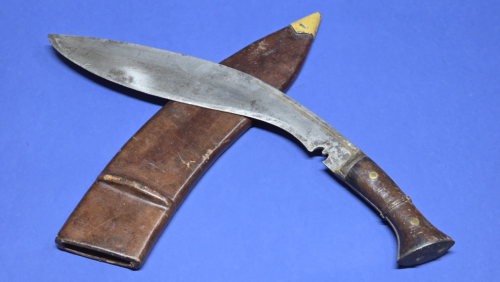
WW1 Pattern British-Indian MKII Kukri – M.E.C. Maker, Dated 1919
£275.00 SKU: 0316MA genuine British-Indian Army MKII kukri, built to the classic WW1 pattern and maker-stamped M.E.C. (Military Equipment Company). Although dated 1919, these kukris continued to see heavy service immediately after the First World War, during a very active period that included the Third Anglo-Afghan War and ongoing North-West Frontier operations. Production, issue and battlefield use carried on exactly as before, and pieces from this year show the same honest field wear as wartime examples. This kukri remains untouched and fully original.Blade:
The blade shows honest service wear typical of an issued MKII kukri, with scattered pitting from age and use. There are no modern sharpening, grinding or over-cleaning. There are clear military markings, including the M.E.C. maker stamp, number II stamp, indicating the MKII pattern, broad arrow with Indian Army inspector initials, and the date of production 1919. Just below the date sits the number "18" stamp - this is not a date, but almost certainly a batch or inspection number.Hilt & Grips
The hilt retains its original hardwood grips, showing small chips, knocks and handling wear that are completely in keeping with a kukri that saw genuine field use. The original two brass rivets are present, along with the pommel metal plate and tang rivets.Scabbard:
The scabbard is in excellent condition, made in the traditional leather over wood construction, with all stitching being intact and tight. The chape at the tip is present and secure, complete with its original staple. The blade fits the scabbard as it should.Historical Note:
The MKII kukri represents one of the most practical and long-lived edged weapons issued by the British-Indian Army. Introduced in the early 20th century, the pattern was designed not only as a close quarters fighting knife but also as an essential all purpose field tool. The MKII pattern became iconic largely because it was built to be used rather than admired, and surviving examples often show the same combination of practical wear, and military markings as seen on this piece.
We sell to the USA, Europe, and most worldwide destinations.
All items are securely packed for safe transit.
-
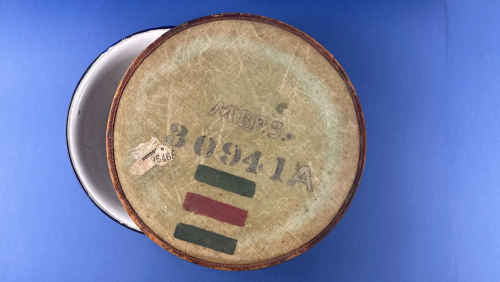
This is a WW2 era British officer’s enamel wash bowl, complete with its original leather-bound carrying case and distinctive hand-applied markings. It’s a fascinating piece with plenty of history - the kind of item that invites research and rewards close study. The case is of heavy leather and canvas construction with internal retaining loops for a brush or razor, showing the typical layout of a field hygiene or shaving set. The white enamel bowl with blue rim fits snugly within the case, as designed for portability in field conditions. The stencilled markings and painted bars are consistent with regimental or unit identification practices of the period, possibly relating to a Mobile Bath or Hygiene Section. It bears the marking “M.B.P.S.”, applied by hand, along with a stencilled serial number “30941A.” The letters do not appear to be a standard official marking, and are likely a unit or section-level property mark related to hygiene or support services - perhaps coined locally within the unit. The “A” differs in style and paint from the numerals, suggesting it was added later by hand, possibly when the kit was subdivided, reassigned, or denoted as an officer’s personal issue. Condition-wise, it’s very well preserved. The leather is soft and supple, the buckle functions perfectly, and all strap holes remain intact. The internal leather loops are firm and retain their shape — ideal for holding razors or brushes. The enamel bowl itself has expected wear with small areas of loss exposing the metal beneath, but no dents - remarkable given its age and use. Overall, this is a characterful and well-documented example of WW2 officer’s field equipment, rich in detail and with plenty of research potential for collectors of British campaign or hygiene gear.
-
WW2 German K98 Bayonet by Carl Eickhorn – Matching Numbers – Frog – 1940
£285.00 SKU: 0315MA very attractive matching numbers WW2 German K98 bayonet, produced in 1940 by COF, the wartime code for Carl Eickhorn of Solingen - arguably the most prominent edged-weapon manufacturer of the Third Reich period. This piece presents well, and has strong original bluing throughout. The only drawback is that the blade has been sharpened, which stops it from being graded as mint condition. Apart from this, it remains a desirable, clean example, complete with a 1939-dated frog.Blade:
The blade retains virtually all of its original bluing, with the serial number 9030 appearing on the front of the ricasso. On the reverse side we have the makers code COF, the wartime code for "Carl Eickhorn". In terms of condition, the blade would be mint, but it has been sharpened, and the tip shows a slight alteration from this sharpening.Hilt & Grips
Fitted with classic dark brown Bakelite grips, both undamaged and showing only minimal wear, held in place with the correct screw bolts. The rifle-retaining button functions perfectly, and the hilt displays excellent markings throughout, including the two usual Waffenamt inspection stamps on the pommel, an additional Waffenamt on the release button, and another Waffenamt positioned just above the flash-guard.Scabbard:
The scabbard is in excellent overall condition, showing only light wear and no dents or indentations, with the majority of its original wartime bluing still present - noticeable stronger on the front than the reverse. The front of the scabbard is marked with the matching serial number 9030, confirming this scabbard has always lived with the blade. The reverse is stamped COF, and dated 1940. The throat screw is remains present, and the blade fits the scabbard snugly as it should.Overall:
A very attractive, matching-numbers K98 from one of Solingen's premier makers, Carl Eickhorn (COF). The blade sharpening is the only condition issue, and that has been reflected in the price.Historical Note:
The K98 bayonet was designed as a multi-purpose combat tool for the German soldier, issued alongside the Karabiner 98K rifle throughout the Second World War. Beyond its role as a close-quarters fighting blade, its real day-to-day usefulness came from general field tasks - cutting brush, opening ammunition crates, clearing obstacles and basic utility work around camp.
We sell to the USA, Europe, and most worldwide destinations.
All items are securely packed for safe transit.
-
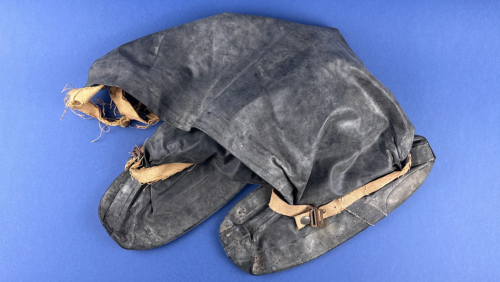
A genuine pair of 1942-dated British Army anti-gas overboots, constructed from rubberised canvas and marked with the War Department broad arrow and “W.A.D.” stamp. Manufactured by N.B.R.C. in February 1942, these overboots were designed to be worn over standard issue boots to protect against chemical agents in the field. Introduced in the early years of WW2, anti-gas overboots formed part of the British Army’s standard chemical warfare defence kit. Following fears of gas attacks similar to those experienced during WW1, all troops were issued protective equipment including respirators, anti-gas capes, gloves, and these rubberised overboots. Their purpose was to shield the wearer’s footwear and lower legs from blister agents such as mustard gas, which could contaminate soil and clothing. Constructed from heavy rubberised fabric with a textile lining and adjustable straps, this pair bears clear maker and inspection markings - N.B.R.C. FEB 1942 - along with the War Department broad arrow. The soles are textured for limited field use, and the materials retain much of their original finish despite minor age-related stiffening and wear. Overall, they remain in excellent condition, with clear markings throughout. The rubber is very supple, showing plenty of flexibility and life. While the straps display some fraying (common on unhemmed edges), all fastenings are intact, and even the soles are in fine condition (see photos). A scarce and authentic example of wartime British chemical protection equipment, these overboots make an excellent addition to any WWII militaria or Home Front collection.