
Welcome to The Vault Militaria
Welcome to
The Vault Militaria
Authentic pieces. Timeless stories. Exceptional service.
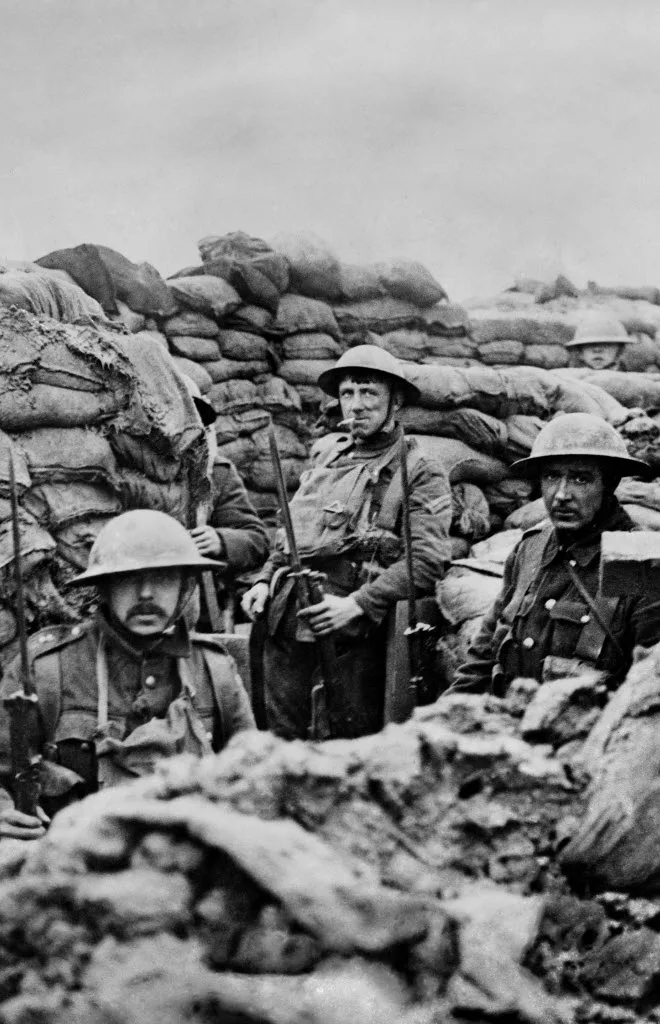
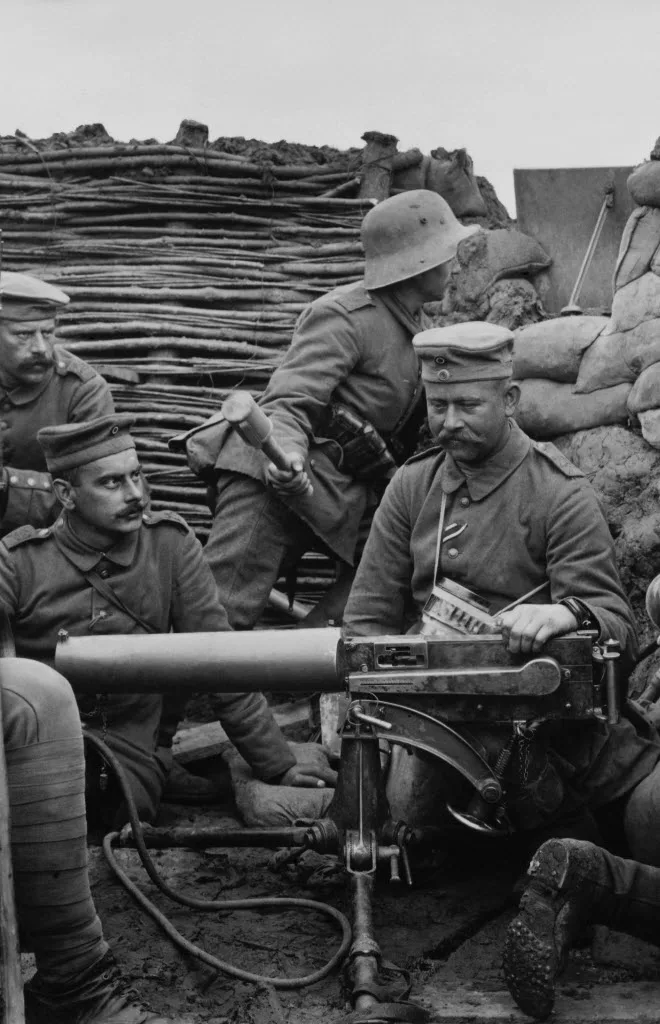
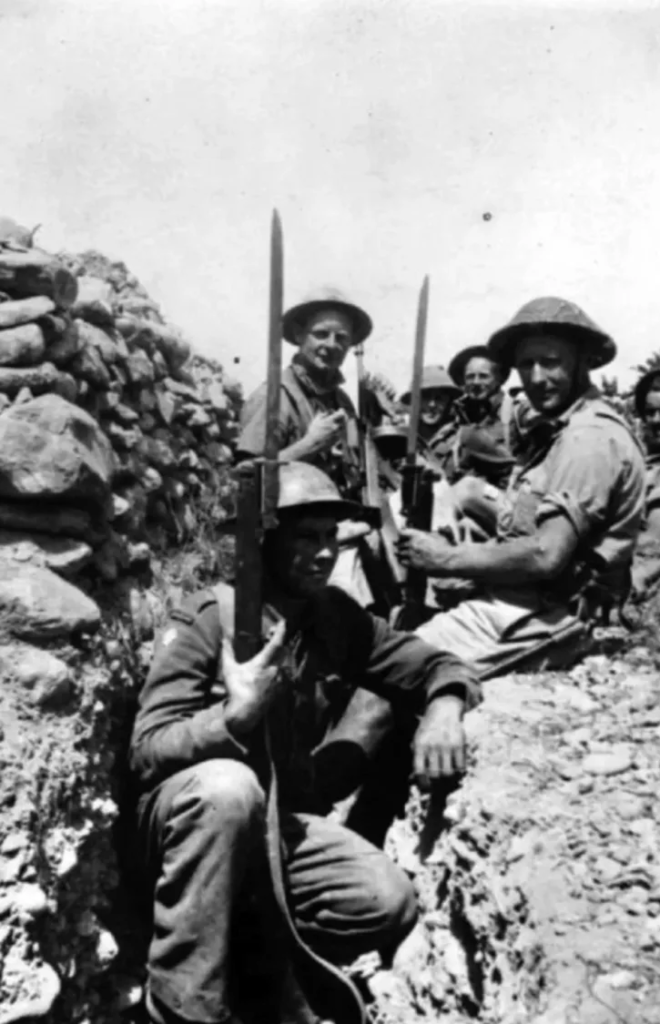
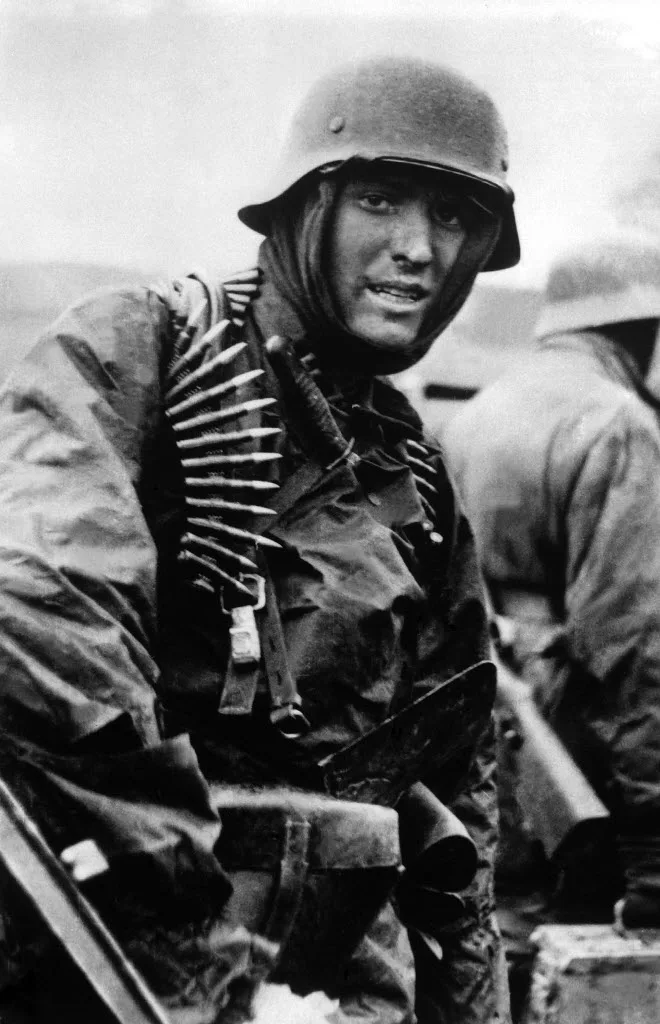
The Vault Militaria is the UK’s newest destination for authentic wartime memorabilia and collectables. Specialising in rare and hard-to-find items from World War I and World War II, we offer history enthusiasts and collectors a carefully curated selection of genuine artefacts.

new items every week
Rare finds
Our team of experts meticulously sources, authenticates, and catalogues each piece, ensuring that you receive only the finest quality items with verified provenance. And we’re adding more and more items on a regular basis.
From battle-worn uniforms and medals to vintage weapons, field equipment, and personal effects, The Vault Militaria brings you closer to the tangible remnants of wartime history.
knowledge & experience
We buy & sell
The founders of The Vault Militaria bring over 50 years of combined collecting experience to the table. They have a pair of keen eyes for the unusual together with an extensive knowledge of wartime collectables to ensure that every item offered is both authentic and exceptional.
With decades spent honing their expertise, they’ve developed an unparalleled ability to source and validate rare military artifacts, making The Vault Militaria a trusted name in the field.
Contact Mark on 07471 058445 or Andrew on 07944 609319
Contact Mark on 07471 058445
or Andrew on 07944 609319
Browse our latest items
-
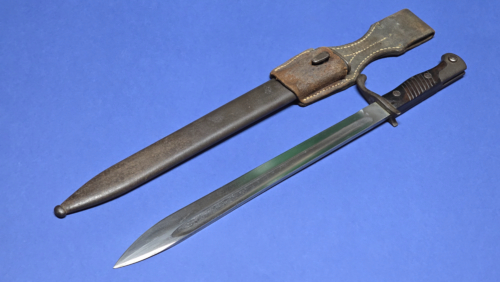
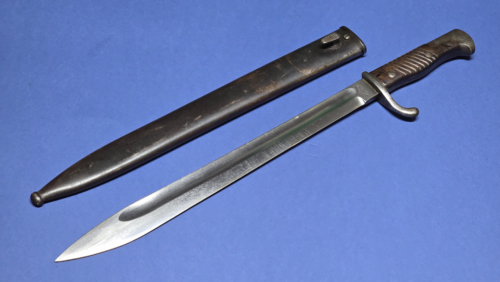
WW1 German 98/05 Bayonet – Early High Ears, Unusual Unmarked Example
£230.00 SKU: 0286MThis is a very interesting example of the German Model 98/05 Bayonet, the early pattern fitted with the tall high-ears crossguard. Collectors often refer to this model as the "Butcher Bayonet" because of its distinctive wide, cleaver-like blade profile. The blade is nice and bright, and in excellent condition. Strikingly, it is completely void of a maker's mark, date, or military acceptance stamps, carrying only a small "94" on the ricasso. This strongly suggests two possibilities: either it was a private purchase example, acquired outside the normal government contract and acceptance system, or it may have been one of the many bayonets sent for post-war refurbishment, during which original markings could of been removed before reissue. In this case, the "94" would be the new reissue number added post-war. The dark wooden grips are undamaged and in very good condition, with the rifle retaining button being fully functional. The metal fittings on the crossguard and pommel match perfectly with the finish of the steel scabbard, showing that these two pieces have always lived together. The blade also fits the scabbard exactly as it should.. The scabbard itself is undented, though it does show service wear and light pitting, and once again, no acceptance stamps are present on the throat or lower ball, where they would be normally found. To finish the bayonet off, it is accompanied by an original 98/05 leather frog, which shows considerable wear from use, including a split at the front where it passes through the scabbard lug. However, all stitching and rivets remain intact and strong. Overall, this is a tidy and very collectable 98/05 bayonet.
We sell to the USA, Europe, and most worldwide destinations.
All items are securely packed for safe transit.
-
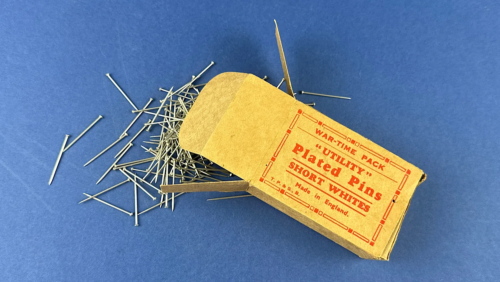
WW2 War-Time Plated Pins Pack
£20.00 SKU: 0091ADuring WW2, almost everything was rationed, even pins. This war-time pack of plated pins contains pins for tailoring and/ or dress making but rather than being made out of nickel, they were often made out of steel, with a thin tin or zinc plating. Nickel was in short supply, and manufacturers had to conform to ‘utility’ standards and demands because nickel was used for munitions and also, on aircraft. This pack, a simple cardboard box full of pins is in excellent condition overall. It has general wear of course, but considering it’s thin cardboard and is so old, the condition is impressive. It’s full of wartime pins, made using wartime standards. It’s a nice, neat, small box that fits great into a home front collection because the label on the front is printed, not just a sticker. It’s nice and bold, clear and easy to read. PLEASE NOTE: If you plan on opening this box, be VERY VERY careful in doing so as these kind of boxes easily rip if you don’t know how to open them with great care. Remember, the cardboard here is over 80 years old. -
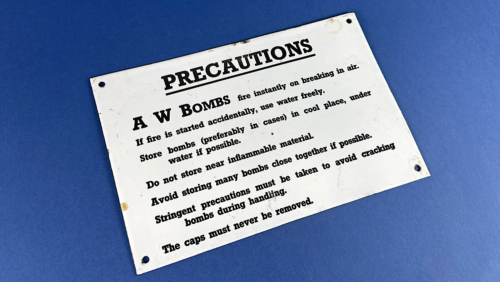
WW2 ARP A W (incendiary) Bomb Precaution Sign
£90.00 SKU: 0090A“A W” stands for ‘Ariel Weapon’ and this term was used before ‘incendiary’ was adopted. In WW2, the ARP put up these precaution signs in factories, shelters and public buildings because they thought people would get confused about what to do when encountering one of these devices. This particular sign came from a factory, rather than a shelter. This is obvious from the wording on the sign itself. With a hole in each corner, this sign was screwed to a wall and retains excellent condition, with only minor marks on the front and rear. Something you can’t tell from the pictures is that it’s made out of sheet metal – making it flat, durable but on the heavier side, almost a kilo and considering it’s 12 x 8 inches in size it gives you some sense of feel for it. These signs also give you an idea of the feel of things in factories during WW2. The fact these signs were posted up with precautions served as a reminder that workers were dealing with some VERY dangerous items. -
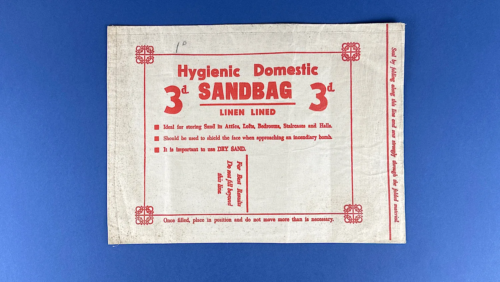
WW2 Domestic Sandbag
£50.00 SKU: 0088ADuring WW2, from 1939 onwards the British government advised householders to take ARP precautions at home. Thee sandbags were used to take some of the blast from bombs and people were advised to put them in windows and doorways, not forgetting, entrances to shelters. These differ from standard military sandbags as they are made of a softer material (canvas) and linen lined. Military bags are typically made from hessian. This made them ‘cleaner’ for use in the home hence the labelling on them as “hygienic”. “Hygienic” was a very wartime marketing word, reassuring families that they were buying something suitable for the home, not just a rough army cast-off. Also, shock from blasts would cause hessian (jute) to let off fibres that if inhaled, could aggravate and irritate the respiratory system. This one here is unused, and well preserved. All lettering is nice and clear with only very minor spotting/ marking on the material. None of the stitching has frayed or been damaged and the outer canvas is overall, in an excellent condition. We don’t see too many of these sandbags because, not surprisingly, most were used. So it’s rare to see one that’s survived, unused, for this long. Additionally, it’s an interesting piece for any home front collector. -
WW1 German 98/05 “Butcher” Bayonet by Alex Coppel – 1915
£195.00 SKU: 0281MThis is an excellent example of the iconic German WW1 98/05 bayonet, often referred to by collectors as the "butcher bayonet." The bright clean blade is in superb condition, coming to a fine sharp tip. It is clearly maker-marked "Alex Coppel, Solingen" - one of the prolific and highly regarded Solingen manufacturers of the period. The spine bears the crown over a "W", the date 15 (1915), along with an inspection stamp, confirming its wartime issue. The wooden grips remain in excellent condition, showing no damage, and are firmly secured by two screw bolts. The rifle retaining button is fully functional and also bears an inspection stamp, with two additional inspection marks to the top of the pommel. The scabbard is undented and in superb condition, still retaining the majority of its original bluing. The throat screw is present, and further inspection marks can be found both at the throat and lower scabbard ball. The blade fits the scabbard perfectly. Overall, this is a fine condition WW1 German 98/05 Bayonet.
We sell to the USA, Europe, and most worldwide destinations.
All items are securely packed for safe transit.
-
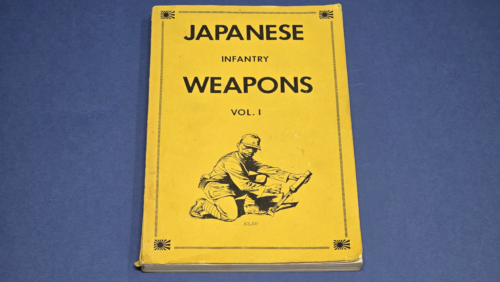
Japanese Infantry Weapons – Vol. 1 (1973) Fourth Printing.
£40.00 SKU: 0279MA scarce reference volume from the respected Combat Bookshelf series, published by Normount Technical Publications in Wickenburg, Arizona. An authoritative reference with over 240 pages based on declassified National Archives documents, covering the small arms and ordnance of the Imperial Japanese Army. Includes rifles, pistols, submachine guns, grenades, mortars, and other infantry weapons, supported by line illustrations and technical data. An essential tool for collectors of WW2 Japanese militaria. -
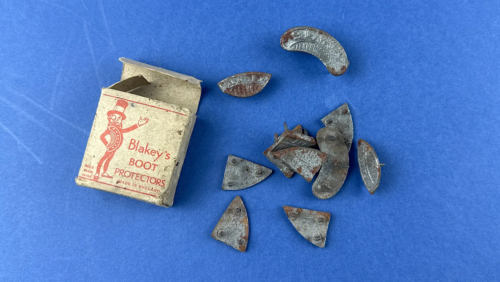
WW2 Blakey’s Boot Protectors (wartime)
£22.00 SKU: 0086ABlakey’s (or Segs) boot protectors are still used today but were advised during WW2 because as the war progressed, leather became rationed (from 1941). By using these, one could prolong the life of the soles of their shoes. They were hammered in place, and applied to the toe, heel, and corners of the heel. They were typically made out of cast iron, or steel and came in a variety of shapes. Notably, triangular, half moon and round, and would come as you can see here, in a small cardboard box. Inside the box, is an assortment of different shapes and. For the toe of the shoe, the corners of the heel, and the heel itself. The box certainly shows some signs of wear but being made of only thin cardboard we think it’s held up rather well. This box is also marked as a “wartime pack”. Each boot or shoe protector also has wording on it, and a little design to go with it as well. -
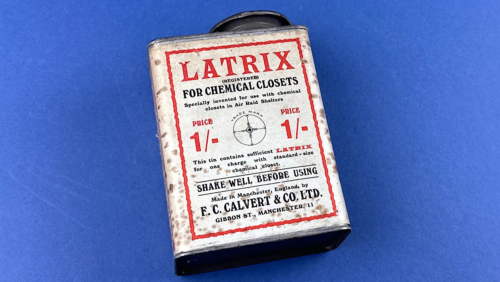
WW2 Latrix Chemical Closet Disinfectant (Anderson Shelter)
£55.00 SKU: 0081ALatrix, was one of the most famous companies that made chemicals for cleaning indoor toilets (closet), also, toilets that were not connected to a sewage system. Mainly used in Anderson shelters and temporary housing during WW2. It was produced by F.C.Calvert & Co. Ltd on Gibbon Street in Manchester until 1965 when the company was taken over by Unilever! This can, is full metal, complete with original seal (you can see in the photos where it’s been welded near the cap), cap AND contents! It has never been opened, and the contents inside slosh when the can is shaken. Even after all these years it hasn’t leaked, and the can hasn’t been dented or split in anyway. The label certainly has some marks on it, and the underside and topside of the can are tarnished, as is the cap. But not rusted. The label, aside from a few spots, has a very small tear on one side at the bottom and any other notable marks have been clearly photographed for you to see. Overall, this is a very interesting piece of home front WW2 history, from a company that no longer exists. The most interesting feature is that this can has never been opened, and doesn’t have a SINGLE dent, even on the base.