Welcome to The Vault Militaria
Welcome to
The Vault Militaria
Authentic pieces. Timeless stories. Exceptional service.
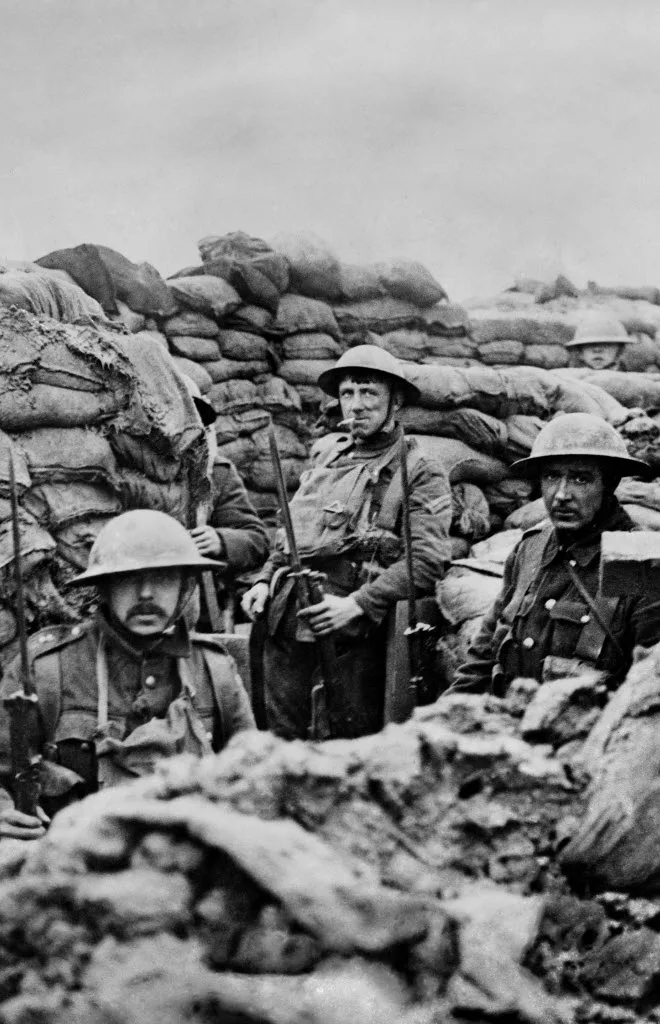
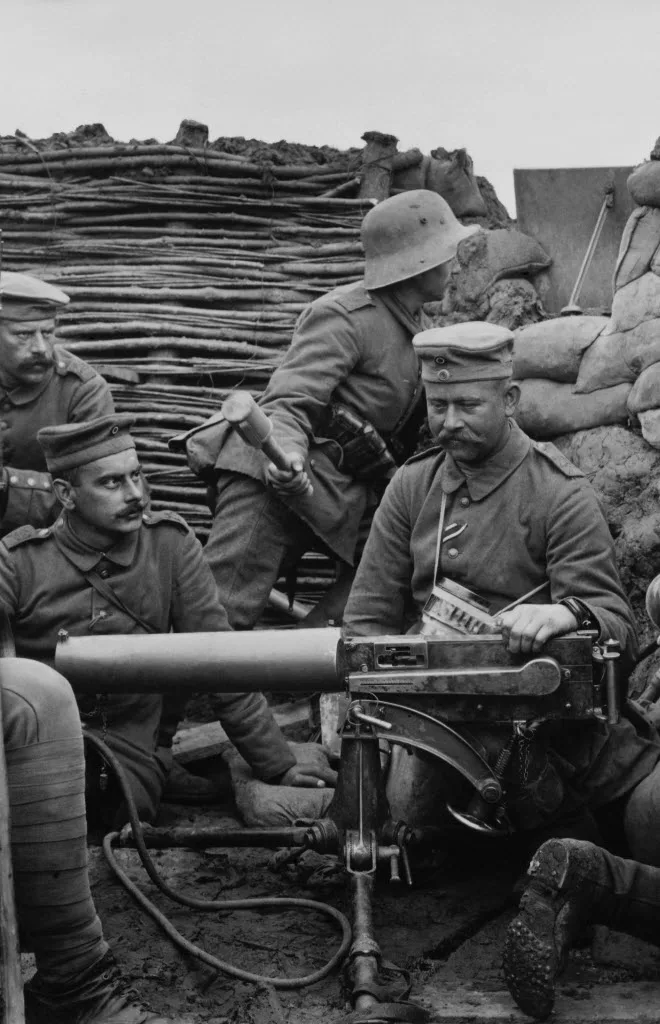
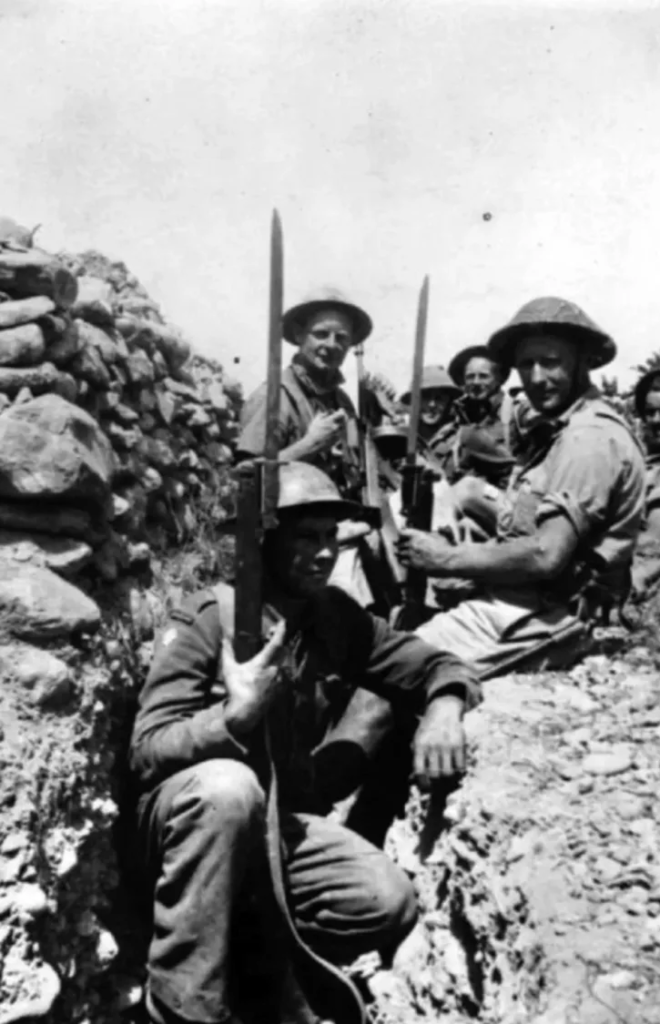
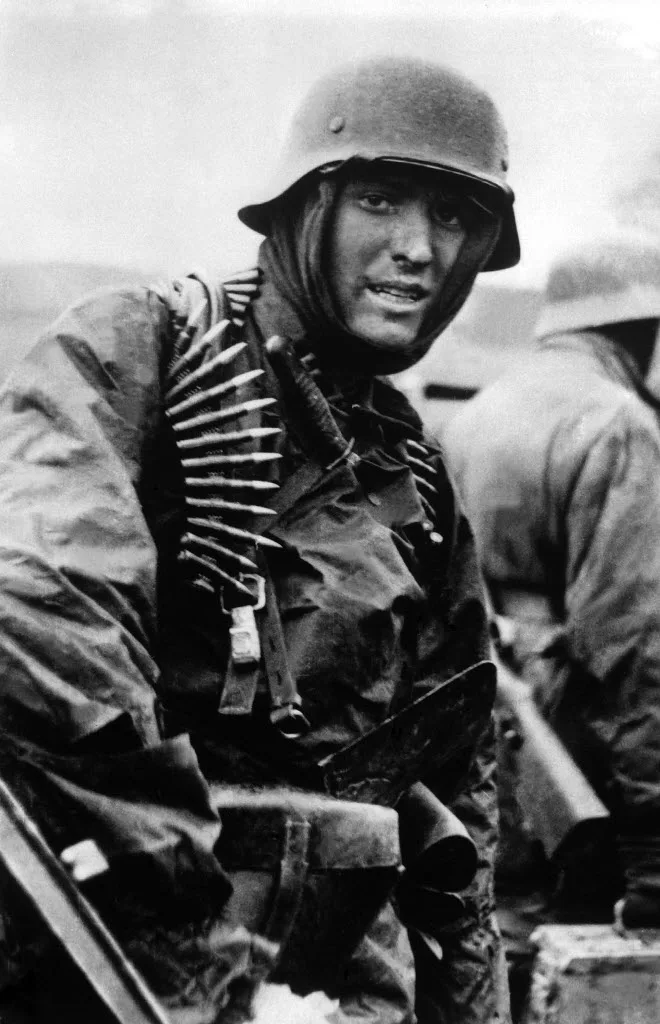
The Vault Militaria is the UK’s newest destination for authentic wartime memorabilia and collectables. Specialising in rare and hard-to-find items from World War I and World War II, we offer history enthusiasts and collectors a carefully curated selection of genuine artefacts.

new items every week
Rare finds
Our team of experts meticulously sources, authenticates, and catalogues each piece, ensuring that you receive only the finest quality items with verified provenance. And we’re adding more and more items on a regular basis.
From battle-worn uniforms and medals to vintage weapons, field equipment, and personal effects, The Vault Militaria brings you closer to the tangible remnants of wartime history.
knowledge & experience
We buy & sell
The founders of The Vault Militaria bring over 50 years of combined collecting experience to the table. They have a pair of keen eyes for the unusual together with an extensive knowledge of wartime collectables to ensure that every item offered is both authentic and exceptional.
With decades spent honing their expertise, they’ve developed an unparalleled ability to source and validate rare military artifacts, making The Vault Militaria a trusted name in the field.
Contact Mark on 07471 058445 or Andrew on 07944 609319
Contact Mark on 07471 058445
or Andrew on 07944 609319
Browse our latest items
-
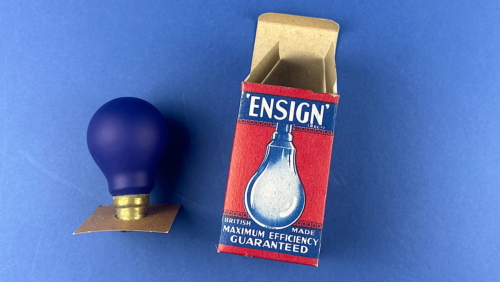
WW2 Ensign Blue Blackout Bulb
£25.00 SKU: 0085AThis WW2 Ensign blue blackout bulb and many others like it during the war were a crucial part of surviving air raids and bombs. They provided a small, dim and in some cases, downward facing or directional light – bright enough to be able to move around in a room. This particular one is blue, and comes in its original box with original cardboard stabiliser which has clearly never been removed. There are no bends, warping marks or perforations on it at all so this was clearly set in the factory, and has never been removed. Also, upon lightly shaking this bulb, you hear silence. Meaning, the filament on the inside is still intact. We have not, and would not test it due to a risk of damaging such an old filament. There’s an ‘opening’ at the end of the bulb, where the light could be directed downwards which is typical of these bulbs. The bulb appears to be in perfect condition, and the box has only VERY minor wear marks which is perfectly acceptable considering it’s made out of cardboard, and is from WW2. All original packaging is present, including the cardboard fitting stabiliser, the corrugated packing and tissue paper as well. A lovely piece in excellent condition that will fit nicely into any Home Front collection and also mark an important aspect of the war effort. -
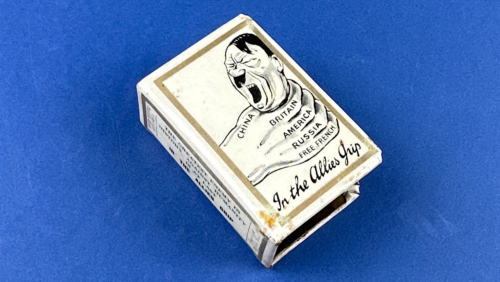
WW2 Adolf Hitler Matchbox Cover
£70.00 SKU: 0084AThis WW2 Adolf Hitler matchbox cover has the same overall design and purpose as others that are similar. Made from the same materials, however this one obviously has a cartoon of Hitler on the front, AND a quote from Mussolini on the back too. The design on the front depicts Hitler being gripped by a hand, labelled with the allied countries. These were used as propaganda during the war, even when things were not going so well for the allies to help keep moral up. On the spine, an insightful message reads: “The greatest enemy in history against humanity is at last in the allies grip” This is a beautiful piece of propaganda that really hits you and gives you an idea of the importance of this sort of material back in WW2. The back has another interesting message from Mussolini (see pictures) and the overall tone here is one of Mussolini telling his friend, Hitler, that things are not going well for them. A simple matchbox cover, oozing with propaganda and is so telling of the mood back during the 1940’s. This specific cover does indeed have some light marks on it which is typical for these covers. However, the picture on the front, all the text, and the corners are all in fantastic condition. All too often these covers, being made of tin or other light materials get bent out of shape quite easily, this one, is still square and clearly has never been damaged so, it’s quite a prized find considering it’s not just Hitler, but also a mention of Mussolini on the back too. -
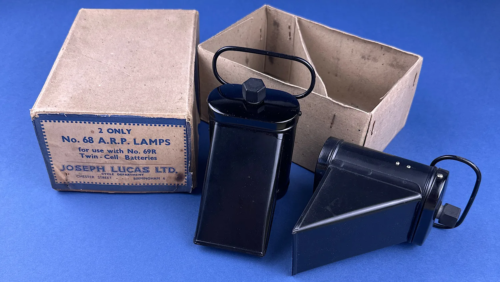
WW2 No. 68 ARP Bicycle Lamps
£85.00 SKU: 0083AThe No. 68 ARP Lamp was a battery-powered, hooded lamp issued to ARP (Air Raid Precautions) wardens and Civil Defence personnel during WWII. It was specifically designed to provide downward-directed light for use during blackouts, minimizing the risk of detection by enemy aircraft. The hood prevented light from escaping upward or outward. It is often referred to as a “hooded bicycle lamp” due to its shape and mounting similarities. They were introduced around 1039 – 1940, and provided a crucial, downward and stealthy way to project light. The pair here, come in their original cardboard box marked with original sticker and maker; Joseph Lucas Ltd. The box itself is in good condition, with minor staining on the inside but overall is in surprisingly good condition. Cardboard boxes from this era usually don’t last as well. The lamps themselves look almost brand new. One has a tiny mark and a chip, and they both have a TINY bit of rust on the handles (see photos). Each one is also marked on the base with the maker and also “Birmingham” which is also marked on the box. Even the bulbs are still intact! Two lovely pieces, in almost new condition in a well looked after box showing minimal wear. A great find for any Home Front collection. -
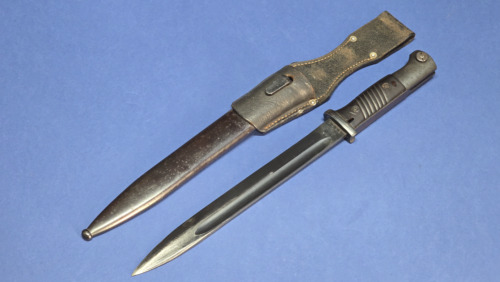
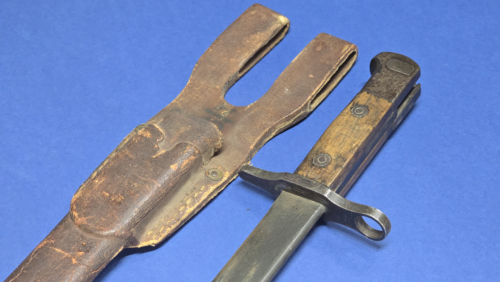
WW2 German K98 Bayonet & Frog (near mint blade)
£210.00 SKU: 0275MThis is a great example of a German K98 bayonet, dated 1943 and made by Paul Weyersberg of Solingen. The dark bakelite grips are in excellent condition with no cracks or chips, and held firmly in place by the original two screw bolts. The pommel displays a waffenamt stamp, along with a fully functioning rifle retaining button, while the crossguard and flashguard retain much of their original bluing. The blade is in superb condition, unsharpened, and retains around 95% of its original bluing, forming a good sharp tip. The blade is numbered on the ricasso "9252", while the reverse side is stamped "43 CRS", with 43 denoting the year of manufacturer "1943" and CRS identifying the maker "Paul Weyersberg". The scabbard is also in very good condition, retaining around 90% of its original bluing remaining. The scabbard throat screw is present and a further Waffenamt stamp can be found on the lower ball of the scabbard. There are two very minor indentations to the reverse scabbard (see photos). The scabbard is numbered "2886", and dated "41" to the reverse. Finally, the bayonet is fitted with the correct K98 leather frog, which is undamaged and in good condition, with all four rivets in place. The frog is maker marked, though the stamping has faded with age, making it hard to read. Overall, a great blade that fits the scabbard perfectly.
We sell to the USA, Europe, and most worldwide destinations.
All items are securely packed for safe transit.
-
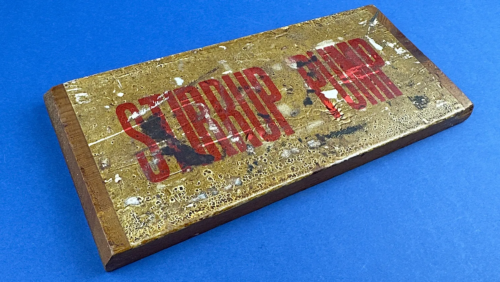
WW2 Stirrup Pump Sign
£50.00 SKU: 0082AA stirrup pump is a small, manually-operated water pump invented before WW2 but mass-produced during the war. It got its name from the metal stirrup-shaped footplate at the base. The user placed a foot in the stirrup to steady the pump while operating the handle. It was a two-person operated piece of equipment. Typically, one person pumping, the other directing the flow of water from a bucket, or other water container source. They were used to pump water, to put out fires and could pump out four to five litres of water a minute. These signs, (often handmade, but mostly mass-produced) were lifesavers because during a panic, people need CLEAR labels and instructions. We all know what a Fire Exit sign looks like, these worked in a similar fashion, letting people know where the pump was located. This one here looks to have been reused. Four holes on the back, and some light filler on the front suggests it was once nailed to a wall, taken off and put somewhere else. The writing in red on the front is clearly visible and more than readable, though the entire face of this sign has some wear on it. Made out of wood, (which suggests it was used in a small factory) it offers a clear indication and is one of those pieces that’s interesting because people often ask, “what is a stirrup pump?”. It’s a lovely piece of home front ARP history. -
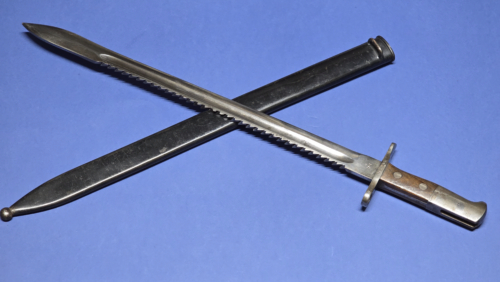
WW1 Swiss Model 1914 Sawback Bayonet (HS Marked)
£295.00 SKU: 0273MA scarce Swiss Model 1914 sawback bayonet, manufactured by Hans Steiner of Wimmis, Switzerland, and issued with the famous Schmidt-Rubin rifles, renowned for their precision and unique action. This impressive WW1 Swiss bayonet features the classic long 480mm blade, designed with a fuller positioned on the right side only. The spine carries 32 pairs of sharp sawback teeth, intended for use by pioneer and engineer troops for cutting wood and bush in the field. The blade has been sharpened and shows some wear along its edge. The ricasso is stamped the the Swiss cross above "HS" (Hans Steiner). The crossguard carries the serial number 42065, which would have been originally paired with a Schmidt-Rubin service rifle. The wooden walnut grips remain in excellent condition, secured by two rivets, with a bird's-head pommel, and working rifle retaining button. The undented scabbard is in excellent condition and retains over 90% of its original black factory paint. It also bears three additional markings, including a Swiss cross on the lower ball and two inspection stamps, one being on the throat of the scabbard. This is a very impressive bayonet, that I feel gives good value for the money.We sell to the USA, Europe, and most worldwide destinations.
All items are securely packed for safe transit.
-
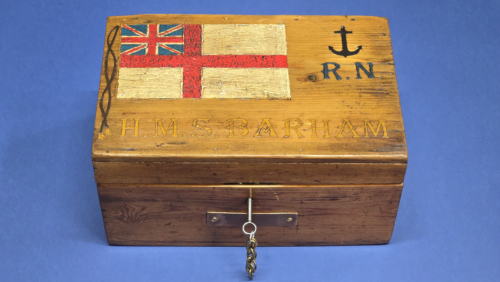
WW2 Royal Navy Sailor’s Wooden Ditty Box – HMS Barham
£225.00 SKU: 0271MA fine Royal Navy sailor's ditty box, personalised to HMS Barham, one of the most famous British battleships of WW2. The lid features a hand-painted White Ensign with Union Jack, anchor, and the initials "R.N." (Royal Navy), together with the ship's name. Inside are some personal items, including a stencilled cloth bag, a postcard of the battleship, tins, bottles, and other small items, giving a sense of a sailor's life. The box is of excellent overall quality, dovetail-jointed with a working lock and key. The box shows honest age but remains in superb condition. Historical note: HMS Barham, a Queen Elizabeth-class battleship, was tragically sunk by U-331 in November 1941 with the loss of over 800 men. Her destruction was captured on film by a naval cameraman, making her one of the most remembered ships of the war. -
An original WW2 Japanese Type 30 Navy Special bayonet, one of the scarcer variations produced for use with the Japanese Navy Special Type 99 rifle It features a straight guard, flat birdhead pommel, and undamaged straight wooden grips, fitted to a fuller-less blade with a false edge along the spine. The bayonet has no manufacturer's markings or serial numbers, which is correct for this late-war Navy contract pattern. The blade is in excellent condition, showing no signs of use and still retaining its original wartime finish. Of particular note is the rubberized scabbard and frog, a feature unique to Navy-issue bayonets and a clear sign of late-war production, when steel shortages forced the Japanese to adopt substitute materials. This example shows age, but remains in very sound condition. Adding further appeal, is the hand applied Japanese writing on the front of the scabbard, (see photos) most likely a soldier's name or unit mark, giving this piece a possibility of further research. Great example of a scarce bayonet
We sell to the USA, Europe, and most worldwide destinations.
All items are securely packed for safe transit.