
Welcome to The Vault Militaria
Welcome to
The Vault Militaria
Authentic pieces. Timeless stories. Exceptional service.
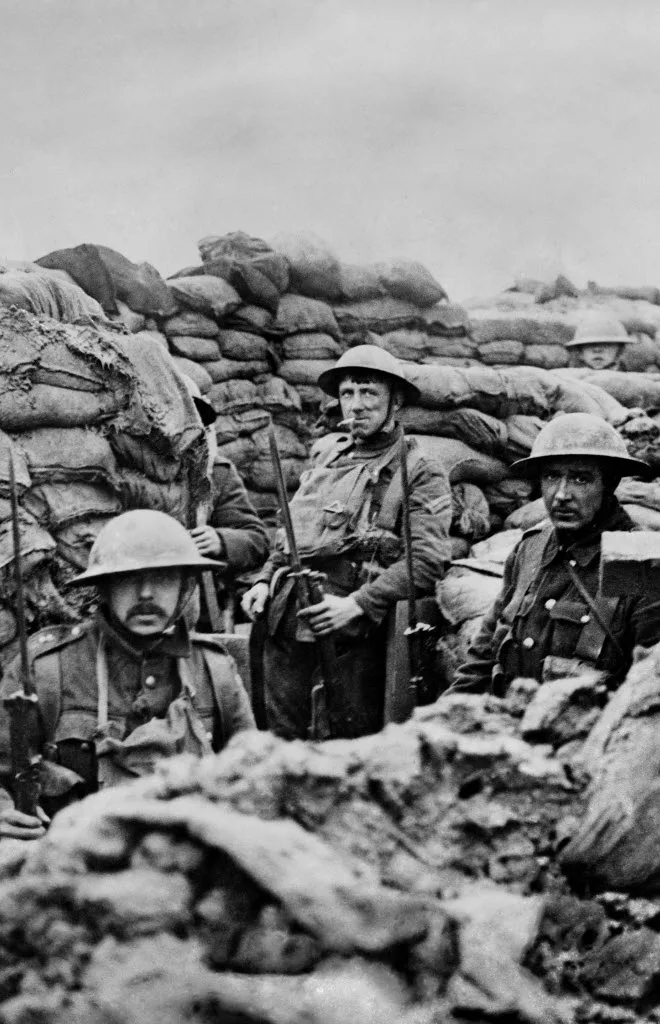
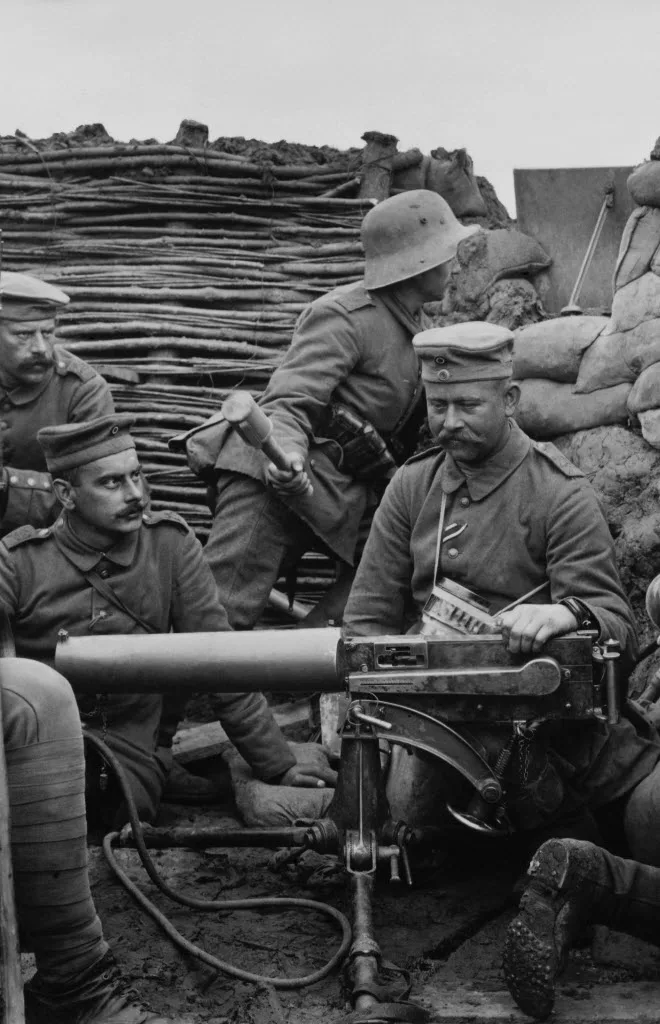
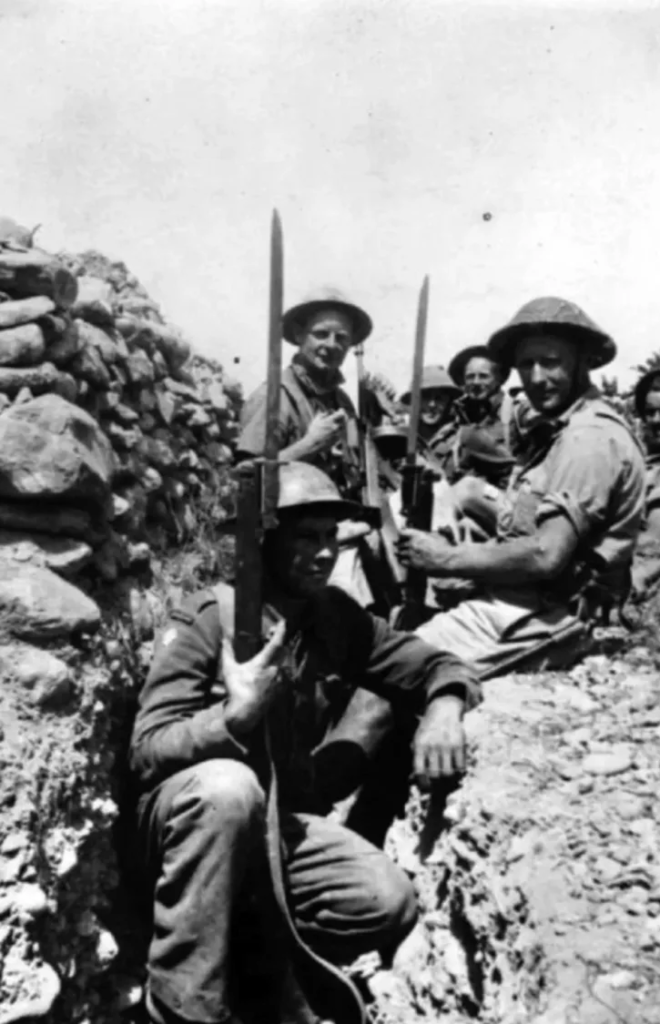
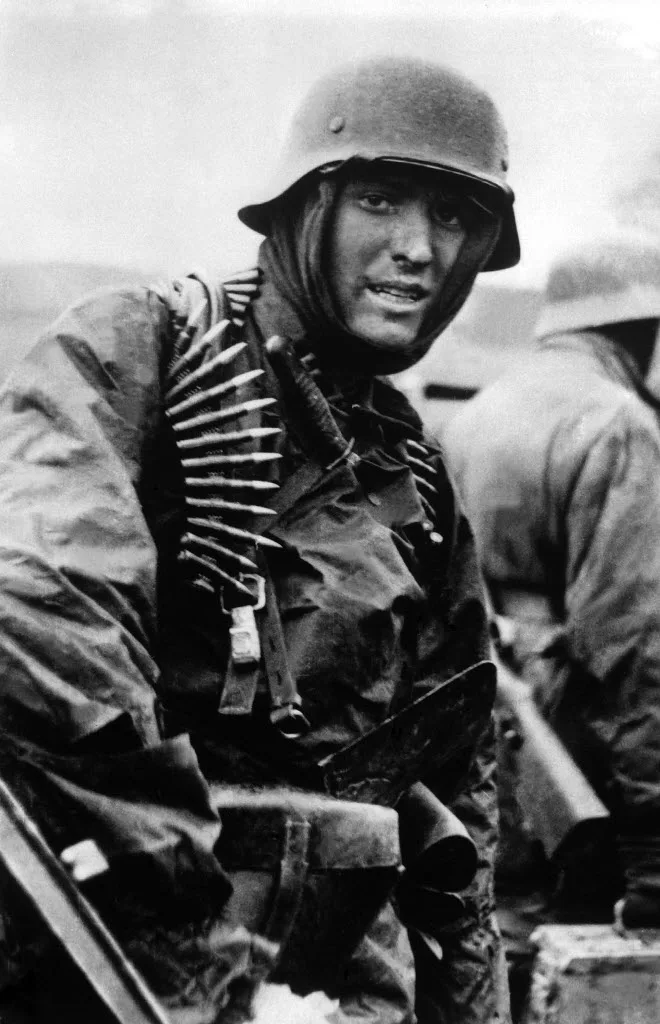
The Vault Militaria is the UK’s newest destination for authentic wartime memorabilia and collectables. Specialising in rare and hard-to-find items from World War I and World War II, we offer history enthusiasts and collectors a carefully curated selection of genuine artefacts.

new items every week
Rare finds
Our team of experts meticulously sources, authenticates, and catalogues each piece, ensuring that you receive only the finest quality items with verified provenance. And we’re adding more and more items on a regular basis.
From battle-worn uniforms and medals to vintage weapons, field equipment, and personal effects, The Vault Militaria brings you closer to the tangible remnants of wartime history.
knowledge & experience
We buy & sell
The founders of The Vault Militaria bring over 50 years of combined collecting experience to the table. They have a pair of keen eyes for the unusual together with an extensive knowledge of wartime collectables to ensure that every item offered is both authentic and exceptional.
With decades spent honing their expertise, they’ve developed an unparalleled ability to source and validate rare military artifacts, making The Vault Militaria a trusted name in the field.
Contact Mark on 07471 058445 or Andrew on 07944 609319
Contact Mark on 07471 058445
or Andrew on 07944 609319
Browse our latest items
-
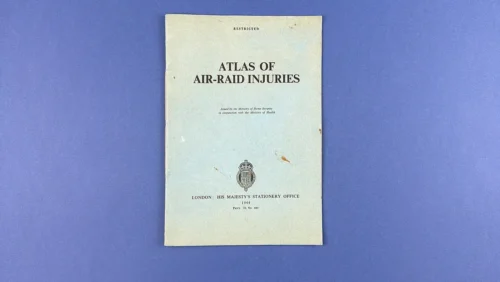
This is an original WW2 British government medical training publication, titled Atlas of Air-Raid Injuries, issued in 1944 by the Ministry of Home Security in conjunction with the Ministry of Health, and published by His Majesty’s Stationery Office (HMSO). The atlas is clearly marked Restricted, reflecting its intended circulation solely among professional medical and Civil Defence personnel rather than the general public. Produced during the later stages of the war, the atlas was designed as a visual reference for the assessment of civilian casualties resulting from air raids. It formed part of Britain’s Home Front medical preparedness, supporting doctors, surgeons, and emergency medical staff working within hospitals and the Emergency Medical Service during periods of sustained aerial attack. The publication is plate-based in format and utilises colour photographic plates accompanied by concise clinical notes highlighting diagnostic features and observable symptoms. The imagery was intended to assist medical personnel in recognising injury patterns commonly encountered following bombing incidents. The atlas contains a combination of staged instructional photographs and photographs of real air raid casualties, included to ensure clinical accuracy. All material is presented in a factual, professional, and instructional manner consistent with official wartime medical documentation. Distribution of this atlas was tightly controlled. Copies were made available only through official channels, often by written application via local authorities, and it was not offered for open commercial sale. As a result, surviving examples are comparatively scarce, with many having been heavily used in service or withdrawn after the war due to the sensitive nature of their contents. Ethical note on images: a conscious decision has been taken to include only one photograph depicting a real casualty from this publication, despite the book containing six such images in total. While these photographs form an important part of the historical record of WW2, restraint has been exercised to avoid the unnecessary display of graphic material. The images document real injuries sustained by real individuals, and are presented here with respect rather than for sensational effect. As a historical object, this atlas represents a sobering but important element of Britain’s Home Front Civil Defence and medical history, documenting the practical realities faced by civilian medical services during wartime rather than military battlefield conditions. It stands as a genuine government-issued reference produced to meet the demands of mass-casualty treatment under wartime conditions. The condition is another noteworthy part of this atlas. The cover both front and back is in a very good condition. There is some very mild staining on the front of the cover (see photos). Also, no hand written notes have been made on this inside, no pages have been ripped out or torn. No pages have been dog-eared and even the original binding looks very good too. Most surviving WW2 Home Front publications, including standard ARP manuals and first aid booklets, were produced in very large numbers and remain relatively common today. By contrast, this atlas was a restricted, professional medical publication with limited circulation, produced for specialist use and seldom encountered on the open market. Its scarcity, official government issue status, and specialist content place it outside the usual pricing range of common wartime manuals.
-
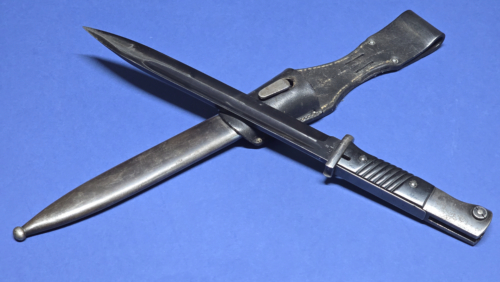
A very attractive and honest example of a World War II German K98 bayonet, manufactured by E.&F. Horster and dated 1941, complete with its original scabbard and leather frog. This is a matching-numbers set with a particularly strong, near-mint blade, making it an excellent collector’s piece.
Blade
The blade is in near-mint condition, retaining approximately 98% of its original blued finish. It remains unsharpened and shows virtually no signs of use, apart from some fine scratches.
The blade ricasso is stamped with the serial number 3156 on one side, and 1941 with the maker code ASW on the reverse, the wartime code for E.&F. Horster.Hilt & Grips
Fitted with very dark Bakelite grips, almost black in appearance, secured by the original two screw bolts. The crossguard, pommel, and muzzle ring retain a good percentage of their original blued finish.
The rifle retaining button functions correctly. Two Waffenamt inspection marks are present to the hilt, with a further Waffenamt stamp to the retaining button.Scabbard
The scabbard retains a good amount of its original blued finish and remains solid throughout. The throat screw is present, and the bayonet fits the scabbard smoothly and snugly.
The serial number 3156 is stamped to the front, with 1941 ASW to the reverse, confirming this as a matching scabbard by E.&F. Horster. A couple of small indentations are present to the rear, but these are minor and not immediately noticeable. A Waffenamt inspection stamp is visible to the lower body.Overall
A very pleasing matching-numbers K98 bayonet set. The combination of an excellent blade, matching numbers scabbard, and original frog, makes this example very collectable.
Historical Note
The K98 bayonet was the standard bayonet of the German Wehrmacht during World War II, issued alongside the Karabiner 98k rifle. Production was carried out by numerous Solingen manufacturers under coded markings to conceal factory identities. E.&F. Horster, operating under the code ASW, was one of the recognised wartime producers, supplying bayonets for service across all theatres of the war.
We sell to the USA, Europe, and most worldwide destinations.
All items are securely packed for safe transit.
-
British “Home” First Aid Case by Boots – Pre-WW2 Domestic Medical Kit
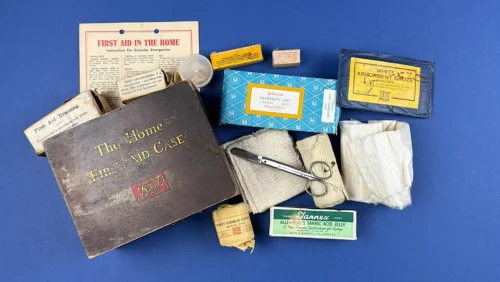
£35.00 SKU: 0149AThis is an original British “Home” First Aid Case produced by Boots, dating to the early 20th century and intended for civilian household use. Sold as a complete domestic medical kit, examples like this were designed to provide practical first aid guidance and essential supplies for use in the home. The wooden case retains its original hinged construction and internal printed instruction panels, which give period advice on the treatment of common injuries including cuts, burns, fractures, fainting, and fits. The structured layout and instructional content reflect the growing emphasis on organised civilian first aid and self-help in Britain during the Edwardian and inter-war years. Retail first aid cases of this type were widely promoted for private households and represent an important precursor to later Home Front medical preparedness. While not a Second World War issue item, it illustrates how domestic first aid knowledge and equipment were already well established in Britain prior to the outbreak of war. The wooden box itself retains its original working latch and most of its original paint, with the Boots logo remaining clearly visible. Overall, and considering its age, the case is in good condition. The internal cardboard instruction panels are bright and legible, with a couple of small stains and no rips or tears, although the fold lines are beginning to show age-related fragility. Please study the photographs carefully, as multiple angles have been provided for buying confidence. The contents include a mixture of period items and later household additions acquired during continued use. A full contents list is provided below.- A set of first aid instructions
- Assorted bandages
- 2x Boxed Sterilized Burn Dressing
- A pair of scissors
- Packeted White Absorbent Gauze
- Boxed Tannic Acid Jelly
- Boxed Absorbent Lint
-
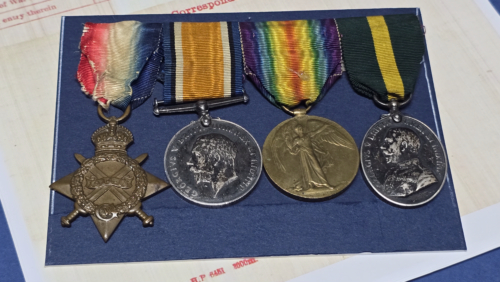
Medal group and associated paperwork relating to Edward Godfrey, Royal Field Artillery, Territorial Force.
Godfrey enlisted in April 1909, joining the Territorial Force several years before the outbreak of the First World War. He was mobilised in 1914 and served overseas with the Royal Field Artillery, entering France in October 1915. He remained on active service throughout the war, later being appointed Acting Bombardier, reflecting experience and responsibility within his unit. He was demobilised in 1919.
The paperwork consists of 21 pages, and traces his military career from pre-war enlistment through wartime service and eventual demobilisation, including enlistment and medical documents, service and posting records, promotion, and medal entitlement.
Medal entitlement:
-
1914–15 Star
-
British War Medal
-
Victory Medal
-
Territorial Force Efficiency Medal
The medals remain uncleaned and have developed a nice even patina.
A well-documented group to a long-serving Territorial artilleryman, combining pre-war service, active wartime deployment, and post-war demobilisation.
We sell to the USA, Europe, and most worldwide destinations.
All items are securely packed for safe transit.
-
-
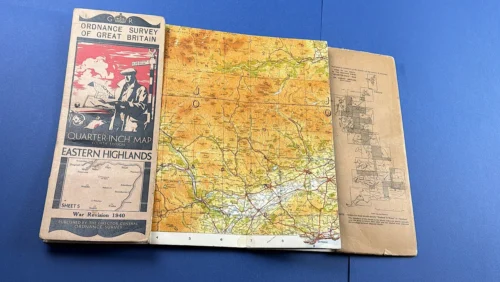
This original WW2 Ordnance Survey quarter-inch map covers the Eastern Highlands of Scotland and is a War Revision edition dated 1940. Produced during the early stages of the Second World War, maps of this type were widely used across Britain for Home Front planning, civil defence, and military orientation. Quarter-inch Ordnance Survey maps provided a wide-area overview of key towns, transport routes, coastal areas, and inland terrain, making them particularly useful to Home Guard units, ARP services, and other Home Front organisations. Covering a strategically important Highland region, this map represents an authentic piece of British wartime mapping and Home Front ephemera. Condition wise, this is in good condition. The cover is nice and bright, very clear, and devoid of rips, tears, or stains. The map itself is also bright, with all text perfectly readable and clear. Where the map folds, there are some very small holes, typical of folded documents of this era (see photos). It’s around 27×36 inches in size.
-
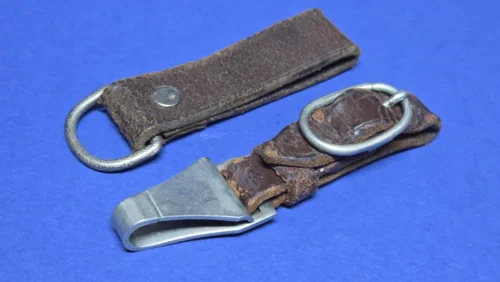
WW2 German SA Dagger 2-Piece Hanger – Early Nickle Fittings
£145.00 SKU: 0355MA genuine German SA dagger two-piece hanger, of the early pattern, featuring a full nickel-silver buckle and nickel clip. This is the correct two-piece configuration, consisting of the belt loop section and main hanger strap, without the additional third section found on three-piece vertical hangers.
An honest, service-used example that presents well and remains perfectly functional.
Leather
The leather shows clear period wear, as expected, but remains strong throughout with no rips, or structural damage. The belt loop section is particularly good, with only light wear for its age, and still holds its shape well.
Fittings
The hanger retains its nickel-silver buckle and nickel clip, both of which remain in good condition. The spring in the clip is fully functional and holds securely. The D-ring on the belt loop shows the stippled finish sometimes encountered on early examples.
Overall
Not a mint example, but a decent, honest hanger with early nickle fittings. A very presentable piece that would finish an SA dagger display nicely.
Historical Note
SA daggers and their associated hangers were introduced in the early 1930s, with production beginning around 1933. While this style of hanger originates from the pre-war period, examples such as this continued to be worn and paraded throughout World War II, making it entirely appropriate to place within a WWII context. Original hangers remain an essential part of completing an SA dagger, and surviving examples in sound condition are increasingly sought after by collectors.
We sell to the USA, Europe, and most worldwide destinations.
All items are securely packed for safe transit.
-
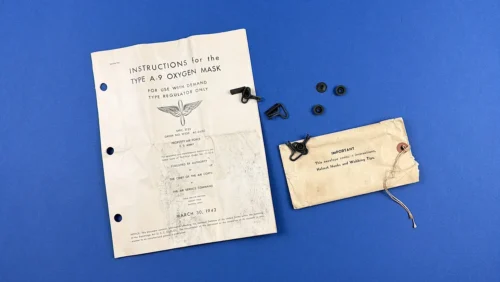
WW2 USAAF Type A-9 Oxygen Mask Instructions – Dated 30 March 1942
£65.00 SKU: 0147AThis is an original WW2 U.S. Army Air Forces instruction sheet issued for the Type A-9 Oxygen Mask, dated 30 March 1942. Officially titled “Instructions for the Type A-9 Oxygen Mask for Use with Demand Type Regulator Only”, the document was produced under the authority of the Chief of the Air Corps via the Air Service Command, Field Service Section at Wright Field, Dayton, Ohio. Marked Restricted, it reflects early-war USAAF operational procedures during the rapid expansion of American military aviation following U.S. entry into the conflict. The Type A-9 oxygen mask formed part of the USAAF’s high-altitude life-support equipment, and documentation such as this was issued to ensure correct fitting, use, and maintenance by aircrew and ground personnel. Dated examples from early 1942 are particularly scarce, making this a desirable supporting item for displays relating to USAAF flight equipment, oxygen systems, or wartime aviation medicine within the United States Army Air Forces. Also included is the original brown envelope containing the associated helmet hooks and webbing attachments. The envelope is open, as shown in the photographs, and all items visible are included. The instruction sheet survives in good original condition, showing expected period folds, light creasing, and surface wear consistent with wartime handling and storage. The paper remains complete and structurally sound, with clear, legible text and illustrations throughout, and notably no handwritten additions, which are commonly encountered on operational paperwork of this type. Overall, this is an honest and well-preserved piece of early WW2 USAAF documentation with strong historical and display appeal. -
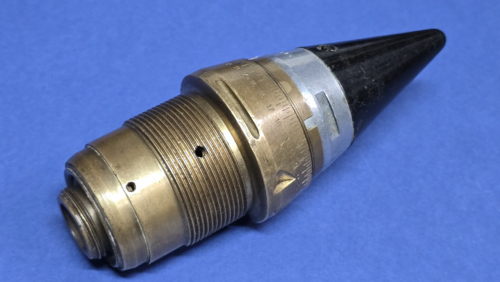
WW2 British No. 208 Mk V Artillery Fuze – Inert – 1945 Dated
£75.00 SKU: 0354Mhis is an original British wartime artillery fuze, pattern No. 208 Mk V, offered here in totally inert condition and safe for collection and display.
A fuze is not a bomb and not the explosive part of a shell. It is the trigger mechanism that once controlled when an artillery shell would function after being fired. This example has no explosive content and is preserved purely as a piece of historical ordnance hardware.
The fuze shows clear period markings, including the pattern designation and 1945 date, along with batch details from wartime production. The overall condition is honest and unpolished, with natural age and handling wear that gives it the correct, untouched look rather than a restored or over-cleaned appearance.
Pieces like this were part of Britain’s huge wartime munitions effort, fitted to artillery shells used by anti-tank, field artillery and, in some cases, air-defence units. Today, surviving inert examples offer collectors a direct link to the technical side of WWII weaponry without being weapons themselfs.
We sell to the USA, Europe, and most worldwide destinations.
All items are securely packed for safe transit.