
Welcome to The Vault Militaria
Welcome to
The Vault Militaria
Authentic pieces. Timeless stories. Exceptional service.
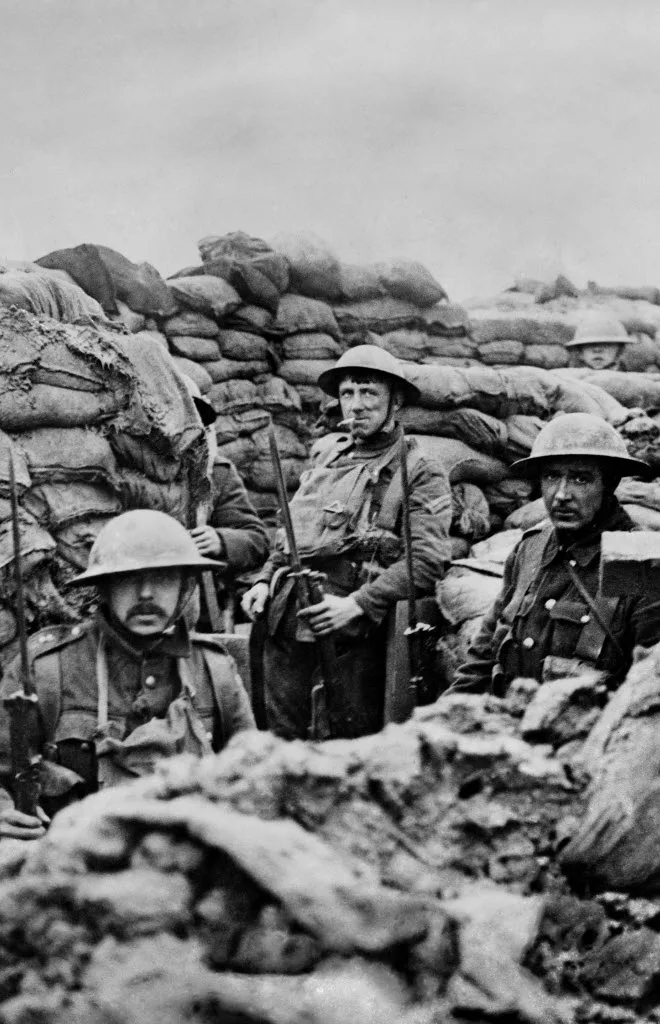
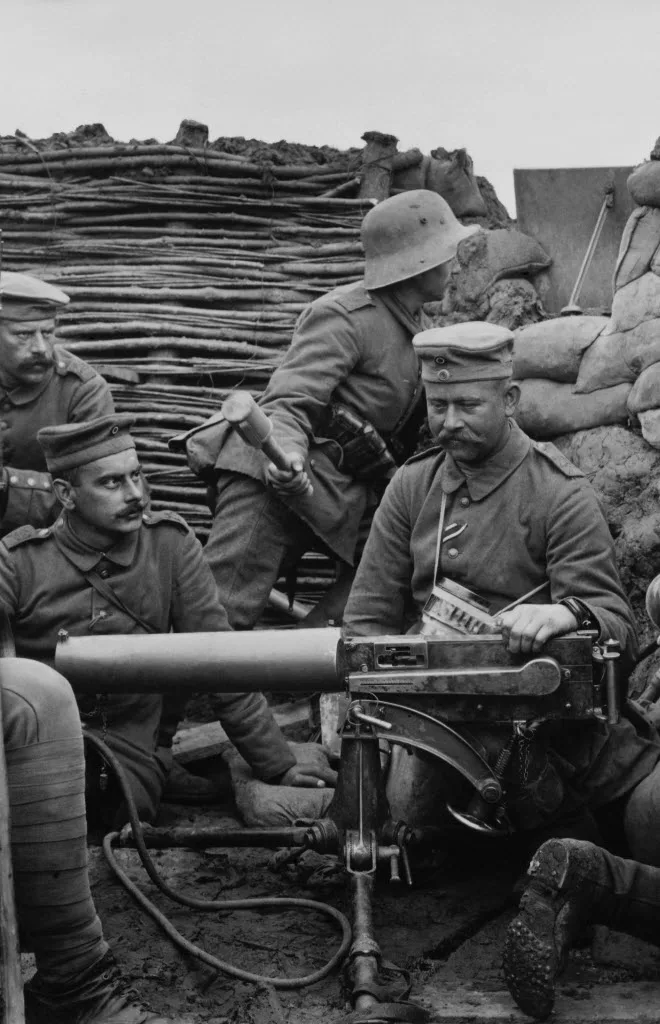
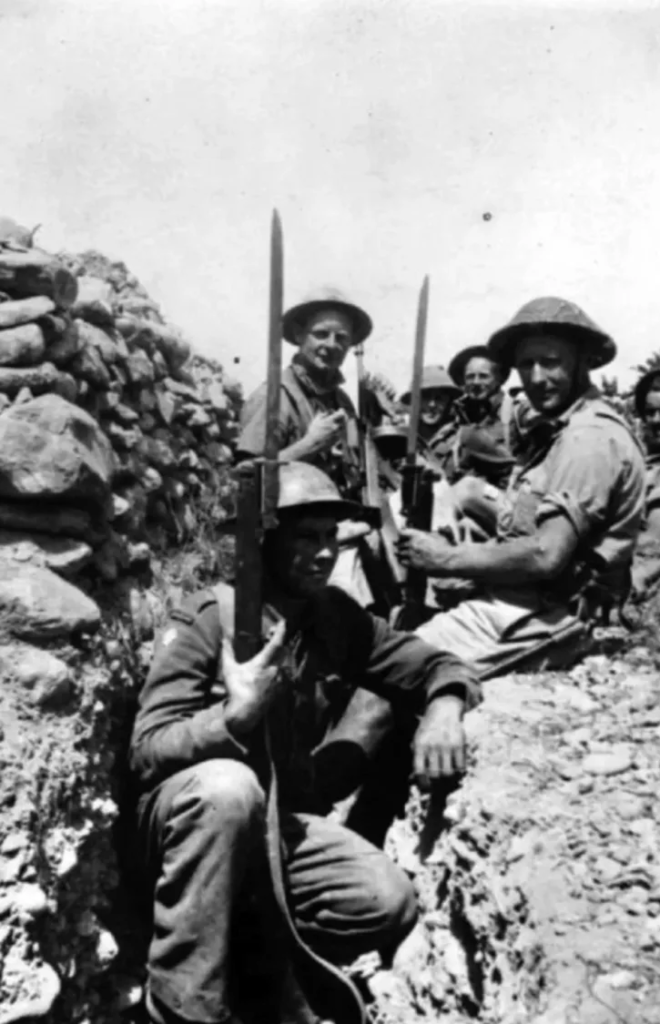
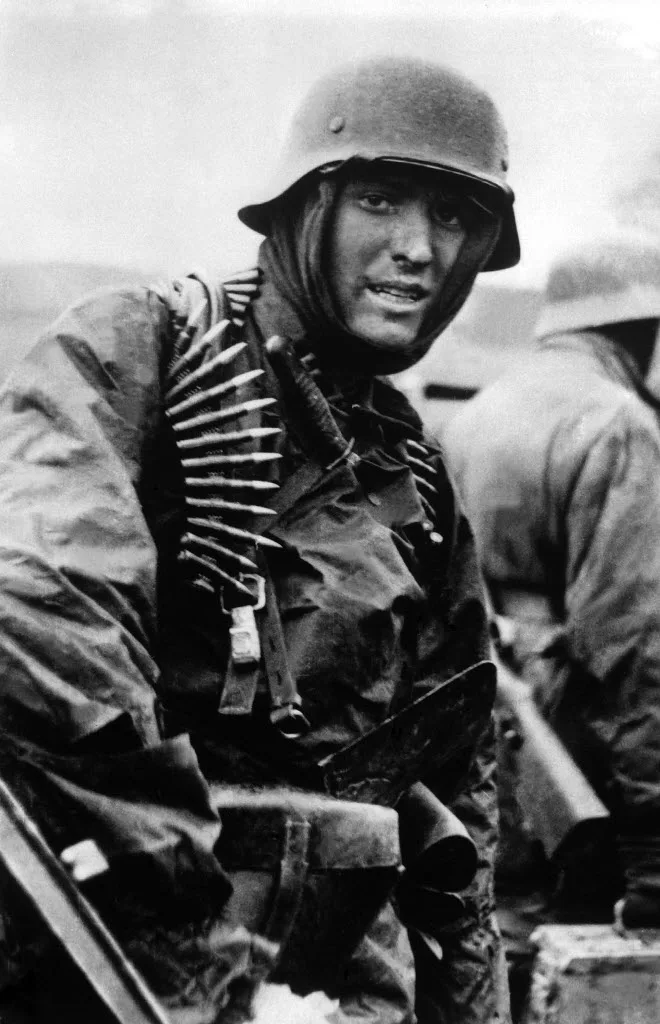
The Vault Militaria is the UK’s newest destination for authentic wartime memorabilia and collectables. Specialising in rare and hard-to-find items from World War I and World War II, we offer history enthusiasts and collectors a carefully curated selection of genuine artefacts.

new items every week
Rare finds
Our team of experts meticulously sources, authenticates, and catalogues each piece, ensuring that you receive only the finest quality items with verified provenance. And we’re adding more and more items on a regular basis.
From battle-worn uniforms and medals to vintage weapons, field equipment, and personal effects, The Vault Militaria brings you closer to the tangible remnants of wartime history.
knowledge & experience
We buy & sell
The founders of The Vault Militaria bring over 50 years of combined collecting experience to the table. They have a pair of keen eyes for the unusual together with an extensive knowledge of wartime collectables to ensure that every item offered is both authentic and exceptional.
With decades spent honing their expertise, they’ve developed an unparalleled ability to source and validate rare military artifacts, making The Vault Militaria a trusted name in the field.
Contact Mark on 07471 058445 or Andrew on 07944 609319
Contact Mark on 07471 058445
or Andrew on 07944 609319
Browse our latest items
-
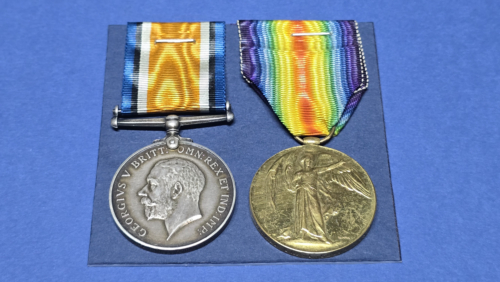
A genuine First World War medal pair awarded to Gunner Leonard Cook, Royal Garrison Artillery, service number 340427. The group consists of his British War Medal and Victory Medal.
A solid, honest RGA pair — ideal for the collector who appreciates named groups with traceable provenance.
Medals
The pair comprises:
-
British War Medal (George V issue)
-
Victory Medal
Correctly named to:
340427 GNR. L. COOK. R.A.The naming is consistent on both medals.
Condition
Both medals show good, honest wear with a nice patina. clear details remaining to the obverse and reverse. No obvious edge knocks or damage.
Ribbons show minimal age-related wear but remain presentable for display.
Historical Note
The Royal Garrison Artillery operated the heavy guns of the British Army during the First World War — manning coastal batteries and heavy artillery on the Western Front and other theatres. RGA gunners played a vital role in bombardment operations and defensive fire throughout the conflict.
We ship to the USA, Europe, and most worldwide destinations.
All items are carefully packed for safe transit.
-
-
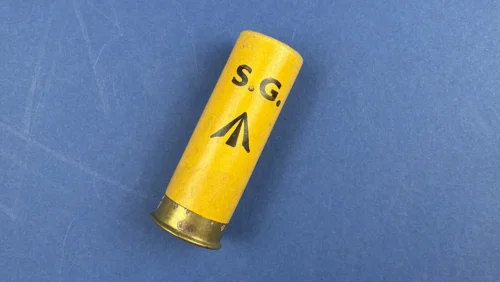
This is an original WW2 British 12 Bore S.G. cartridge manufactured by Eley Kynoch Ltd, retaining its distinctive yellow paper case and clearly printed “Smokeless Diamond S.G.” top wad. The headstamp reads “ELEY KYNOCH 12 12” with the ICI roundel, identifying it as wartime British production. During WW2, commercial 12 bore ammunition such as this was widely used for guard duties, airfield security, factory protection and by Home Guard units throughout Britain. The S.G. marking traditionally denotes a large buckshot loading (comparable to what is often referred to as “00 buck”), intended for close-range defensive use. The yellow paper case remains structurally sound with clear printed markings, and the brass head shows honest age-related patina. The top wad remains legible and well defined, making this an attractive and displayable example of wartime British shotgun ammunition. The primer has been drilled and the cartridge is inert for collection and display purposes. Due to age, there is minor historic powder leakage visible when handled, which is not uncommon in paper-cased cartridges of this period and simply reflects its 80+ year age. The brass head is obviously not factory shiny, but it has no dents. The paper casing is in good condition, with markings clearly readable and with absolutely no tears. A good example of a WW2 British 12 bore cartridge representative of Home Guard and domestic defence use on the Home Front. FOR CLARITY; this item will be shipped with something covering the primer hole, just in case a residual material comes out. This covering can be removed upon delivery, and won’t harm, discolour or affect the item in anyway. It’s just to protect it during delivery.
-
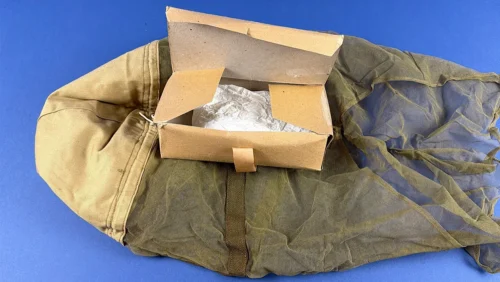
This is an original WW2 British War Department Helmet Mosquito Net, dated 1944 and complete with its original WD-labelled carton. Designed for use in tropical theatres such as Burma, India and the Far East, this helmet net was intended to be worn over the standard British steel helmet, providing vital protection against mosquitoes and other insects in malaria-prone operational areas. By 1944, mosquito discipline was taken extremely seriously, and items such as this formed an essential part of a soldier’s field equipment in overseas service. The net features a khaki cotton drill crown section designed to sit securely over the helmet, with a fine olive mesh veil falling around the face and neck. A reinforced horizontal band helps prevent the mesh from collapsing against the wearer’s face, while the long skirt is designed to be tucked into the collar of a battledress blouse or shirt. The original drawstring adjustment remains present. The accompanying carton is clearly marked: WD 1944 NETS HELMET MOSQUITO Complete boxed examples are notably less common than loose nets, and the survival of the original period packaging adds both display appeal and collector interest. The net itself remains in very good condition, with the mesh appearing intact and free from obvious damage. The cotton crown retains good colour and structure, and the stitching appears sound. The original cardboard carton shows expected age-related wear but remains structurally solid, with the printed label clear and legible though due to it being a simple cardboard box, it’s not retained a 100% rectangle shape, as the photos display. A clean and honest late-war British Army tropical issue item, ideal for collectors of Burma campaign material, tropical equipment, or original boxed WW2 field kit.
-
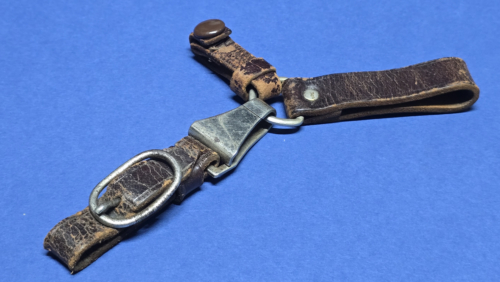
Mid-1930s German SA Three-Piece Dagger Hanger – RZM M5/25
£295.00 SKU: 0384MAn original German three-piece dagger hanger produced for wear with the SA-Dienstdolch - the standard service dagger of the Sturmabteilung, - "Storm Troopers".
This example is RZM marked M5/25, indicating manufacture under the authority of the Reichszeugmeisterei, most likely dating to the mid-to-late 1930s period.
Designed to suspend the SA dagger in the correct vertical position from the belt.
Leather
All three leather sections display consistent age and tone, suggesting they have remained together as a set. The leather shows honest service wear throughout, consistent with age, yet remains strong and supple.
There is one small section of missing stitching on the retaining loop beneath the buckle where the securing tab tucks through; however, the structure remains tight and functional.
The popper stud functions correctly.
Fittings & Clip
The upper clip is clearly stamped M5/25 with the RZM double-circle logo. The spring action remains strong and secure.
Fittings retain their original finish with natural age patina. No cleaning or refinishing has been undertaken.
All rings remain tight.
Overall
A genuine, service-used example with a pleasing, untouched appearance. Not mint, not dressed up — simply an honest mid-1930s SA hanger that would complement a decent SA dagger well.
Historical Note
The SA dagger was introduced in 1933 as the standard service sidearm of the Sturmabteilung. Early examples featured nickel fittings before material economies led to transitional and later plated variations from around 1935 onward. Three-piece hangers such as this were worn for parade and political uniform display, suspending the dagger vertically from the belt.
We ship to the USA, Europe, and most worldwide destinations.
All items are carefully packed for safe transit.
-
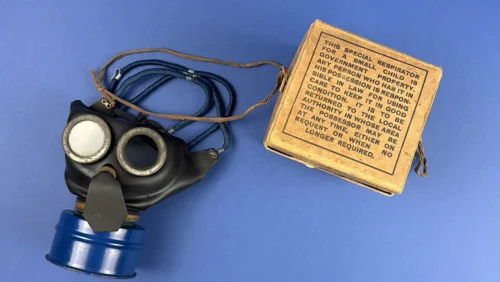
This is an original and increasingly scarce WW2 British Home Front “Pluto” Small Child’s Civilian Respirator, dated November 1942, complete with its original government-issued cardboard box. Far less commonly encountered than both the standard adult civilian respirators and the well-known “Mickey Mouse” infant masks, the Small Child’s respirator was produced in significantly smaller numbers to serve a narrow age group — too old for the infant hood, yet too small for the standard civilian issue. As a result, surviving examples are noticeably scarcer, particularly when retaining their correct box and remaining in strong condition. The face-piece is clearly stamped HO 31 and manufactured by 4B R Co Ltd, dated 11/42. The original blue filter canister is present and in very good condition with no dents, along with its correct blue elasticated harness. The accompanying box retains bold, legible print stating “Small Child”, with government property text clearly visible — an increasingly uncommon survival in its own right. Most importantly, the rubber remains exceptionally soft, supple and flexible throughout. There is no stiffness or hardening, and the mask retains its original shape beautifully. The survival of wartime rubber in this condition after more than eighty years is increasingly unusual, as many examples now suffer from perishing, distortion or seam splitting. In this respect, this example stands comfortably above average. Beyond its technical details, this is a deeply evocative Home Front object. These respirators were entrusted to parents to safeguard their young children in the event of gas attack — kept ready in hallways, cupboards and prams during a period of genuine national anxiety. They represent one of the most poignant aspects of Britain’s civilian wartime preparations: the effort to protect the youngest members of society during uncertain and fearful times. For the dedicated Home Front collector, the “Pluto” respirator occupies a special place. Much scarcer than the more frequently encountered Mickey masks, and far less often found complete and in such pleasing condition, it is both a historically important and emotionally resonant piece. A strong, honest example of a genuinely scarce wartime civilian respirator — and a standout addition to any serious Home Front collection, capturing both the vulnerability and quiet resilience of Britain’s civilian war.
-
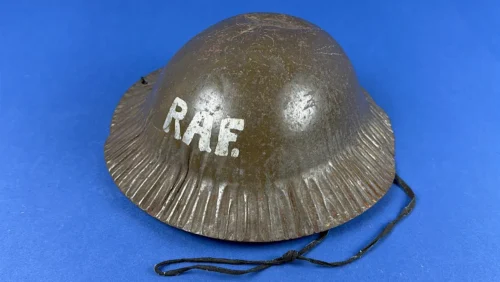
This is a vintage pressed steel “Brodie style” toy helmet, finished in olive drab and hand-painted to the front with “RAF.” in silver. Modelled loosely on the iconic British WW2 Tommy helmet shape, this example was produced as a children’s play or fancy dress item rather than as genuine military issue. The fluted pressed rim, lightweight steel construction and simple cord chinstrap are all typical of mid-20th century toy manufacture. The helmet retains its period olive finish with honest age-related wear, surface rusting and patina throughout, giving it an appealing well-used look. The hand-painted “RAF.” marking appears to have been applied later and adds character, though it is not a factory or official marking. There is no internal liner present, and the chinstrap consists of a simple cord secured through punched holes in the shell. While inspired by the British WW2 Brodie helmet design, this is not a wartime issued piece. Instead, it represents the kind of military-themed toy or fancy dress helmet that remained popular in the years during and after the war. The helmet remains structurally sound and displays honest age-related wear consistent with mid-century manufacture. There are a couple of shallow dents to the crown and some minor misshaping to sections of the fluted rim, likely from storage or use. The olive drab finish shows surface wear, light rust spotting and general patina, though it is notably less corroded than many comparable examples. The chinstrap remains present and secure. Overall, it presents well with attractive character and retains a strong display presence despite the expected signs of age. A nice mid-century militaria-style collectible, ideal for display alongside vintage RAF memorabilia, toy collections, or as an affordable decorative piece with period character.
-
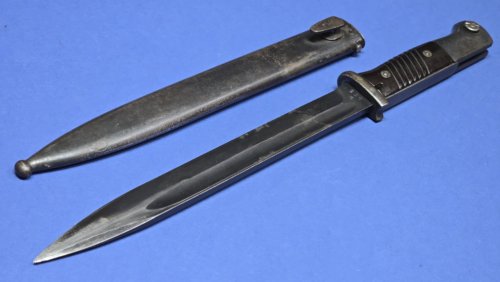
WWII German K98 Bayonet – Matching Numbers – E.u.F. Horster – 1940
£255.00 SKU: 0383MA matching numbers WWII German K98 bayonet by E.u.F. Horster, dated 1940. A good wartime example retaining the majority of its original finish to both the bayonet and scabbard, showing typical age-related wear.
Blade
Unsharpened blade retaining most of its original bluing. The spine is dated 40 for 1940 production and the reverse ricasso is clearly marked E.u.F. Horster. Matching number 268 is present to the ricasso. There is visible staining in sections of the blade, primarily mid-blade. The staining is localised rather than across the entire surface, but even with the staining present, i'd still class the blade in very decent condition, and better than most.
Hilt & Grips
Dark Bakelite grips in very good condition, secured by the original screw bolts. The flash guard is free from damage and the rifle retaining button functions correctly. Two Waffenamt inspection stamps are present to the pommel, with bluing remaining to the crossguard and pommel.
Scabbard
The scabbard retains the majority of its original bluing and is free from dents. The finish shows more wear to the rear than the front face, allowing it to display well. It retains its original throat screw, with the matching number 268 present at the throat. The reverse is maker marked E.u.F. Horster with 1940 beneath. A Waffenamt stamp is present to the lower ball. The bayonet fits the scabbard correctly and securely.
Overall
A matching numbers 1940 E.u.F. Horster K98 bayonet retaining much of its original finish and presenting well overall.
Historical Note
The K98 bayonet was the standard issue bayonet of the German Wehrmacht during the Second World War. Produced by Solingen makers such as E.u.F. Horster, examples dated 1940 reflect early wartime production and remain a staple piece for collectors of German edged weapons.
We ship to the USA, Europe, and most worldwide destinations.
All items are carefully packed for safe transit. -
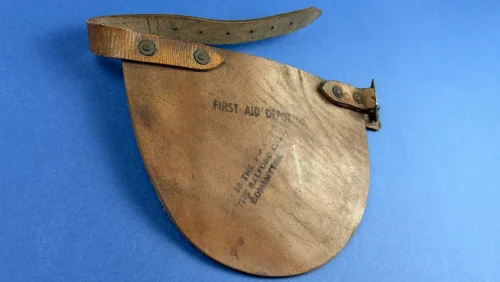
This is an original WW2 British Civil Defence stretcher bearer’s knee pad, dated 1941 and clearly stamped to the Salford C.D.E. Committee. Constructed from thick, shaped leather with an adjustable strap and buckle fastening, this protective pad was designed to be worn by ARP stretcher bearers and casualty service personnel while working in bomb-damaged streets and buildings. Rescue work during the Blitz frequently required kneeling on broken masonry, shattered glass, and unstable debris, making protective equipment such as this both practical and essential. The face is stamped “FIRST AID DEPOT No.” along with “ISSUE THE PROPERTY OF THE SALFORD C.D.E. COMMITTEE,” firmly identifying it as municipal Civil Defence issue. Salford, adjoining Manchester, was heavily industrial and suffered bombing during the war, placing this piece squarely within the operational reality of the northern Home Front. The marking “A.G. 1941” confirms wartime manufacture at the height of the Blitz period. Unlike helmets and armbands, stretcher bearer equipment such as knee pads was purely functional working kit and is encountered far less often today. Its survival offers a tangible connection to the practical, hazardous rescue work carried out by civilian volunteers under Civil Defence authority. The leather remains solid and structurally sound, with honest service wear and age-related marking throughout. The strap and buckle are intact and functional, and the wartime stamps, while worn in places, remain clearly legible. A strong and evocative piece of named WW2 Home Front Civil Defence equipment.