
Welcome to The Vault Militaria
Welcome to
The Vault Militaria
Authentic pieces. Timeless stories. Exceptional service.
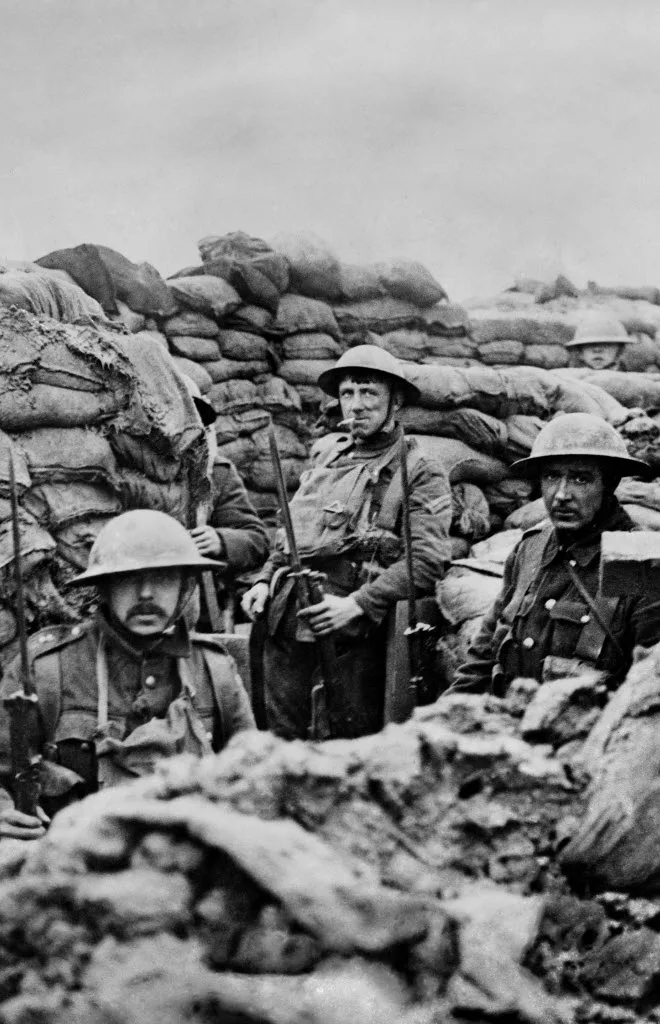
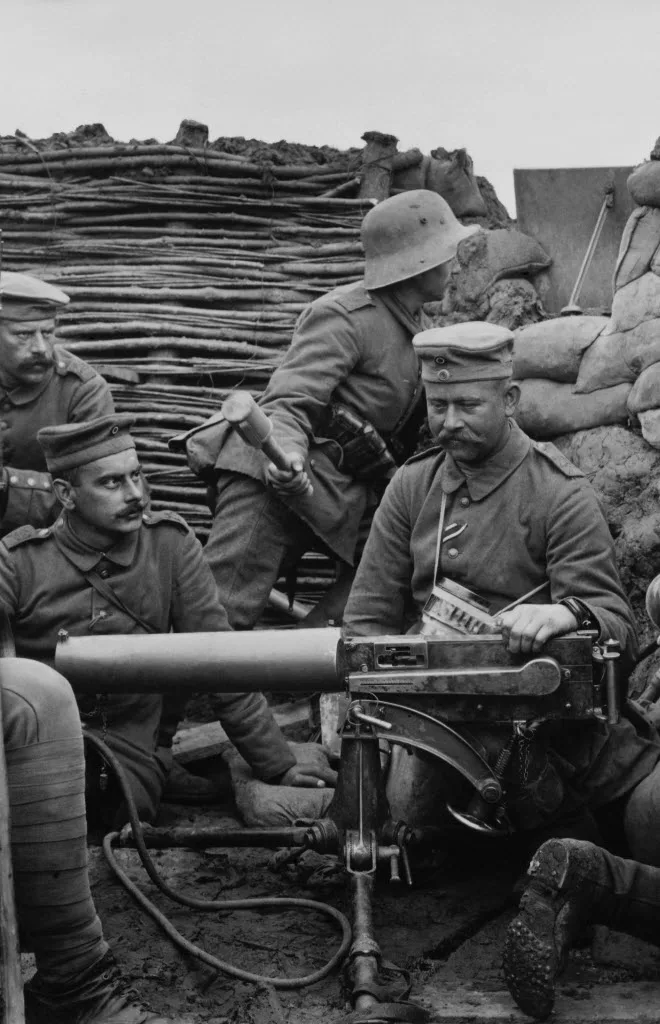
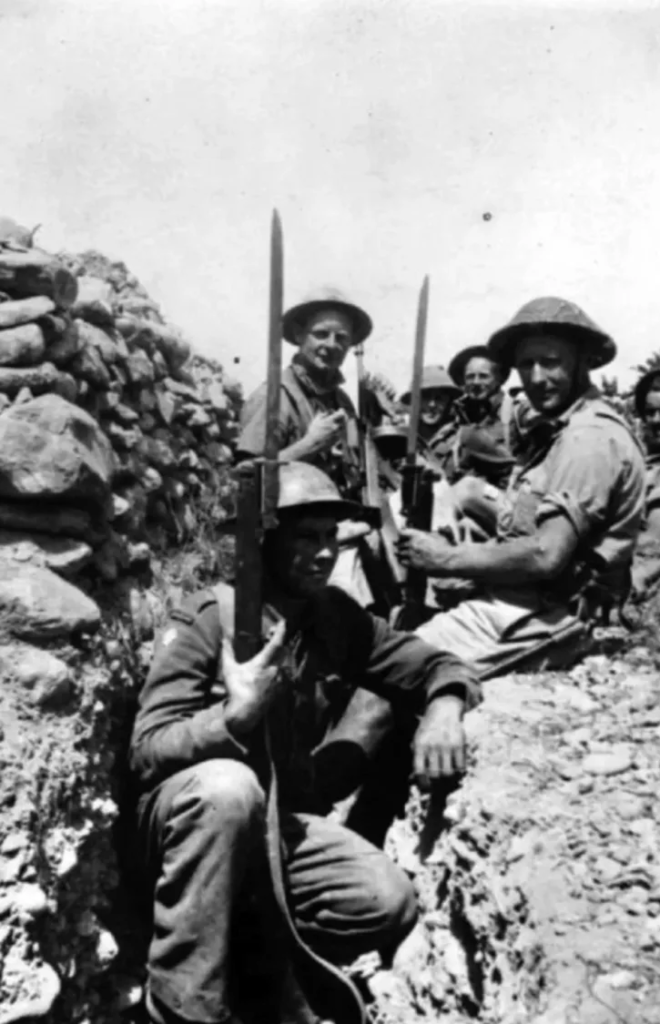
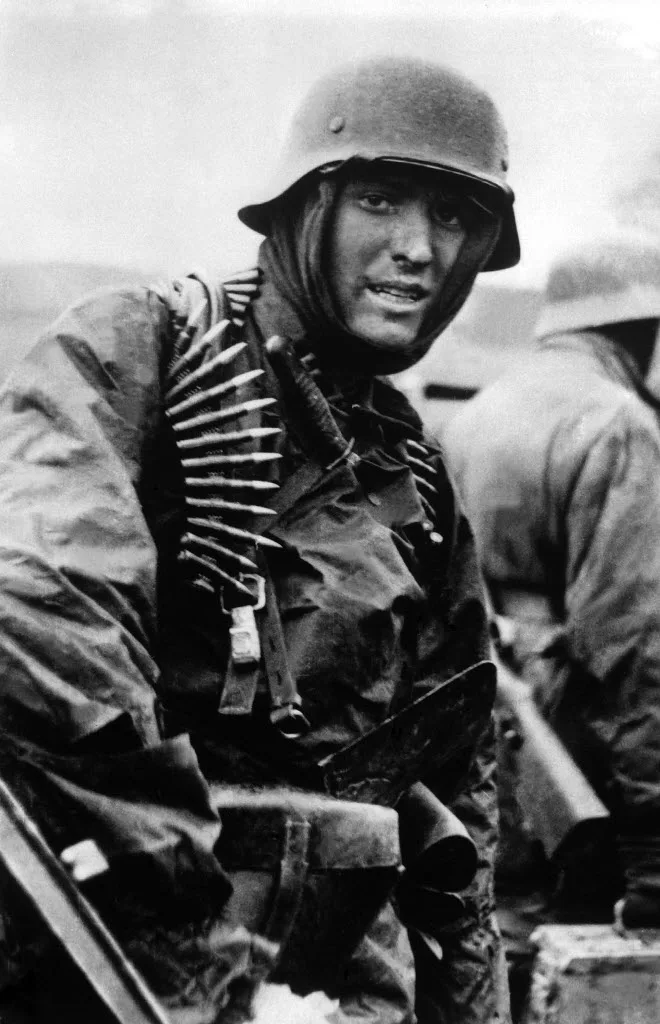
The Vault Militaria is the UK’s newest destination for authentic wartime memorabilia and collectables. Specialising in rare and hard-to-find items from World War I and World War II, we offer history enthusiasts and collectors a carefully curated selection of genuine artefacts.

new items every week
Rare finds
Our team of experts meticulously sources, authenticates, and catalogues each piece, ensuring that you receive only the finest quality items with verified provenance. And we’re adding more and more items on a regular basis.
From battle-worn uniforms and medals to vintage weapons, field equipment, and personal effects, The Vault Militaria brings you closer to the tangible remnants of wartime history.
knowledge & experience
We buy & sell
The founders of The Vault Militaria bring over 50 years of combined collecting experience to the table. They have a pair of keen eyes for the unusual together with an extensive knowledge of wartime collectables to ensure that every item offered is both authentic and exceptional.
With decades spent honing their expertise, they’ve developed an unparalleled ability to source and validate rare military artifacts, making The Vault Militaria a trusted name in the field.
Contact Mark on 07471 058445 or Andrew on 07944 609319
Contact Mark on 07471 058445
or Andrew on 07944 609319
Browse our latest items
-
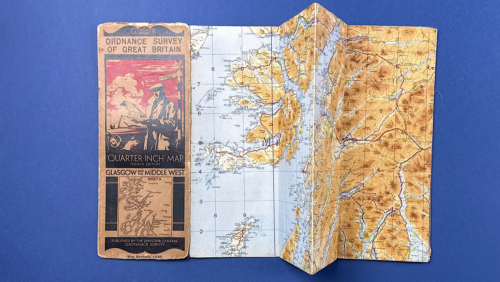
This original WW2 Ordnance Survey quarter-inch map covers Glasgow and the Middle West of Scotland and is a War Revision edition dated 1940. Produced during the early stages of the Second World War, maps of this type were widely used across Britain for Home Front planning, civil defence, and military orientation. Quarter-inch Ordnance Survey maps provided a wide-area overview of key towns, transport routes, industrial centres, and coastal regions, making them particularly useful to Home Guard units, ARP services, and other Home Front organisations. Covering a strategically important industrial and shipbuilding area, this map represents an authentic piece of British wartime mapping and Home Front ephemera. This map has certainly seen some wear which tells us it’s got a lived history. There’s a round mark on the back, the corners are worn and also, the corners of the map when it’s unfolded are worn and some even have small holes. We’ve photographed all wear, marks and points to note so please see them for a more accurate reference. It’s around 33×36 inches in size.
-
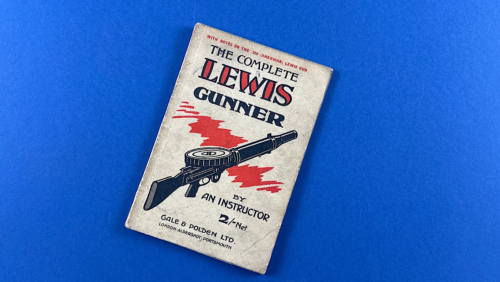
This original copy of The Complete Lewis Gunner, published by Gale & Polden Ltd., is a classic interwar–early WW2 training booklet designed to give new gunners a clear, practical introduction to the Lewis Gun. Privately printed “by an Instructor”, these compact guides were widely purchased by soldiers, Home Guard volunteers, and units still equipped with the Lewis during the early war period. Produced in Gale & Polden’s distinctive pulp-style format, the booklet covers all essential aspects of the gun’s operation, including stripping, firing positions, stoppages, cleaning, and notes on the .300 (American) Lewis Gun—a feature relevant to units using both British and U.S. pattern weapons. Surviving examples are increasingly hard to find, as the thin wartime paper was easily damaged, and most were heavily used in training. This example retains its original illustrated cover, showing honest age toning and expected edge wear but remaining complete and structurally sound. An appealing and authentic piece of Lewis Gun history, ideal for collectors of early WW2 small-arms manuals, Home Guard training material, and Gale & Polden publications. There’s also an included folded sheet that displays the barrel band and gas chamber. However, we believe this sheet to have originally been attached (see photos). Overall the condition of this small book is very good, and it’s slightly rarer than the usually easier to find Bren gun version. The cover is intact and included with only a small fold (see photos) on the bottom right corner. Full disclosure, we are not sure if the page at the back is complete or not (see photos) it appears to display the magazine.
-
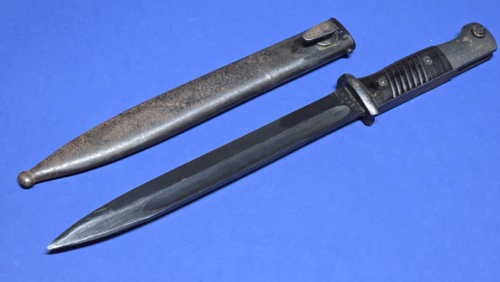
A very honest late-war K98 bayonet produced in 1944 by FZE (F.W. Höller). The blade is genuinely near mint—in absolute superb condition. Typical 1944 production shows crude machining, rushed finishing and lack of refinement as Germany’s industry collapsed. Non-matching numbers, though bayonet and scabbard share the same year, which is always a bonus. A late-war example with a near mint blade .
Blade
Dated 1944 with maker code FZE on one side of the ricasso, and the serial 5993 on the reverse. The blade retains around 98% original bluing, unsharpened, undamaged and extremely clean. All the correct late-war machining marks are visible—nothing polished smooth, exactly as these left the factory. The blade is unquestionably the standout feature.
Hilt & Grips
Fitted with Bakelite grips showing only light handling wear, no chips or cracks. Both grip screws present and undisturbed, with the rifle retaining button being fully functional. Flash guard shows minor indentations and scratches from service. The hilt is crudely machined with no attempt at the rounded finish seen on earlier K98s. Its coarse, angular and very late-war in appearance - the sort of work collectors often call a "Friday afternoon job", when speed clearly took priority over refinement. The hilt carries a single clear Waffenamt stamp.
Scabbard
The scabbard is undented and solid, with serial 2813 to the front. The reverse is 44 dated with maker code cvl (WKC), and the lower ball carries a clear Waffenamt. The throat screw is present and original. Much of the original bluing remains, with some light surface rust mainly to the front, but it still presents very well. The blade sits in the scabbard with a perfect, snug fit.
Overall
A very crudely made late-war 1944 K98 bayonet with a superb near-mint blade and an undamaged scabbard dated the same year. Late-war bayonets are much scarcer, and finding one with a blade this clean is rare. A textbook example of end-stage German wartime production.
Historical Note
By 1944, German factories faced severe shortages of materials, skilled labour and time. Bayonets from this period show rough grinding, coarse machining and simplified finishing—traits collectors now recognise as correct late-war characteristics. Surviving 1944 pieces with exceptional blades are highly sought after for illustrating the realities of late-war production.
-
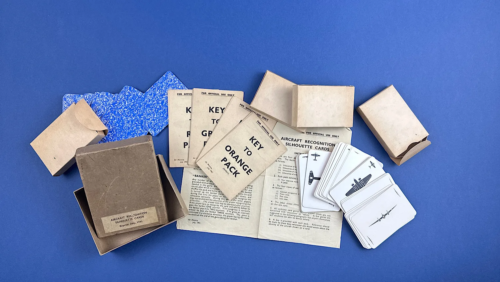
This original WW2 Aircraft Recognition Silhouette Card Set is an excellent early-war example of the training aids used across Britain to teach rapid identification of both friendly and enemy aircraft. Reprinted in July 1941, it dates from the crucial period following the Blitz, when the RAF, Royal Observer Corps, Anti-Aircraft Command, and Home Guard all intensified their aircraft recognition programmes. Produced in card format with bold black silhouettes, these flash-training cards were designed for quick visual drills, helping personnel distinguish approaching aircraft by their top, side, and frontal profiles. Sets of this type were widely used in recognition classes, anti-aircraft batteries, ROC posts, and Home Guard training centres, forming the backbone of Britain’s early-war aircraft identification training. The boxed set represents a classic piece of wartime instructional material and an iconic example of British Home Front and air-defence training equipment. Early-dated sets such as this, especially reprints from mid-1941, are notably harder to find complete, making them particularly appealing to collectors of RAF, ROC, and Home Front memorabilia. This example is complete and in very good condition throughout. Every card is present, along with all four individual internal boxes. All four key sheets are intact and in excellent condition, and the main introduction sheet is also included. The outer box is solid and displays well, with only minor age-related wear visible, all of which has been clearly photographed.
-
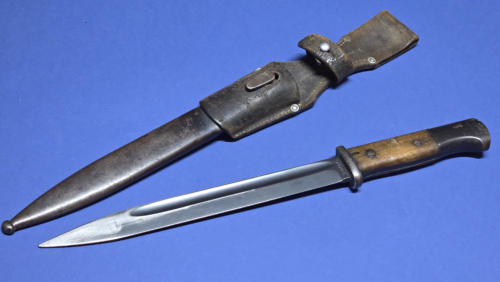
A very attractive early S-code K98 bayonet by WKC, dated 1935 and carrying the code S/174G. This example is matching numbers (7049), and the standout feature is the blade, which I would certainly rate in near mint condition. It retains around 96% of its original bluing and remains completely unsharpened. The piece comes with its period maker-marked leather frog, dated 1938, creating a very tidy early-war set. Overall, it’s a clean, honest bayonet that displays extremely well, with only one grip plate showing some damage — fully pictured and noted.
Blade
The blade is exceptional, retaining roughly 96% of its original factory bluing, with a nice, untouched finish and no signs of polishing or post-war cleaning. The maker code S/174G confirms WKC production for 1935, and the blade carries the matching serial number 7049. The cutting edge remains completely unsharpened, although the tip is not as pointed as some examples. A very attractive blade.
Hilt & Grips
This early example features wooden grip plates. One side remains in very good condition with its original bolts in place. The other grip plate does show some period damage to the wood, which is clearly photographed for accuracy. The rifle release catch functions correctly and has a Waffenamt inspector’s stamp on the button, with two further Waffenamt markings on the pommel. Much of the original bluing remains on the upper hilt, giving it a nice looking finish.
Scabbard
The scabbard is free from any dents or damage and retains the correct matching serial number 7049 on the front. The rear carries the maker code S/174G, confirming it as the correct scabbard for this blade. The original throat screw is still present, and a further Waffenamt is stamped into the ball. Traces of the original bluing remain to the front of the scabbard, with a large portion of bluing surviving on the rear.
Frog
The bayonet comes with a very good condition frog, with all four rivets in place, and is maker-marked and dated 1938. All stitching is intact and the leather remains in strong condition. One of the rivets is larger than the other three. Initially I thought this must be a post war replacement, but on further inspection, the ageing and patina match the rest of the frog exactly, so I lean more towards this being done during wartime. I have taken some close up photos of this, so you can see exactly what I mean. The frog displays well and completes the bayonets nicely.
Overall
A very appealing early K98 bayonet with matching numbers, an outstanding blade, and a tidy period frog. Honest wear to one grip plate has been shown. Early S-code bayonets from 1935 with blades in this condition are very collectable, and this one is a good honest example.
Historical Note
The S-code system was used before 1937 to obscure the identities of German manufacturers. The code S/174 was assigned to WKC, and the suffix G indicates 1935 production. Early K98 bayonets of this period were finely machined, blued to a high standard, and fitted with wooden grips before later wartime cost-cutting measures were introduced. Matching-number examples with strong blades and original frogs remain highly sought after by collectors.
We sell to the USA, Europe, and most worldwide destinations.
All items are securely packed for safe transit.
-
This original Victorian De La Rue & Co. Campaign Folding Inkwell is a superb example of high-quality portable writing equipment produced for field, travel and administrative use in the late 19th to early 20th century. Designed for durability and compactness, the inkwell features a cast-iron folding lid stamped RANSOMES PATENT with the additional maker’s stamp “DE LA RUE & Co”, confirming manufacture for one of Britain’s most prestigious stationery and writing-equipment firms. The inkwell is housed within its original wooden frame, purpose-made to keep the piece secure during transport and to act as a small desk mount when in use. The iron lid opens on a robust hinge — slightly stiff in places, as expected with age — and reveals a fitted glass ink reservoir, typical of De La Rue’s higher-quality portable designs. The rear of the lid is neatly engraved “PUSH”, indicating the direction of operation. Compact in size at approximately 2 inches square, and just under an inch thick when closed, this is exactly the type of field-ready inkwell carried in campaign chests, dispatch kits, portable writing slopes, and travelling office sets used by officers, engineers, colonial administrators, and commercial travellers. De La Rue produced a range of folding and protective inkwells of this type, but surviving examples with cast-iron lids are notably scarce. Condition is excellent for age, with no damage to the wooden mount, glass insert, or cast-iron components. The hinge remains fully functional, and the piece displays beautifully both open and closed. A rare and highly appealing piece of Victorian campaign writing equipment, ideal for collectors of field gear, portable stationery, De La Rue ephemera, and 19th-century travel and military accessories.
-
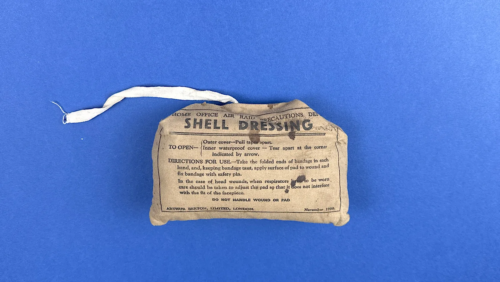
This original ARP Shell Dressing, manufactured by Arthur Berton Ltd of London and dated November 1938, is an excellent early example of British Home Front medical equipment produced during the urgent pre-war mobilisation period. Issued under the Home Office Air Raid Precautions (ARP) Department, these dressings were supplied to wardens, first aid parties, and civil defence units preparing for the expected air raids. The packet remains fully unopened, with clear printed instructions and its original khaki outer wrap. Although dated before the official outbreak of war, ARP-marked medical items from 1937–1939 are universally regarded as WW2 issue, as they were manufactured specifically for wartime emergency use. Arthur Berton Ltd is one of a number of lesser-known London firms contracted by the Home Office in the late 1930s to support civil defence production. Surviving examples bearing their name appear in documented ARP first-aid sets, confirming their role in producing medical supplies during the critical build-up to WW2. There are a couple of light marks on the front, but the dressing has no rips or tears and remains unopened in its original condition. A desirable piece for Home Front collectors, especially those interested in early-war equipment or items from rarer makers.
-
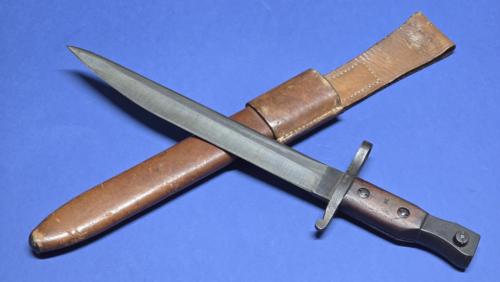
Here we have an absolutely superb Canadian Ross MKII bayonet, complete with its original WW1 leather scabbard. Two things immediately stand out on this piece: 1. The blade is in near mint condition - genuinely one of the best Ross blades I've handled. 2. The leather scabbard is in superb condition, far better than the majority you come across. A real quality Canadian WW1 piece - honest, untouched, and exactly what collectors appreciate.
Blade:
The 257mm un-fullered, single-edged blade retains its original factory edge and shows exceptional finish throughout, with the bluing still remaining on the ricasso. From there the bright blade runs all the way down to the clipped point, with no signs of reshaping, or repointing. You can still see the original factory finish cross-grain on the blade, which is a nice bonus, as a lot of blades have had this polished out over the years. This is a text book MKII blade in outstanding condition, very difficult to upgrade.Hilt & Grips:
The wooden grip plates are in excellent condition, showing hardly any wear, with the Canadian inspection stamp on either side of the grips. One side of the pommel is clearly stamped: "Ross Rifle Co. Quebec. Patented 1907", while the other-side shows the Government Broad Arrow, the date 9/15 , and a further Canadian inspection stamp. The rifle retaining button works perfectly, with all the metal hardware displaying its original bluing, giving that untouched, original finish.Scabbard:
The original MKII leather scabbard is in excellent condition, and superbly made - one of the better ones you'll find. - Leather condition rates 8/10 showing only minor wear - All stitching intact and tight - Bottom metal cap is present - Leather is stamped with further markings, including Broad Arrow (see photos) - The leather displays a lovely patina throughout - Markings to the throat of the scabbard The bayonet fits the scabbard snugly and correctly, exactly how a matching example should.Overall:
A truly strong example of a WW1 Canadian Ross MKII bayonet - superb blade, excellent grips, functional mechanism, and a scabbard that is far above average.Historical Note:
Manufactured by the Ross Rifle Company, Quebec, the MKII Ross bayonet was issued during the early years of the First World War to accompany the Ross MKII and MKIII rifles. Production included multiple inspection and acceptance stages, which explains the large number of inspection stamps commonly found on these examples. These bayonets are identifiable by its single-edged, un-fullered blade, distinctive clipped point, and full leather scabbard fitted with a steel lower cap.
We sell to the USA, Europe, and most worldwide destinations.
All items are securely packed for safe transit.